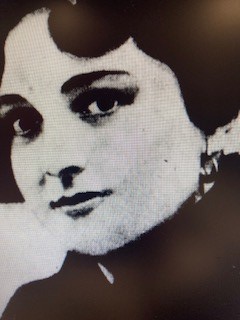
Queen of the Con: Buda Godman’s early life and first brush with the law

In 1916, Buda Godman gained national attention for her role as the lost damsel in a badger game con that garnered much fanfare after touring New York, Atlantic City and Chicago, when authorities there finally brought its run to a close.  News of a former convent school girl running with a gang of international blackmailers shocked the nation, and many believed Buda was as much a victim of the con as its mark, wealthy widower Edward R. West.  But Buda Godman was nobody’s victim, and West was not the first knight in shining armor she had taken for a ride.

Although Helen “Buda” Godman was born and raised in Chicago, her parents, Otha and Julia, both hailed from Indiana and were married in Lafayette.  Due to family ties, the Godman’s spent a great deal of time visiting relatives in Lafayette, and some newspapers report Buda’s family even resided there for a time.  It was in Lafayette that little Helen Godman had an older cousin or aunt also named Helen Godman, which may partly explain how little Helen came to be referred to as Buda.  

As a pint-sized entertainer, little Buda Godman dazzled the townsfolk of Lafayette, Indiana, dancing her way into their hearts long before embarking on her life of crime.  In September of 1898, Miss Buda Godman performed three numbers at a benefit for St. Ann’s church, 612 Wabash Avenue.  

According to the Lafayette Sunday Times, “The feature of the evening’s entertainment was a cake walk, skirt dance and contortion work by Miss Buda Godman ….  This little miss is the personification of grace, and her three numbers were greatly enjoyed and enthusiastically applauded by the large gathering present.”   

The Journal and Courier declared, “This small graceful child completely captivated the audience with her dances….  She is about 9 years old and is one of the most accomplished little dancers in the country.”

In May of 1899, little Helen Godman again delighted the people of Lafayette, singing and dancing to great acclaim at Grand Army hall.  As the Lafayette Journal gushed, “While several of the numbers were encored, the singing of Master Harry Hannagan and the singing and dancing of Little Miss Helen Godman…received the greatest favor.  Miss Helen was recalled several times and her part in the entertainment was one of the most enjoyable features of the evening.”

But it wasn’t just the local townsfolk who found Buda’s performances captivating.  Even a big city impresario became enchanted by her act.  “Little Buda, a short time ago, attracted the managerial eye of Col. John D. Hopkins of a large circuit of theatres, having houses in Chicago, Cincinnati, St. Louis and other cities.  The colonel offered Mr. and Mrs. Godman a very tempting sum for their daughter’s services, but the parents were opposed to her just now becoming associated with the stage,” the Lafayette Sunday Times wrote.

It seems, even at an early age, Buda Godman had already developed the power to send rich men reaching for their wallets.

It wasn’t just the townsfolk of Lafayette that delighted in little Buda’s talent and charm.  Up the road in her hometown of Chicago, she became something of a backstage celebrity among the many who turned out to catch a glimpse of the beautiful and engaging song and dance sensation.  

In Chicago Confidential, Jack Lait and Lee Mortimer report, “One of the principle theatrical hangouts was the basement table-d’hote under the Brevoort Hotel, adjoining the LaSalle Theater, and it was there the town came to peek at and gasp over Buda Godman, who was called the prettiest girl ever born and raised in the town….  Her beauty was so fearsomely fascinating that before maturity she stopped traffic on the streets.  She was petite, a wee trifle plumpish, with big steel-blue eyes, a tip-tilted nose, an oval face with a dimpled chin, a peewee mouth, and tiny hands and feet.”

Clearly, Buda possessed the power to charm the socks off of just about anyone who beheld her beauty or discerned her many talents.  But, as a race track sheet-writer, Buda’s “father’s calling threw him in with shady people.”  So, while her parents may have wished to shield her from a life of the stage and protect her from the many unpredictable and unsavory characters who inhabited her father’s profession, they likely never considered the threat that loomed almost literally inside the home. 

On July 13, 1903, a young couple was arrested by Milwaukee police at the Cream City Opera Garden, which some news reports described as a beer garden.  A 14-year-old Helen Godman of 1169 Lexington Street, Chicago was found in the company of her 20-year-old cousin Norvin Godman of 1133 Lexington Street, Chicago.  Norvin was a barber by trade and lived with his parents just down the street from his little cousin Buda.  

Accounts of how they came to be at that location together were somewhat unclear.  One said Buda had asked her cousin to take her to Milwaukee, to which he obliged.  Other versions said the pair had eloped.  What is clear is that Buda’s parents did not approve of her associating with the young barber and forbid her to see him.

The proprietor of the Cream City Opera Garden, Frank Nolan, was a friend of Norvin Godman.  It was reported the pair had planned to reside with the man.  Buda’s parents were aware of Norvin’s association with Frank Nolan and likely directed authorities to that location.  While Buda’s parents would later deny the couple planned to elope, and the whole affair was simply a misunderstanding, Buda and Norvin’s comments in the press seemed to contradict that assessment.  

According to the Chicago Examiner, Norvin Godman told detectives, “‘I love Helen,’ he said, ‘and I want to marry her.  I don’t see that this is any of your business.’”  Despite the young man’s protestations, the police made it their business, and Norvin Godman was treated to a few nights in jail. 

Buda told reporters, “Of course, I’m too young to marry, but I guess I would have married my cousin, Norvin Godman, if my father hadn’t prevented me.”  

Attempts by Buda’s parents to portray the incident as an innocent miscommunication were likely an effort to avoid additional scandal.  While it is difficult to judge whether the sordid affair contributed to Buda’s eventual pursuit of a life of crime and deception, her parents may have seen the writing on the wall.  A year later when Buda was fifteen, her parents sent her off to St. Joseph’s Academy, a Catholic girls’ school in Adrian, Michigan.

Illinois tourism offering quarantine getaway packages

The State of Illinois would like to make Chicago your quarantine destination.  Responding to a lagging tourist economy brought on by skyrocketing homicides and an out-of-control epidemic, officials at Illinois tourism are venturing way outside the box to come up with bold and innovative ways to promote the Second City.  

On Monday, officials unveiled “Come quarantine with us!” a glitzy new multi-million dollar campaign to attract visitors to the Windy City.  Offering 14-day getaway packages to some of Chicago’s finest hotels and resorts, the aggressive advertising attempts to lure quarantine tourism from surrounding states.    

“We want folks to think of Chicago as America’s premiere pandemic destination.  If you’ve accidentally come in contact with an infected individual, why not quarantine in luxury and style,” says Jake Winterbottom, a spokesperson for the Illinois Board of Tourism.  

“Our hotels offer the finest amenities,” the ads boast, “and with our new Windy City Video Tours you can explore Chicagoland from the comfort and safety of your 5-star hotel room.  Thank your lucky stars you stayed indoors as you watch lawless mobs of looters trash Chicago’s Magnificent Mile.  Dine on room service as you witness a real live carjacking.  We’re adding new video tours everyday, so don’t miss out!

“Are narcotics your thing?  Download Chicagoland’s own DrugHub app and experience a slice of Chicago style hospitality as the city’s finest gig workers keep you higher than the Sears Tower for the duration of your stay.” 

Chicago public health commissioner Alison Arwady endorsed the new campaign as a necessary step to improve an ailing economy while concurrently trying to protect Chicago’s ailing population.  Citing “a poorly contained outbreak” in Indiana, despite the Hoosier state showing significantly better per capita numbers than Illinois, the commissioner supports a plan that doesn’t make an already bad public health situation even worse.  “Clearly, with all the murders and sickness and what have you in our fair city, quarantine tourism makes the most sense to boost our economy while also protecting visitors from our abysmal public health record,” Arwady said.

Internal documents reveal ice cream industry lobby behind Illinois weed legalization

If residents thought the effort to legalize weed in the state of Illinois was an entirely grass-roots organized movement, then it might come as something of a buzzkill to learn that powerful ice cream industry lobbying actually spearheaded the push.

Secret internal documents and private communications among industry insiders shows a highly orchestrated effort by Big Ice Cream to bring legal pot to the people of Illinois.

“Who stood to benefit? Who had the power?  These are the questions we asked ourselves as we began looking into this matter,” says Alex Downer of the ineffectual government watchdog group Responsibility and Integrity in Government, or RIG for short.  “You must remember, the cannabis industry is still relatively new and as yet has no politically connected corporate structure powerful enough to influence Illinois politics. If you want to be a political player in Illinois in general, and Chicago in particular, then you had better be sitting on top of a mountain of cash.”

The Chicagoland Ice Cream Manufacturers and Retailers Association seemed to be just such an organization.  “These guys figured out years ago that if they could bring legal pot to Illinois, the industry stood to reap the benefits of a 50 to 70 percent increase in ice cream sales,” added Downer.  “The leaked documents prove a conspiracy was afoot. In fact, the CICMRA even shook down their dairy suppliers in Wisconsin to help fund the lobbying effort.”

‘Lobbying’ is a term Downer uses loosely as it appears many Illinois legislators were rewarded handsomely for their vote.  “It should have been evident who was in the pocket of Big Ice Cream interests. At the time the legislation was under consideration, there was an ice cream van circling the capitol building everyday handing out treats and playing that infernal nursery rhyme:  ‘The more we work together, together, together. The more we work together, the happier we’ll be. Cause your friends are my friends and my friends are your friends….’ I mean, come on!  

“And that wasn’t the half of it.  We obtained one email where a very powerful government official, capable of delivering a lot of votes, detailed plans for his eight year old’s birthday party.  He wanted a dump truck load each of chocolate, vanilla, and mint chip ice cream dumped on his lawn for the kids to play on. Obviously, they called on the State Highway Department to provide the trucks.  He had his pool filled with soft serve, and witnesses say kids were running around squirting each other with super soakers filled with chocolate syrup and ready whip topping. The decadence is mind-blowing, man!”

However, don’t expect anyone in state government to be held accountable for a potential conflict of interest.  “RIG considered filing an ethics complaint until we were visited by a couple of goons going by the names Mr. Peppermint and Mr. Butter Brickle,” Downer explained.  “They encouraged us to drop the matter so we complied. I mean, what can you do? This is Chicago and this is Big Ice Cream. They don’t play.”

Cubs embark on ambitious 100 year plan to bring World Series title back to Chicago

Following the dismissal of Joe Maddon last month and this week’s hiring of new skipper David Ross, the Chicago Cubs have positioned themselves brilliantly for a run at a World Series title in 2119.

In Monday’s presser, Ross stressed accountability in his new role, impressing fans and building confidence that the wait to bring an MLB title back to the northside would last no more than a century.  “Today we begin laying the groundwork that will serve as the foundation for what this organization does a decade from now, which in turn will provide the infrastructure for future decades of construction, culminating in a world championship sometime long after I’ve passed.”

Cubs president Theo Epstein seemed to echo those sentiments.  “They say ‘Rome wasn’t built in a day.’ They say the pyramids of Egypt took decades to build and the Great Wall of China took centuries.  Someday they’ll say the same about the Cubs quest for a title. Wait a minute, I’m being told that story has already been written. Well, folks, get ready for the sequel.”

Some reporters questioned Epstein’s decision to let Maddon go.  In response, Epstein explained, “Look, Joe was the perfect manager for the perfect time.  But we want to look forward to a new time. The 2100s are going to require fresh thinking and a new approach.  I just don’t think Joe’s going to be up to it. Plus, he probably won’t be with us anymore.”

Regardless, after Monday’s announcement, a new spirit of hope and optimism seems to have pervaded the northside, built upon a recognition that a World Series title might now only be several generations away.