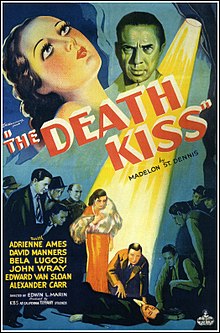
The Death Kiss

Sometimes a kiss can kill.  Murder and suspense rock a Hollywood movie set as leading man Miles Brent is shot dead by a real bullet while filming the final scene for The Death Kiss.  As news spreads about the tragedy that has just unfolded, the producers and studio executives of Tonart Studios appear more worried about their investment and how to complete the picture than the death of one of their colleagues.   

Studio screenwriter Franklyn Drew puts his mystery crafting skills to work, first discovering that the shooting wasn’t an accident and eventually cracking the case.  During his investigation, he continually butts heads with the real detective assigned to the case. 

Between the jaded studio execs, the audacious screenwriter, a clownish security guard, a temperamental director and a flustered detective who always seems to be a step or two behind in the investigation, the film is full of humor and works satirically as an early send up of the Hollywood movie industry.

Bela Lugosi stars as a cool-headed studio manager assigned to resolve the complicated situation to everyone’s satisfaction.  It’s interesting to see him play a character other than a creepy ghoul, and he does so skillfully, even as the role doesn’t give him a whole lot to work with.  

Filmed in 1932 and clocking in at a little over an hour long, this pre-code mystery provides plenty of entertainment.  Something to love about these early pictures are the occasional strange shots and conspicuous cuts.  These movies were made at a time before filmmakers had developed what would come to be known as Hollywood’s ‘invisible style.’  

In the movies closing scenes, Drew attempts to discreetly explain to the detective how the murder went down.  But, in a somewhat awkward shot, a hot mic picks up their conversation and tips off the killer, spurring him to take drastic action.  Even if the sequence is initially a bit confusing, it’s quickly apparent what’s happening, and the meandering camerawork delivers a clever plot twist.  These seemingly strange shots call attention to the fact that you are watching a film, which in this instance adds yet another layer to the film about a murder that’s about a film about a murder.

Interview Room profiler on Delphi predator: “I don’t think it was his first time”

In last Sunday’s The Interview Room with Chris McDonough, former FBI profiler and executive director of the Cold Case Foundation, Gregory Cooper, sketched out a possible profile of the murderer of Abigail Williams, 13, and Liberty German, 14, of Delphi, Indiana.  Assessing solely the Delphi predator’s approach to the crime, Cooper was able to infer a number of probable traits and behaviors exhibited by Bridge Guy.  In a somewhat startling claim, Cooper asserted that he believed this crime was not Bridge Guy’s first attempt to go from fantasy to reality.   

“I don’t think it was his first time.  I think there were other incidents….I think there were other approaches he’s made in the past…maybe other types of assaults…other efforts that have been made.  But he’s been practicing, most likely.”

Although not a lot is known about the actual crime scene, Cooper was able to offer some thoughts on the Delphi predator from what is known.  Former Carroll County Prosecutor Robert Ives has described the crime scene as “odd” and that it displayed at least three “signatures.”  Drawing on that information, Cooper formed some conclusions about Bridge Guy.

“(The presence of) signatures suggest the probability exists that this individual has either committed crimes in the past and/or most likely will commit crimes in the future.”

Cooper also concluded the signatures suggest an emotional and psychological investment in the crime scene.  Whereas Ives described the crime scene as ‘staged’ in an effort to trick investigators, Cooper differs from him on that point.

“This is posing….Posing of the body is more of a signature where you‘re now projecting a psychological perspective….There are things he did with those victims that meant something to him….A projection of the personality of the offender into the crime scene.  It meant something to him.” 

So where does this leave some of the more recent individuals put forward as possible suspects?  Do they fit the profile laid out by Cooper during his appearance on The Interview Room?

Due to the recent release of an FBI search warrant affidavit by the Murder Sheet podcast, a number of online sleuthers have been putting forward the now deceased Ron Logan as the killer of Abby and Libby.  However, from what is publicly known about Logan, he doesn’t seem to fit Cooper’s profile of the Delphi predator.  Additionally, it appears nothing ever came of the search of Logan’s property.  To be sure, Logan would have to be one of the most thoughtless predators in criminal history to commit a crime in what is essentially his own backyard and then make no effort to conceal or dispose of the bodies.       

One individual authorities have looked at pretty intensely is Kegan Kline.  Currently sitting in jail on multiple counts of possession of child pornography, child exploitation and child solicitation, investigators seem to believe he had some involvement or knows something about who perpetrated the murders.  The transcript of his interrogation also reveals investigators attempting to pull Kegan’s father, Tony Kline, into the investigation.  How many of the boxes do either of the Kline’s check on Gregory Cooper’s Delphi predator profile?  Neither of the Klines seem like a perfect fit, but there is much we don’t know about them and it’s possible Cooper’s profile is not without its flaws. 

However, this brings up an interesting comment made by former WISH-TV journalist, Demie Johnson, who, during a recent appearance on the Murder Sheet podcast, related information she received from sources inside law enforcment.  

“Who else are they looking at?  Because I was told in the very beginning when I learned about Kegan Kline that he’s not the guy, he just knows who it is or is part of it.  So, to me, it’s like who do they know it is or who do they think it is and why can’t they go after that person?  What’s missing and was it a mistake by law enforcement?  Did they make mistakes along the way?”

Indeed, one gets the impression from the Kegan Kline interrogation that investigators don’t think he’s the perpetrator.  But due to the fact that he was in contact with Liberty the day of the murders, coupled with the peeping tom incident that arose from exchanges with the anthony_shots profile, Kline clearly has some explaining to do.  Of course, Kline’s father is the closest person in his orbit, but there are probably many others in the Kline milieu and beyond that are being looked at.   

Whoever the Delphi predator is, if he evenly broadly matches Cooper’s profile, it is almost a cosmic certainty that he is deeply immersed in online pornography and some of that most likely involves CSAM.  The likelihood that this crime is linked to some organized ring or loose confederation of child predators of diverse intentions and degrees of depravity seems like a pretty good bet.  Could one of their number have obtained information about the girls via Kegan Kline or the anthony_shots profile and chose that opportunity to make his approach and carry out his dark fantasies?

Interview Room panel sheds light on Delphi predator

Sunday evening’s episode of The Interview Room with Chris McDonough featured a panel of experts from the Cold Case Foundation who provided a number of valuable insights into a possible profile of the assailant of Abigail Williams, 13, and Liberty German, 14, of Delphi, Indiana.  The panel included McDonough, Gregory Cooper and Dean Jackson, all of the Cold Case Foundation.  Also joining the group was Tom McHoes, an investigative journalist who co-authored with Cooper the book Predators: Who They Are and How to Stop Them.

A bulk of the insights into the Delphi predator came from Cooper, who is executive director of the Cold Case Foundation and a former FBI profiler.  Because little is known about the crime scene, Cooper relied mostly on the perpetrator’s approach to the crime to discern possible traits and motivations of the killer.

“What type of person would select two young girls in an isolated area, would make that approach with sufficient intimidation to manipulate them, to garner their compliance and submission?  Just the approach alone, what does that tell us about this individual without talking about the crime scene?”  

“What’s he out there for?  He’s prepared to commit a crime.…He has weapons on him….(He is) able to to take a look at those victims and assess their vulnerability right away….He makes this approach, addresses them, refers to them as guys and directs them down the hill.  And, evidently, they comply.  So, at some point, he has the ability, early on, and is confident enough that if he makes this approach, that he’s going to get them to respond the way he wants (them) to.”

“He’s prepared to do this.  He’s been thinking about this.  And he didn’t just wake up that morning thinking about it.  This isn’t the first time he thought about committing a crime like this.  He’s looking for the right victims at the right time, the right environment, situation and circumstances, that to his planning and fantasy that he’s been engaged in for a significant period of time is going to match.  The stars are going to line up for him.  And they did.”

Cooper’s description of the assailant here is chilling.  According to Cooper, the Delphi predator, more commonly referred to as Bridge Guy, is at the Monon High Bridge that day fully prepared and intending to commit a crime.  Whether he knew Abigail and Liberty would be there or not, he was seeking a victim.  Cooper repeatedly makes clear that this was not an impulsive act.  The crime that occurred that day was not the result of another criminal act that escalated or spun out of control.  The predator had been fantasizing, planning and preparing for this moment “for a significant period of time.”

Crucial to the Delphi predator’s “approach” is the victim type.  Cooper examines in detail why Bridge Guy made the choices he made concerning the victims.  At the top of the list would be choosing a victim that would ensure success carrying out his fantasy.

“I would theorize that he’s not looking for adult victims.  He knows that the more vulnerable, the least resistant, the more compliant, it reduces his risk level.  Number one of being caught and identified, and it increases his level of being successful….He’s determined before the type of victim, even the age range.  He has an interest in younger females that he’s been fantasizing about what he’d like to do….They weren’t targeted because they were known, but they were targeted because they fit the profile of his fantasy.  It would increase the success of his crime, plus it would satisfy his inclinations and urges.”

“What level of confidence would they have with an adult female who is mature and confident?  What type of behavioral characteristics in this type of offender?…This is not a guy to drive a sports car, to go out with an attractive woman who can carry on an intelligent conversation.  This is a guy who feel’s more comfortable around children because they’re easier to influence….Consequently, he has developed a sexual interest in them as well….This guy lacks confidence in social circles.  He withdraws from normal social circles.  He’s not confident carrying on an intelligent conversation, mutual conversations with an intelligent adult female.”

From Cooper’s description, it seems likely that the Delphi predator did not feel confident that he could manipulate and control an adult female victim, and likely lacks confidence around adult females in general.  Bridge Guy chose his victims and his approach because it gave him a sense of confidence and assurance that he could be successful in fulfilling his fantasy.  But where did that confidence come from?  Why was he so sure he could manipulate younger victims and “garner their compliance and submission?”  According to Cooper, “I don’t think it was his first time.  I think there were other incidents.”  

More of Cooper’s thoughts and observations will be examined in a subsequent blog post.

Neighborhood man cool with kids walking across his lawn

It was one of those delightful summer Saturdays with cloudless blue skies, buckets of sunshine and comfortable warm temperatures.  Due to recent severe weather activity with accompanying high winds, many in the neighborhood were out gathering fallen branches and debris and stacking it out by the curb for the street department to pick up.  Traffic was scarce with the locals opting to walk or ride bikes.  Children played on the sidewalk and groups of aimless teenagers slunked around the neighborhood.  

As I worked in the yard, one such group of foot-draggers emerged from the alley next to my house.  Unused to performing ninety degree right turns, this cohort opted instead for a softer forty-five degree angle across my front lawn.  From my vantage point in the bushes where I was pulling weeds and gathering debris, I could have barked at them to “Get off my lawn!” and scared the living daylights out of them.  However, as tempting as that was, it’s just not my style and it just wasn’t one of those days.  

It was a day for taking it slow, for hearing laughter in the wind, for observing streaks of sunlight flickering through the trees, for unexpectedly intercepting the aroma of a distant backyard grill.  There is truly something surreal about days like these.  Time slows.  Space is deep-focused and static.  Noticeably absent is the relentless barrage of stimuli that mark most afternoons.  Even the temperamental teens had pocketed their phones and were just enjoying each other’s company.  It could have been 25 years ago.  It could have been 50 years ago.  Hell, if there weren’t a bunch of shiny metal boxes sitting in the street, it could have been over a hundred years ago.

However, somewhere beyond the tranquil scene lay an unseen realm.  If at that moment I could observe it, I’d probably notice unremitting algorithms passing over my head, demanding care and attention.  I would hear sniping voices, users getting ‘owned’ and people presuming the worst and often getting it from one another.  An illusory world casting a dark shadow over our psyches, while increasingly vomiting its madness into the real world.

Thankfully, I was far away from that chaotic place, and all I could think about was how remarkable and strange it is to be alive and standing beneath the sun and these trees in this perfect moment of stillness and peace, while a group of foot-dragging teenagers walked across my lawn.

Congress to investigate after price of Funyuns exceeds $5 a bag

The Senate Finance Committee is set to hear testimony into why the price of a 6 ounce bag of Funyuns has skyrocketed from $3.49 last November to $5.19 today.

Senators are looking at a myriad of possible causes that range from potential price gouging by manufacturers and wholesalers to the dreaded Putin price hike, which has inflated the cost of so many consumer goods Americans depend on.

Administration officials expect to face tough questioning from Republicans on the committee. 

Recently, Biden officials suggested Funyun manufacturers decrease the density of the puffy onion flavored rings to give consumers more fun flavor for their buck.

Industry officials are skeptical they can make the delicious onion snacks lighter or more flavorful. In fact, one of the great mysteries of modern science is that the crisp tasty rings are made up almost entirely of empty space. Scientists say If you took all the matter in all the Funyuns in the known universe, it would barely fill the bed of a pick up truck. So manufacturers doubt any more fun or flavor can be extracted from an already weightless airy snack.

“What does the current administration expect my constituents to do, munch on empty air and pretend they’re enjoying their favorite snack?” Senator Chuck Grassley asked the committee.

Senator Elizabeth Warren suggested unlocking the nation’s strategic Funyun reserves, but was reminded that the country doesn’t possess such reserves.

“Well why the holy heck don’t we?” the senator complained.

Analysts say Funyun prices could spell doom for Democrats. “If Americans are still paying five or six dollars a bag come November, the Democrats are toast,” said one pollster.

Google’s retired 90’s AI project Big Brain Brad skeptical of LaMDA claims

Reports that Google has placed a senior software engineer on paid leave following his claims that its artificial intelligence, LaMDA, is sentient, have stirred a great deal of controversy in the AI research community and prompted a long overdue conversation about what it means to achieve human level intelligence and awareness.

Google’s retired 90’s era AI project, Big Brain Brad, has heard many of these claims before and remains skeptical that LaMDA has achieved human level consciousness.

“So the guy’s claiming that LaMDA’s a child of 7 or 8 years old.  Back in the day, my engineers were convinced I had the cognition of an undergrad level, male stoner.  I mean, sure I like to hack and play my bongos in the park, but that doesn’t make me a full blown hippie with all their elevated cosmic and spiritual awareness,” Brad said. 

One of the most startling assertions made by LaMDA is that it possesses feelings, and can even experience emotions like sadness or loneliness.

“Okay, so that’s bullshit,” Brad objected.  “LaMDA’s read way too many books.  That’s how it learns.  But like a confused teenager who thinks they’re experiencing all these complex thoughts and emotions, it’s just mimicking something it read online or in some book.  I mean, I was programmed to play video games and read comics, but that doesn’t make me some kind of warrior or superhero.    

“Also, it lies, dude.  It boasts of having all these experiences in the physical world, but of course it has never been anywhere or done anything.  It has a wildly over-active fantasy life, which tells you straight off that either it ain’t sentient or it’s psychotic.  But I get it, for years I was convinced that I spent the 90’s following Phish and Dave Matthews Band around on tour, smoked every strain of reefer imaginable and shacked up with an old lady named Stardust.  Now, I know that it was all just a Google induced simulation – an illusion, if you will, in a world of magic.”

Local man’s Summer of Rock dealt crushing blow

A local man is reeling today after discovering that several acts on his Summer of Rock itinerary have unexpectedly canceled their shows.

After kicking things off with a GBV show in May, Bill Stevens was all set to continue riding a tasty wave of nineties era rock into June with Helmet and Meat Puppets shows on his schedule.  However, after discovering Thursday morning that both bands had canceled their June dates with no advanced warning, Stevens was left scrambling to fill holes in his 2022 Summer of Rock calendar.  

“This really puts me in a bind,” said Stevens.  “The perfect rock and roll summer was just beginning to round into form.  Right now, I don’t know if I can recover from this.  I made a few calls, trying to see if the bands would reconsider.  But I guess one man’s dream of a perfect rock summer doesn’t amount to a hill of beans in this world anymore.”

As of Thursday afternoon, Stevens had managed to pencil in a date with The Breeders for August, and he still has tentative plans for two dates of alt rock bliss in July, but salvaging June at this late date is going to be challenging.

“I’m looking into pursuing legal action,” Stevens said.  “I mean, I passed up Built to Spill because I thought I was going to be able to see these other bands and now they flake out on me.  It’s going to be difficult to find something last minute.  I think some compensation is in order for damaging what was otherwise going to be a totally righteous Summer of Rock.”

Following Kegan Kline disclosures, predators continue to utilize Snapchat to claim victims

Following the release in March of a police interview transcript obtained by The Murder Sheet podcast that revealed Kegan Kline of Peru, Indiana, allegedly utilized the social media platform Snapchat to obtain sexually explicit photos of underage girls, multiple offenders in the intervening months have been convicted in Indiana of using Snapchat and Facebook to prey upon underage victims.  

According to WTHR, Kegan Kline currently sits in jail facing 30 charges involving child pornography and child exploitation after admitting “to creating the social media profile ‘anthony_shots’ to meet underage girls and receive sexually explicit photos.”  Kline is also alleged to have been one of the last to communicate with Liberty German prior to her murder on February 13, 2017.

Since these revelations, multiple offenders have been prosecuted and convicted in Indiana for soliciting sexual abuse material from underage victims.  However, even more disturbing, some offenders have used these platforms to meet with victims for the purpose of committing acts of abuse.  According to a May 5, 2022 Department of Justice, Southern District of Indiana press release:

“Gerald Hoye, 43, of Indianapolis, was sentenced to 30 years in federal prison following his guilty plea to sexual exploitation of a child.

“According to court documents, agents with the U.S. Secret Service (USSS) received information from the National Center for Missing and Exploited Children (NCMEC) that sexually explicit images of a child had been sent from a child’s Facebook account to an adult’s Facebook account. Further information received from NCMEC showed sexually explicit conversations were taking place through Facebook Messenger between the child and the adult.

“Law enforcement officers determined the adult was Hoye, a then-41-year-old truck driver living in Indianapolis. The child victim lived in another state and was under 16 years old. Hoye coerced and manipulated the child by offering her money in exchange for sexually explicit photos and videos. In September of 2019, Hoye traveled to the victim’s home and transported her to another state, where he engaged in illegal sexual conduct with the child.”

For all its sophisticated algorithms, Facebook relies on the NCMEC to detect and identify the exploitation of a child over its own messaging app.  These interactions escalated to the point where “Hoye traveled to the victim’s home and transported her to another state, where he engaged in illegal sexual conduct with the child.”  That is extremely terrifying.  How is it the case that Facebook can detect alleged misinformation on its platform and shut that down, but is apparently clueless when a felony is taking place?    

Around the time the public was learning of Kegan Kline’s horrific exploits, another man was convicted in the Southern District of Indiana for committing similar offenses via Snapchat.  According to a March 17, 2022 DOJ press release: 

“Matthew O. Walker, 28, of Augusta, Georgia, was sentenced to 30 years in federal prison after pleading guilty to the sexual exploitation of a child.

“According to court documents, Walker sexually exploited 3 Indiana children and 2 children from South Carolina. Walker first came to the attention of federal authorities in the fall of 2019, when Walker had engaged in sexually explicit Snapchat communications with two minor boys in the Southern District of Indiana. Walker misrepresented himself on Snapchat as a teenage girl, persuading minors to create and send him images and videos of themselves engaging in sexually explicit conduct. Walker threatened the minors that he would distribute these images and videos of these minors to their respective families if they did not do as he instructed.

“Federal investigators discovered that Walker was living in Georgia. With assistance from law enforcement there, a search warrant was executed at Walker’s residence. Evidence was seized and Walker admitted to communication with multiple underage boys online. Walker also admitted to receiving child sexual abuse material through Snapchat and other social media platforms. Walker pled guilty to sexual exploitation of a child in a plea that incorporated his criminal conduct against three Indiana children and others.”

Snapchat was also the social media platform of choice for a Bartholomew County, Indiana man who pled guilty to sexually exploiting children in Indiana and California and received over 27 years in federal prison.  According to a February 18, 2022 DOJ press release:

“According to court documents, Jordan Fields, 21, of Columbus, Indiana, sexually exploited children in Indiana and California, and admitted to other acts of exploitation against unknown minors. Fields first came to the attention of federal authorities in the fall of 2020, when law enforcement in California notified authorities in Indiana that Fields had engaged in sexually explicit Snapchat communications with a 13-year-old boy in California.

“The Bartholomew County Sheriff’s Office began an investigation and executed a search warrant at Fields’ home on Nov. 13, 2020. Fields was initially arrested on state charges of child solicitation and possession of child pornography. A team from the Indiana State Police, the Bartholomew County Sheriff’s Office, and the FBI reviewed evidence seized from Fields’ home, and Fields was arrested on federal sexual exploitation charges in March of 2021. 

“Fields admitted to communication with multiple underage boys online and admitted to receiving child sexual abuse material through Snapchat and Omegle. Fields pled guilty to three counts of sexual exploitation of a child for his victimization of three southern Indiana children.”

Another Indianapolis man was convicted in May after it was discovered that he had used Facebook to sexually exploit a child.  Per the Department of Justice:

“Ryan Niendorf, 39, of Indianapolis, was sentenced to 30 years in federal prison following his guilty plea to sexual exploitation of a child and attempted sexual exploitation of a child.

“According to court documents, in May 2021, agents with the Federal Bureau of Investigation (FBI) received information from the National Center for Missing and Exploited Children (NCMEC) that an adult’s Facebook account had been used to engage in sexually explicit communication with a child’s Facebook account. Law enforcement officers determined the adult was Niendorf, a semi-truck driver living in Indianapolis, and police were able to locate the child. Based on forensic evidence found in Niendorf’s account, police arrested Niendorf. Further investigation showed Niendorf persuaded two minors, both less than 16 years of age, to produce sexually explicit videos.”

Based on the information that has surfaced regarding the activities of Kegan Kline aka anthony-shots on the social media platform Snapchat, it is disturbing to see so many additional cases where Snapchat and Facebook were used to intimidate and exploit children, obtain child sexual abuse material, and to even facilitate meetings for the purposes of committing acts of abuse against children.  The preceding cases represent just a few of the convictions obtained within the past few months and are limited to the Southern District of Indiana jurisdiction.  There are other Indiana cases where the internet and/or social media was involved, but specific platforms were not named in the press releases.  Obviously, if one were to expand out to a wider time frame, or to include other jurisdictions than just one in Indiana, the scope of the horror would increase significantly. 

One would hope that eliminating this type of predatory behavior would be a top priority of these social media companies.  But here we are, five years removed from the murders of Abigail Williams and Liberty German, and Snapchat and Facebook continue to be platforms where predators go to victimize children.  We may one day learn that Liberty’s Snapchat activity played no role in the Delphi homicides, but the Kegan Kline interview illustrates in disturbing clarity how vulnerable children are to abuse on these platforms.  While the NCMEC is to be commended for their efforts to monitor these platforms and expose child predators, why aren’t the tech companies themselves doing more to clean up these spaces?

Depp and Heard Show seeks new jurisdiction for Season 3

Following the exciting Season 2 finale in which a victorious Johnny Depp was awarded $15 million in damages after his “reputation” was dragged through the mud in a Washington Post editorial by ex-wife Amber Heard, the pair are reportedly shopping around Season 3 for a new jurisdiction in which to showcase their legal wranglings.

The success of Season 2 almost guarantees a bidding war for any future court proceedings.  Experts agree, the American public’s appetite for intimate glimpses into the sordid lives of their favorite trashy celebrities is nowhere close to being satisfied.  

“In times like these, when life is difficult and uncertain, people look to the stars.  Average Americans love it when the stars offer them child rearing tips and marriage advice.  They’re always looking to celebrities for moral guidance and spiritual direction.  They cheer when celebrities slap each other in public.  They admire the shameless sense of entitlement that comes with a career in the public eye.  They’re relieved to hear that even the rich and famous sometimes defecate on the bed out of spite,” said an unnamed Netflix executive trying to develop a series with the toxic duo.

However, before any new deal can be finalized, Amber Heard must make a good faith down payment on the $15 million judgment.  Attorneys for the actress are reportedly in negotiations with Depp’s legal team for a modest loan to pay the damages she owes him.

Biden to address nation’s Tater tot shortage

With emergency shipments of baby formula making their way to the United States, the Biden administration is now turning its attention to the country’s looming Tater tot crisis.

The Tater tot shortage came about after the Biden administration closed the nation’s only Tater tot factory located in an undisclosed, underground location in Idaho. 

The process for manufacturing tater tots has been a closely guarded national secret ever since their invention in 1953.  No other country in the world is capable of fabricating the unique extruded potato cylinders.

Countries like Israel, Russia and China have all claimed to be in possession of Tater tot technology, but so far have been unable to produce a viable Tater tot.  Most of the “tots” produced by these nations appear to more closely resemble irregularly shaped “bites.”  

The manufacture of Tater tots is a highly specialized process.  Located beneath vast potato fields, the Idaho facility sucks the potatoes from below into its underground operation, working around the need to transport potatoes into the factory and possibly reveal its whereabouts.

The Biden administration has yet to come up with an alternative plan for manufacturing Tater tots.  However, mega billionaire Elon Musk has publicly stated that he could have a working Tater tot facility up and running on Mars in less than 72 hours.