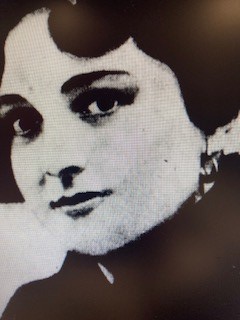
Queen of the Con: Buda Godman Marries Tell Taylor

Safely ensconced at convent school in Adrian, Michigan, Buda Godman was midway through her time at St. Joseph’s Academy when a group of travelling players came through town.  It was Christmas Eve and the students were allowed to give a late supper.  One of the invited guests was Mr. Tell Taylor, a young actor and aspiring songwriter from Findlay, Ohio.  He sat across the table from Buda Godman and the pair seemed to hit it off.  However, when the dinner ended, the two parted ways without any intention of continuing the friendship through future meetings or correspondence.

A few years later, a nineteen-year-old Buda Godman was out of school and back in Chicago where her family resided.  One evening in 1907, Buda attended a performance of The Girl Question, a hit musical that enjoyed a run of over a hundred performances at the Lasalle Theater.  There she recognized the man playing the part of Harold Sears as the same actor she’d met a few years earlier.  After the performance, she sent him a note and “their acquaintance was renewed.”  Buda Godman and Tell Taylor proceeded to embark on a whirlwind courtship.  “Several times during the course of the week the young couple were out together, lunching and driving, and Monday evening after dinner together at a downtown hotel Judge Arms was called to the parlor and joined them in marriage,” the Lafayette Journal and Courier reported.  Before going to the theater to catch her husband’s performance that evening, Buda called her parents and notified them of the marriage.  Buda’s father joined her at the theater and after the performance took the couple back to his house where the Godmans held a dinner for the newlyweds. 

While the Journal and Courier reported that the new bride “would not go on the stage,” Jack Lait and Lee Mortimer wrote in Chicago Confidential that Taylor got Buda work in the chorus of The Time, The Place, and The Girl.  According to Lait and Mortimer, following Buda’s performance “Chicago woke up to the discovery of a new rave, Buda Godman.  She was wooed and pursued and she fell.  Taylor tried to kill her and fired several shots at her, but missed.”

There are more than a few inaccuracies in Lait and Mortimer’s account of the life of Buda Godman, so it’s difficult to know how much, if any, of this episode actually happened.  However, one thing that is undeniable is that Tell and Buda’s relationship was stormier than a water spout off of Ohio St. Beach.  To hear Tell Taylor tell it, “I married Buda when we were both drunk and I found out she was quite incapable of loyalty to anyone.”  As Variety put it when Taylor filed for divorce from Buda in 1910, “his complaint mentioned several vaudevillians as ‘affinities.’  Their names were omitted from the final record.”

One thing that is never mentioned in the ‘love story’ of Tell Taylor and Buda Godman is the erratic behavior of Taylor himself.  Life with the songwriter wasn’t always blissful romance by the old mill stream.  Taylor did start a successful music publishing company in Chicago, and he managed to author his most famous tune “Down By The Old Mill Stream” in 1910 while still married to Buda.  However, Taylor had his own ‘affinities’ that caused him to make headlines on more than one occasion.  

In July of 1908, Taylor was fined $3 for disorderly conduct over a fight that took place at Freiberg’s Dance Hall 182 22nd street, Chicago.  In his defense, “Taylor declared to Judge Crowe that as a result of the fracas he was carrying around two highly decorated eyes as well as several and sundry abrasions on different parts of his anatomy and that he did not deserve any additional punishment,” The Inter Ocean reported.  Apparently, Taylor, Tim Jordan of the Brooklyn Superbas professional baseball team, and several other individuals were out “doing the levee” when they wandered into Freiberg’s at around two a.m.  As the Inter Ocean reported, Taylor “created a disturbance in the dance hall, and that when asked to leave he had started a row.”  He was then ejected by two waiters and later arrested when he tried to return to the dance hall.

During a separate incident in August of 1910, Tell Taylor again tangled with waiters at George Silver’s basement saloon at Clark and Randolph streets.  After Taylor made a request to cash a check, he was attacked by Silver and several waiters who “threw him to the floor” and “pounded his head with a billy.”  Silver maintained that Taylor “started the row” when he “used abusive language” and “refused to leave when ordered,” the Chicago Tribune reported.  “O, no, he wasn’t beaten up.  He was just thrown out gently,” Silver said.    

The following month, on September 13, 1910, Buda’s father, Otho Godman, died in New York City at the age of 53.  Less than two weeks later, Tell Taylor filed for a divorce.  While Taylor blamed Buda’s lack of loyalty and affinities for fellow vaudevillians as the reason for the break up, it is pretty clear that his adventures in the levee, his brawling, and public drunkenness demonstrated that he was no more committed to the marriage than Buda.  

Within a few years, Buda Godman would be deploying her theatrical skills to con rich men out of large sums of money.  How a former convent school girl managed to fall in with a highly organized gang of international blackmailers is a bit of a mystery.  She certainly could have encountered some of these characters in Chicago.  Lait and Mortimer write that “her father’s calling threw him in with shady people….”  Could Buda have come in contact with underworld figures among her father’s business associates?  Otho Godman’s obituary said he worked “at race tracks in the big cities, and his services were always in demand.”  As an expert in telegraphy, morse code and wireless communications, Otho Godman’s work at horse racing tracks would have placed him directly in the sphere of big-time gambling interests.  Was it only a matter of time before Buda Godman adopted the life of crooks and conmen?  Whatever the case may be, it appears that once the protective influence of Otho Godman had fallen away, and her marriage to Tell Taylor dissolved into ruin, Buda Godman was set free to relieve rich, philandering fat cats of their beefy bankrolls.

Forty Years Unsolved: The Abduction and Murder of Peggy Sue Altes

Forty years ago on November 12, 1984, eleven-year-old Peggy Sue Altes was abducted from Porter Park in Indianapolis, Indiana.  Five days later her nude body was discovered by hunters in a field off Jacobi Road in Hancock County, Indiana.  She had been sexually assaulted, brutally stabbed in the neck and left for dead.

Peggy Sue’s brother-in-law, Jerry Watkins, was wrongfully convicted and served fourteen years for her murder, despite having a solid alibi and a blood type that excluded him as her attacker.  Watkins was exonerated in 2001 when DNA evidence pointed to another man, Joseph Mark McCormick, as the man who sexually assaulted Peggy Sue.  Turns out, Joseph Mark McCormick lived across the street from the park where Peggy Sue was abducted.  

November 12, 1984 was Veterans Day and Peggy Sue had the day off of school.  She went to a neighborhood friend’s house while her mother and sister went to a church meeting.  When Peggy Sue’s friend wasn’t at home, she went to Porter Park to enjoy some play time.  At around 2:30 in the afternoon she was seen playing with two other boys who were also in the park that day.

A delivery driver in the area witnessed Peggy Sue get pulled into a black Camaro against her will.  He was able to provide an accurate description of Peggy Sue and the clothes she wore that day.  The witness described the black Camaro as having gray stripes that ran the length of the car along the door handles.  The car had rust over the rear wheel well, a blue interior, and a piece missing from a wing on the back of the car.  The witness described the driver of the Camaro as having a mustache and black curly hair that puffed out in the back.   

Additionally, information contained in Judge David Hamilton’s decision freeing Jerry Watkins revealed detectives were looking at two sets of brothers, the Munsons and the Beevers, who may have had knowledge or been involved in the abduction.  According to Hamilton, the investigator’s “notes on the Munsons and the Beavers reflect a confusing and sordid account of drug use, knives, violence, and adult men having sex with under-age girls.”

By August, 2001, Joseph Mark McCormick was sitting in the Hancock County jail charged with murder, felony murder and two counts of child abuse to which he pleaded not guilty.  At McCormick’s September, 2001, bond hearing, Kenneth Wayne Munson testified against McCormick, at one point telling the defense attorney, “I saw your client rape that baby.”  During testimony, and through conversations with investigators, Munson revealed his own involvement in the abduction and murder.  Detectives knew Munson had to have been involved because he was able to lead investigators to the exact location of the murder.

Despite the presence of McCormick’s semen on vaginal swabs taken from Peggy Sue, and a witness willing to testify against him, McCormick was allowed to plead down to child molesting and received a mere six years in prison.  For Kenneth Munson’s part, even though he was clearly involved in the kidnapping and admitted pushing Peggy Sue to the ground and stabbing her, he was allowed to plead down to conspiracy to commit criminal confinement resulting in serious bodily injury of a child.  He faced a potential 20 year sentence, but he only got six. 

The dropped charges and light sentences were contingent on McCormick and Munson testifying against William Beever, who they claimed delivered the fatal stab wounds to Peggy Sue’s neck.  However, William Beever was never brought to trial.  Prosecutors decided McCormick and Munson lacked credibility and eventually dropped the charges against Beever.  Well played, Hancock County.

I’m just a true crime dipshit who likes to read old newspapers.  I have no education, experience or training in how to build a case, bring it to trial or prosecute.  But you’ve got two suspects who are clearly involved in this crime through DNA and knowledge of the facts and circumstances of the crime itself.  While their stories don’t align on every detail, they’re mostly consistent and partially backed up by other witnesses.  It just seems like there should have been some way to hang a felony murder charge on this whole pack of scumbags, no matter who actually delivered the fatal knife blows.  How could prosecutors allow these men to escape justice for this awful crime?  Are detectives still investigating, and is there currently any effort being made to hold all involved accountable?     

It’s been forty years since Peggy Sue Altes lay in that Hancock County field dying from this savage attack.  Confused and full of fear, surrounded by monstrous figures, she could never have anticipated the evil that would come for her as she innocently played at the park on her day off from school.

“If somebody was going to stab you, wouldn’t you cry or scream?  Can you imagine a child being in fright, scared to death?” Myrlene Altes told the Indianapolis Star.

A memorial written for Peggy Sue on her Find A Grave page reads in part:

“Growing up in Indianapolis, Peggy Sue’s life was much like that of any other child in America’s heartland. She was a fifth-grader at School 48, known for her blondish-brown hair and her bright, engaging smile. Those who knew her describe a girl full of life, a child who embraced the world with the innocence and enthusiasm characteristic of her tender age.

“Though Peggy Sue’s life was heartbreakingly short, her impact transcends the years she spent on this earth. Her story, a poignant reminder of the fragility of life and the cruelty that can befall the innocent, has resonated with countless individuals. It serves as a call to protect the vulnerable in our society and to tirelessly seek justice for victims and their families.

“As we reflect on the life of Peggy Sue Altes, we are reminded of the preciousness of each moment and the enduring impact of a single life. Though she is no longer with us, her memory continues to inspire and influence those who hear her story. May her spirit find peace, and may those who loved her find solace in the knowledge that her life, though brief, will forever be remembered.”

The inscription on her grave marker reads, “I cried – He answered.”  Indeed, God answered Peggy Sue’s cries during those final terrifying moments and pulled her into His loving arms.  When are investigators going to answer her cries and bring some measure of justice and resolution to this awful case?

Predator in the Park: The Abduction and Murder of Peggy Sue Altes

Porter Park

Hidden behind working-class homes on the eastside of Indianapolis, Porter Park isn’t visible from the city streets that surround it.  If you’re driving on English Avenue by the Greater Shepherd Baptist Church, you might catch a glimpse of the park behind the church’s parking lot.  Otherwise, you could pass it everyday and never know it exists.  Maybe the city prefers it that way, because the park looks more like a municipal afterthought than a destination for fun and excitement.  Surrounded by a crooked chain link fence, the park boasts some swings, a basketball court, a jungle gym and a large open field.  The only way to access Porter Park is via the aforementioned church parking lot or the nearly hidden alleyways that split off of Hamilton Avenue or St. Paul Street.  Undoubtedly, it is a source of amusement for the neighborhood children, but it lacks a parking area, and there is little chance any area family loads up the minivan and heads out for an afternoon of laughter and thrills at Porter Park.   

But Porter Park is where 11-year-old Margaret “Peggy Sue” Altes found herself on the afternoon of Monday, November 12, 1984.  It was Veterans Day and a school holiday.  Peggy Sue had left her home at 442 St. Peter Street around 1:00 p.m. to meet a friend at a neighboring residence where the friend’s grandmother resided, while Peggy Sue’s mother and sister attended a church revival.  However, when no one answered the door at the residence, Peggy Sue did what a lot of kids did in those days, she went to the local playground to pass the time and connect with neighborhood friends.  Around 2:30 that afternoon, Peggy Sue was seen playing in the park with a couple of neighborhood boys.  Peggy Sue was a fifth-grader at School 48.  She was five foot tall with blondish brown hair.  She wore a white furry jacket, burgundy corduroys and blue tennis shoes.  A witness saw her playing on the swings.  By all accounts she was taking full advantage of time away from teachers and parents to have a carefree day of play and fun.

However, there were others in this neighborhood who were also taking the day off.  Not because they were honoring those who had nobly served their country, but because for these men of low character most days were an exercise in scoring dope and getting high, or swigging whisky and getting wasted on a weekday afternoon.  And if that is all they did and they confined their activities to the dark places, the seedy bars and grubby apartments that concealed their shabby and disordered lives, then maybe their weakness of character could be forgiven.  But men like these are not content to stay in the shadows.  They are jackals hunting the weakest prey, stalking innocent lives for their own vile and twisted pleasure.

One of these jackals was creeping through the streets surrounding Porter Park in a black Chevy Camaro.  A witness described seeing Peggy Sue enter the passenger side of the vehicle.  The witness, a delivery driver whose schedule routinely brought him to the area, said Peggy Sue was forced to get into the car.  He told authorities, “she didn’t want to get in, he grabbed her by the sleeve.”  The witness described the black Camaro as having gray stripes that ran the length of the car along the door handles.  The car had rust over the rear wheel well, a blue interior, and a piece missing from a wing on the back of the car.  The witness described the driver of the Camaro as having a mustache and black curly hair that puffed out in the back.

The parents of Peggy Sue Altes did not realize their daughter was missing until 7:00 p.m. when they received a phone call from the family of the friend she was supposed to have met that afternoon.  Peggy Sue’s family immediately began searching the area and reported Peggy Sue missing to police around 11:15 that night.  In the days that followed, the search continued with family, friends and church members joining in to search neighborhood streets and abandoned buildings.  A flier bearing Peggy Sue’s name, age and description was distributed to neighborhood businesses imploring anyone who had seen her to contact “missing persons.”  However, family members charged that the police response was nearly non-existent with Peggy’s brother James telling the Indianapolis Star, “they haven’t done all they could do.”  IPD detectives didn’t exactly dispute James’ claim, responding that they had entered Peggy Sue’s name and description into a state and a national database, which apparently constituted the extent of investigative effort for locating missing eleven-year-olds at the time.   

Peggy Sue’s nude body was discovered by hunters in a Hancock County field around 10:00 a.m. the following Saturday, November 17, 1984.  Although reports initially claimed she had been shot, it was later confirmed that she had been stabbed in the neck.  Her body was located about 100 yards off Jacobi Road just north of County Road 300S in Hancock County.  A group of hunters had parked their truck just off the road and we’re following a path on foot back to a wooded area.  About a hundred yards in they discovered the body of Peggy Sue lying face up along the path.  The four men quickly returned to their truck and drove to a nearby house where the owner immediately contacted Hancock County Sheriff’s Deputy Jim Bradbury who was a resident of the area.  

Hancock County investigators were on the scene by 11:00 a.m.  There they discovered that the path leading back to the scene was deeply rutted with tire tracks.  In some places, the ruts were more than 12 inches deep, indicating a vehicle may have become stuck in the mud at some point.  Investigators made plaster casts of the tire tracks.  They also photographed the scene extensively and recovered several items, including a thin gold bracelet.  Present at the scene were Hancock County Prosecutor Larry Gossett and Deputy Coroner Fred Counter.  Sheriff Detective Technician Bill Applegate and Captain Malcolm Grass supervised the evidence gathering.  Around 3:00 that afternoon, Counter and Applegate assisted as Peggy Sue’s body was carefully sealed in sterile wrappings and transported to Wishard Hospital in Indianapolis for autopsy.  Investigators concluded that Peggy Sue had been murdered at the scene because her hand was found to be clutching grass and weeds, and initially they thought her death had been quite recent.  While awaiting autopsy results, Hancock County Sheriff Nick Gulling told reporters, “Until we get those results, we’re operating under the assumption that we had Saturday, and that is that she died sometime Friday night or Saturday morning.”

That she may have been killed the morning of her body’s discovery seems like a pretty startling assertion.  Based on their assessment of the crime scene and the condition of the body, homicide investigators, a crime scene tech and the county coroner were of the opinion that she likely died within the previous 24 hours, maybe even a mere few hours prior to discovery.  That would mean that she had to have been held somewhere in the intervening days since her abduction Monday afternoon.  

The autopsy report would tell a different story, although it would fail to nail down conclusively when Peggy Sue Altes was slain.  Forensic pathologist Dr. John Pless would conclude that she died of knife wounds to the left side of her neck that severed a jugular vein and carotid artery.  No other wounds were indicated other than some superficial cuts.  There was evidence of rape which included the presence of semen in her vagina and a tear caused by penetration.  The time of death was estimated to be at least 48 hours prior to the discovery of her body.  

Perhaps investigators could be forgiven for being a few days off on the time of death.  After all, it was November, so cold temperatures probably made it difficult to determine with any degree of certainty.  But, in retrospect, crime scene investigators’ failure to distinguish a stab wound from a gunshot wound may have revealed a lack of experience, if not a lack of competence, and that misstep may have proven to be a rather ominous sign of investigative failures to come.  Because this is a case where poor decisions on the part of investigators and prosecutors sent an innocent man to jail and allowed guilty men to walk free, all while two grieving parents eventually went to their graves having never seen justice for their slain daughter.

Wrongful Conviction

After a year in which there seemed to be little movement in the Peggy Sue Altes murder investigation, suspicions came to rest squarely on the brother-in-law, Jerry Watkins.  Two days prior to Peggy Sue’s disappearance, Watkins was caught by his wife, Janice, molesting the girl in the couple’s living room as Peggy Sue watched cartoons.  According to his testimony at trial, it was the “second or third time” he had molested Peggy Sue, and he also admitted molesting another Altes sister on multiple occasions.  Janice moved out of their home that Saturday, but the couple reconciled the following day after Watkins made a public admission to the family that he had molested Peggy Sue.  That weekend, Watkins cut his hair and shaved his beard for the first time in several years.  He expressed an interest in attending church with Janice and appeared ready to turn his life around.  The next day, Peggy Sue went missing.  

Eventually, the timing of the Watkins’ disclosures just prior to Peggy Sue’s abduction, rape and murder would seem like too much of a coincidence to overlook for both the family and authorities.  However, other than the admissions of molestation, there was no evidence to link Watkins to Peggy Sue’s murder.  On August 14, 1985, Jerry Watkins pleaded guilty to molesting Peggy Sue.  Additional charges of assaulting a five-year-old boy were dropped as part of the plea agreement.  Watkins was sentenced to serve two years at the Indiana State Farm, but ended up serving only five months after a judge reviewed his case and released him early.

It wasn’t long after Watkins’ release from prison that he was arrested and charged with the murder of Peggy Sue.  Following the arrest, Hancock County Sheriff Nick Gulling revealed that Watkins had been the focus of authorities since “the initial stages of the investigation.”  Gulling went on to disclose that a search warrant had been served at the Watkins’ home shortly after Peggy Sue’s body was discovered.  Additionally, investigators searched Watkins’ car and drew his blood for testing and comparison. Results of testing came back negative or inconclusive.  Sheriff Gulling admitted the search netted “some evidence, but I’m not sure it was critical evidence.”  Indianapolis Police Department investigator Alda Kaiser echoed the notion that the investigation zeroed in on Jerry Watkins almost immediately.  “I’ve always felt the molesting disclosure had something to do with her murder,” Kaiser told reporters.   

Clearly, Watkins is someone investigators would want to take an intense look at due to his ongoing abuse of Peggy Sue and her sister.  But it seems like investigators went all in on Watkins to the near exclusion of other investigative leads, despite having no evidence against him.  According to Sgt. Louis J. Christ of the Indianapolis Police Department, “Our primary thought throughout the entire investigation was to try and locate physical evidence to connect the perpetrator to the crime.  From the very beginning we came to the realization that we had no real evidence to tie the perpetrator to the crime.  Anything we found we processed through the lab, but we had no identifying evidence.” 

So how were authorities able to execute an arrest on Jerry Watkins?  What was the crucial piece of evidence that dropped in their lap tying Watkins to the crime?  Enter jailhouse snitch Dennis Ackeret.  According to Ackeret, on August 14, 1985, he shared a cell with Jerry Watkins in the City-County building while Watkins awaited sentencing for his Marion County molestation conviction.  At that time, Watkins told Ackeret that he had killed a girl, slashed her throat and dumped her in some bushes in Hancock County.  This was the big break investigators had been waiting for.  They had their confession and didn’t seem to mind that it was made not to authorities, but to another inmate.

Watkins went on trial in September of 1986.  The prosecution’s case relied almost exclusively on the jailhouse confession and their ability to poke holes in Watkins’ alibi.  Dennis Ackeret was the star witness, describing for the jury a distraught Watkins so wracked with guilt that he felt compelled to unburden himself to a cellmate, Ackeret, whom he had just met.  The defense pointed out that Ackeret was a thief and a forger, and that he had previously worked as a paid police informant.  Other defense witnesses testified that Ackeret made up the story to get a reduced sentence, and that Ackeret boasted about how to become a state’s witness by researching crimes in the newspaper.

Forensic pathologist Dr. John Pless, who conducted the autopsy on Peggy Sue, testified that she died from 15-20 stab wounds to the left side of her neck.  Some of the wounds severed a jugular vein and a carotid artery.  The doctor testified that Peggy Sue had abrasions on her hands and neck, plus a bite mark on one of her breasts.  Additionally, there were other wounds that indicated a sexual assault had taken place.  Regarding time of death, Pless could be no more specific than sometime between the day of her disappearance and the day before discovery of her body.  While there was no murder weapon presented, prosecution witnesses testified that Watkins was sometimes seen carrying a knife at work and at church. 

Watkins himself took the stand.  His testimony focused mostly on denying the accusations made by other witnesses and establishing an alibi for the day of the abduction and the days that followed.  Watkins testified that he had worked from 7:00 a.m. until 3:30 p.m. on the day of Peggy Sue’s abduction.  His testimony was corroborated by his employer.  After work, he and his wife, Janice, moved furniture back into their house that had been removed during their brief separation.  This testimony was corroborated by Janice and Watkins’ mother.  At 7:00 p.m. the couple attended a church revival at Bethel Tabernacle 4232 S. Foltz St. Indianapolis until 10:00 p.m.  After the revival, the couple returned to Janice’s parent’s home to find out that Peggy Sue was missing and participated in the family search until 2:00 or 3:00 in the morning.  Subsequent days were spent searching, working and attending church revival meetings in the evenings.

During closing statements, Hancock County Deputy Prosecutor Pete Shumacker attacked the veracity of Jerry and Janice Watkins’ testimony.  “If you’re going to be a liar, you better have a good memory.  Janice doesn’t have a good memory and neither does Jerry.”  For prosecutors, the fountain of truth and virtue was Dennis Ackeret who wanted nothing for himself, but willingly gave testimony “as any human being with a soul that had information would come forward with it,” said Prosecutor Larry Gossett.  Furthermore, prosecutors would assert, Ackeret’s testimony had to be credible because he gave details that went unreported in newspaper accounts.  According to Prosecutor Gossett, newspaper articles made no mention that Peggy Sue’s jugular vein had been cut as Ackeret had testified.  In fact, Judge Richard Payne allowed newspapers to be entered into evidence to allow jurors to verify that the information could not have been gleaned from news articles.  I’m no lawyer, but this seems like a highly prejudicial move.

Despite the scarcity of evidence, Watkins was convicted and sentenced to 60 years in prison.  In the end, Watkins was an admitted child predator who had molested Peggy Sue and her older sister on numerous occasions, making him a wholly unsympathetic character in the eyes of the jury.  It is not hard to imagine how law enforcement, prosecutors and jurors would think he had to be the guy.  However, there are abundant reasons to believe that investigators should have known he wasn’t the guy.  First, during the investigation, he and Janice both passed a polygraph examination.  While not admissible in court, detectives used the exam to eliminate certain suspects.  Why wasn’t it used to clear Watkins?  Especially, since it lends credibility to what was a pretty solid alibi.  Second, tests on seminal fluid revealed that Peggy Sue’s attacker must have had type B blood.  Watkins was blood type O and Peggy Sue was type A.  How is this not evidence that the rape was commited by someone else?  Third, investigators had a witness that saw Peggy Sue get pulled into a black Camaro at Porter Park around 2:30 p.m. on November 12.  Not only did Jerry Watkins not own a black Camaro, his employer confirmed that he was at work at that time.  Apparently, this bit of evidence was not shared with the defense.  In the end, the exculpatory evidence is much weightier and far more credible than the evidence to convict.  On this knowledge alone, investigators should have known they were pursuing the wrong man and that the real killer or killers were still on the loose.  Although it would take several years and investigators would resist it tooth and nail, eventually DNA technology would set them straight, eliminating conclusively Jerry Watkins as Peggy Sue’s assailant and redirecting the focus onto a man named Joseph Mark McCormick.

Joseph Mark McCormick

With Jerry Watkins securely behind bars, the actual killers of Peggy Sue Altes were now free to pursue their depraved criminality without fear of having to answer for their bloody deeds.  For 16 years after committing this unspeakable act of evil, the murderous jackals continued to stalk the innocent while Peggy Sue’s blood stained their clothes and the sound of her cries and pleadings reverberated in their drug and alcohol soaked memory.  And despite the knowledge that Jerry Watkins could not have been Peggy Sue’s assailant, which included star witness, Dennis Ackeratt, recanting his testimony, Hancock County officials fought like hell to keep the wrong man behind bars.  

Eventually, on April 25, 2000, U.S. District Judge David E. Hamilton overturned Watkins’ 1986 conviction, citing DNA and additional evidence investigators and prosecutors failed to disclose to the defense at the time of Watkins’ trial.  In addition to the DNA evidence eliminating Watkins as Peggy Sue’s rapist, Judge Hamilton’s decision cited the eyewitness to Peggy Sue’s abduction at Porter Park, another suspect who had failed a polygraph, men who had admitted involvement in the crime to others and a man who was seen wearing bloody clothes the night of the murder all as evidence “that no reasonable jury would find Watkins guilty of murdering Peggy Sue Altes.”

Naturally, Myrlene Altes, Peggy Sue’s mother, was devastated.  “If you want a pervert out on the street, that’s what you’re going to get.  I’m very angry because this guy is dangerous,” Mrs. Altes told reporters.  It is certainly true that they were letting a pervert out onto the street.  Jerry Watkins had inflicted immeasurable and lasting damage on the Altes family, but he could not have been Peggy Sue’s killer.  Those degenerate monsters were still at large, slinking in the shadows between brief stretches behind bars for other criminal offenses.  

In August of 2001, the same DNA evidence that led to the release of Jerry Watkins shone a spotlight on one of the shadowy predators.  Joseph Mark McCormick was found to be a match to the crime scene DNA to a certainty of one person in 1.5 billion.  “We put the evidence through an analyzer and it mapped everything,” Indiana State Police DNA database supervisor Paul Misner told The Daily Reporter.  “All we did was use the computer to match the sample we had with anyone in the database.  Everyone arrested in Indiana on crimes against persons or serious offenses is required to provide a DNA sample that is kept on record.  We just did a cross match and found a match.”

McCormick, who investigators learned was living across the street from Porter Park at the time of Peggy Sue’s abduction, was “in the wind” at the time of his identification.  “He is on probation for a theft and burglary conviction in Marion County but has skipped out on his probation officer,” Hancock County Sheriff’s Department Captain Jim Bradbury told reporters.  After embarking on a reinvestigation of the case following the Watkins exoneration, Bradbury uncovered another interesting lead that was showing some promise.  “I had been talking with a confidential informant that was questioned when the original investigation was going on.  I talked with him and he began to tell me little bits about what he knew about the girl’s killing,” Bradbury said.  The informant was able to show investigators the precise location where Peggy Sue’s body was found, and according to Bradbury, “He told me things that only someone who was involved in the case would have known.”  Bradbury also revealed that the confidential informant was safely behind bars under protective custody.

Detectives also interviewed the young men who were then the young boys seen playing with Peggy Sue at Porter Park prior to her abduction.  “The original witnesses to the abduction, who were like 7 years old or 8 years old at the time, said there was more than one (abductor),” Hancock County Sheriff Nicholas Gulling told the Indianapolis Star.  “And the information we received subsequently indicates there was more than one.”  Here Gulling could be indicating that the confidential informant confirmed this piece of information.  Setting aside the DNA match, if all of these witnesses were questioned at the time of the original investigation, why weren’t they taken more seriously then?  Even if investigators felt that Watkins was involved, they had ample reason to believe that others participated as well.  Yet they discounted and even suppressed that information.  Nevertheless, authorities got a tip on Sunday, August 5, that McCormick was in attendance at a party in Morgan County.  Investigators rushed to the scene of the festivities, but a slippery McCormick had left the party by the time they got there.  They missed him by that much.

On Tuesday, August 7, 2001, 39-year-old Joseph Mark McCormick of Indianapolis walked into the Greenfield police station shortly before noon to turn himself in.  His long hair and bushy beard gave him the look of a survivalist or a former Manson family member.  He told police he did not have a permanent address and had been living in motels.  After learning that he was being sought by authorities, McCormick got a ride from a friend to the police station.  The friend, however, didn’t stick around to answer questions.  Despite turning himself in to the wrong law enforcement agency, the Greenfield Police held the bedraggled drifter until Hancock County Sheriff’s officials could arrive.

At an initial hearing, McCormick was charged with murder, felony murder and two counts of child abuse to which he pleaded not guilty.  Despite new suspects and solid evidence connecting Joseph McCormick to the crime, Hancock County still wasn’t finished trying to put Jerry Watkins back behind bars.  “We have seen a lot of twists and turns in the case.  The tests show that Jerry Watkins didn’t have anything to do with the sexual assault.  That doesn’t mean he didn’t kill her but it does point to McCormick,” said Hancock County Prosecutor Terry Snow, seemingly unable to decide whether to state his case emphatically or undermine it by not letting go of Watkins as a suspect.  While indicating that other arrests were possible, Captain Jim Bradbury agreed with Snow that the investigation still included Jerry Watkins.  “We are still not done yet,” Bradbury told reporters.

Indeed, they weren’t done, not by a long shot, and not letting go of Jerry Watkins as a suspect was just the beginning.  Investigators and prosecutors were just getting started on their clumsy efforts to sabotage their own case, practically ensuring that none of the men responsible for the rape and brutal stabbing of Peggy Sue Altes would do time for her murder.

Kenneth Wayne Munson

With a confidential informant in sheriff’s custody revealing details of what happened on November 12, 1984, and a suspect, Joseph Mark McCormick, whose DNA implicated him in the rape and murder of Peggy Sue Altes, investigators finally began to let go of the idea that Jerry Watkins was in any way involved in the killing.  However, from the benefit of hindsight, one has to wonder if the damage was already done.  With Hancock County authorities so sure that Jerry Watkins was the guy, and their failure to pursue anyone else during the fourteen years Watkins sat in prison, how could investigators now be perceived as credible as they began to turn their attention to other suspects?  

According to the confidential informant, several men, including himself and McCormick, were participants in the crime.  After Peggy Sue was kidnapped from Porter Park, she was transferred from a car to a van that was driven by McCormick.  After driving around, the van ends up in the Hancock County field where the murder took place and where Peggy Sue’s body would eventually be discovered.  Initially the informant attempted to distance himself from the worst aspects of the crime.  “(The informant) at first said that he and another man were dropped off at a culvert near the scene but later said he actually went there and saw what happened.  He still has nightmares about it,” Captain Jim Bradbury testified at a bond hearing. 

Naturally, McCormick’s defense attorney John Davis highlighted the confusing and constantly shifting narrative of events offered by investigators.  “I am just trying to figure out what they say happened,” Davis said, playing the simple country lawyer for reporters.  “Their informant has told seven different stories of what happened….I’m just trying to make some sense of it all.”  Even as investigators were finally starting to put the puzzle together, it was clear they were going to face an uphill battle after they’d previously worked tirelessly to ignore the truth for so long. 

At McCormick’s bond hearing in late September of 2001, another member of the murderous crew responsible for the brutal slaying of Peggy Sue Altes emerged from the shadows when former confidential informant Kenneth Wayne Munson took the stand.  Munson testified that on the afternoon of November 12, 1984, he visited the home of a friend on the southeast side of Indianapolis.  After smoking some marijuana, he, the friend and several other men went to a local liquor store in a van driven by Joseph McCormick.  However, the men did not purchase any alcohol, but drove to nearby Porter Park instead.  There they met with another group of people who had already grabbed Peggy Sue and were holding her in a Camaro.  “They had her in the back seat of their car and they pulled the car up to the side of the van and shoved her from the car into the van,” Munson testified.  Once in the van, Peggy Sue was bound with cloth and sat on a milk crate between the front seats.  Munson sat in the back on the floor of the van as McCormick drove to a park on Prospect Street.  Most likely, the park Munson referred to is Paul Ruster Park at 11300 Prospect Street, near the Marion County/Hancock County line.  According to Munson’s testimony, it was at this park where McCormick raped the girl.  “I pleaded for the girl.  I tried to get him to stop but (another man) stuck a gun in my face and told me to shut up and don’t cause no trouble….I saw your client rape that baby,” an emotional Munson told defense attorney John Davis.  The man who threatened Munson with a gun was the friend Munson visited that afternoon.  Munson testified that he was bound with duct tape.  The van continued to the Hancock County field where Munson was able to free himself from the duct tape as McCormick again raped Peggy Sue and another man attempted to.  According to Munson’s testimony, McCormick then held the girl while another man stabbed Peggy Sue.  Munson testified that as many as five men were in the field when the crime occurred and that McCormick threatened him after the crime.  “Joe wanted to shoot me.  I ran and hid for two days.”     

Investigators believed Munson’s story because he was able to provide a description of the vehicles and weapons used in the commision of the crime.  Additionally, a year earlier, Munson was able to retrace the route taken by the abductors and lead investigators to the location of the crime scene.  “He was pretty shaken up about being there,” Indianapolis Police Department Lt. Louis Christ testified at the hearing.  “There was a small deer at the corner of Jacobi Road and the lane when we drove up that day and (Munson) started to tear up.  We stood there for a while and he just cried.  He wasn’t saying much that day.”

There seems to be little doubt that Ken Munson was a witness to the horrible events of that day back in 1984.  Even if he fudged a few facts in an attempt to limit his culpability in the crime, he clearly knew things only a participant would know, and the DNA evidence against McCormick backed up his story.  Despite his career as a criminal, Ken Munson seemed genuinely affected and remorseful over the events of that day, and willingly gave his testimony even though he surely knew that he was implicating himself in serious criminality that would land him back in prison.  However, as the murder trial of Joseph Mark McCormick approached, he too would have a few things to say about the bloody crime and the vicious men involved, things that would implicate others and reveal Ken Munson to be less the unfortunate witness and more the willing participant.

William Beever

With a murder trial looming, Joseph Mark McCormick in March of 2003 secured an extraordinary deal with prosecutors in the Peggy Sue Altes murder case.  Agreeing to plead guilty to child molesting, McCormick saw the murder charges against him dropped in exchange for his cooperation and testimony against others involved in the crime.  The man whose DNA connected him to the crime would not only not face trial for murder, but was sentenced to a mere six years in prison followed by 14 years of probation.  Surely the proffer of such a sweetheart deal to the one man tied to the crime by physical evidence must have been made with the full confidence that his testimony would secure convictions against those responsible for the murder.  How could officials let a man off with only six years for raping an eleven year old girl unless they were absolutely certain that the worst monster of all was going to spend the rest of his life behind bars?

Days after McCormick’s plea, additional men were arrested for the murder of Peggy Sue Altes.  As a result of McCormick’s cooperation, the brothers Hugh Perry Munson, 44, and Kenneth Wayne Munson, 41, along with William Beever, 46, were charged March 14, 2004, with murder, felony murder and conspiracy to commit murder.  Kenneth Munson, who had been cooperating with investigators, was already being held in Marion County on a theft charge.  Hugh Munson, who was living in Florida at the time, waived extradition and was transferred to Hancock County.  William Beever was a resident of Danville, Indiana.  These three individuals were not unfamiliar to Hancock County investigators.  According to reporting by Paul Bird of the Indianapolis Star, these men were on investigators’ radar back in 1984 as their names appeared in police notes from the time.  Failure by prosecutors to disclose investigator’s suspicions of these individuals to Jerry Watkins’ defense attorneys was one of the reasons his conviction was overturned.  According to U.S. District Judge David Hamilton’s decision, “The notes on the Munsons and Beevers reflect a confusing and sordid account of drug use, knives, violence, and adult men having sex with underage girls.”  

Even as the three suspects sat in jail charged with murder, Hancock County Sheriff Nick Gulling continued to downplay how much information they had on these men at the time of the original investigation.  “We had pieces of evidence from several different sources but no real link between many of the pieces,” Gulling told the Greenfield Daily Reporter.  Gulling discounted the story of the 7-year-old boy at Porter Park who saw Peggy Sue forced into a black or dark blue Camaro at about 2:30 the afternoon she disappeared.  “The description of the car that the 7-year-old witness gave us didn’t fit a vehicle that anyone knew anything about at the time, and the description of the man with whom she was seen didn’t sound like any of the guys we were being told about.”  As for William Beever, Hugh Munson and Kenneth Munson, Gulling dismissed their significance as suspects.  “None of them had any motive.  They were just people that were mentioned who were in the park or lived in the neighborhood.”

That last quote bears repeating:  “None of them had any motive.  They were just people that were mentioned who were in the park or lived in the neighborhood.”  Again, investigator’s notes on these three men reflected “a confusing and sordid account of drug use, knives, violence, and adult men having sex with underage girls.”  I realize I’m Monday morning quarterbacking here, but I fail to see how Jerry Watkins had a stronger motive than these three losers.  Peggy Sue was raped.  How is the cover up of that crime not as strong a motive as the Jerry Watkins’ molestation motive?   Yes, Jerry Watkins could be tied directly to Peggy Sue.  But he could also be excluded as her rapist because his blood type did not match that of her attacker. Also he passed a polygraph and had a solid alibi.   So, if it’s true that these men were known around the neighborhood, known to have frequented Porter Park, and known to have sex with underage girls, then why wouldn’t these guys rank near the top of the list of suspects?  How does the word of witnesses and neighborhood residents count for less than a jailhouse snitch? 

Joseph Mark McCormick testified at a bond hearing for the three accused men on Wednesday, June 4, 2003.  His version of events matched what he’d told police and remained consistent under questioning from defense attorneys.  According to McCormick, he began the day by driving a friend to work and then visited an old girlfriend’s house to use drugs.  “We ran out of dope there, and I knew I had some at home, so I drove back,” McCormick told the court.  When he arrived home, there was a light blue van parked near his house.  McCormick testified that Kenneth Munson and William Beever were inside the van with Peggy Sue.  “They said the van wouldn’t run and wanted to use my phone to get somebody over there that could get it running.”  McCormick told the court the three men had sex with Peggy Sue at his home.  They then made plans to purchase more beer and “go out to the country to party when we could get the van running.”  After repairs were made, McCormick drove the van, which belonged to Kenneth Munson, and followed another car around the eastside of Indianapolis and into Hancock County.  “It was a black or dark blue Camaro or Firebird.  I really can’t remember, but I followed it all around the area,” McCormick testified.  According to McCormick, in addition to himself, the occupants of the van included Peggy Sue, Kenneth Munson, and the brothers William and Kenneth Beever.  At some point, the dark blue or black car disappeared and Kenneth Munson directed McCormick to a location along Jacobi Road in Hancock County.  “It was after we got to the scene that Kenny told me that they were going to kill Peggy,” McCormick told the court.  “They told me they were going to kill her because she had sex with us and was getting ready to go to court to talk about having sex with some other guy.”  McCormick testified that the dark blue or black car driven by Hugh Munson arrived at the scene just before Peggy Sue was stabbed, first by Kenneth Munson, then by William Beever.      

In many respects, the story told by Joseph McCormick matches the one told by Kenneth Munson.  Both accounts mention the dark Camaro, which is corroborated by the 7-year-old Porter Park witness.  Both accounts mention the van and driving around the eastside of Indianapolis before ending up in Hancock County.  McCormick talks about buying more beer and Munson says they went to the liquor store.  It’s hardly a surprise that Munson’s story leaves out the part where he participates in the rape and later the stabbing of Peggy Sue.  However, Munson does implicate someone other than McCormick as the individual who delivered the fatal knife wounds.  According to Judge Hamilton’s decision in the Jerry Watkins appeal, Ken Munson points the finger at William Beever as the one who fatally stabbed Peggy Sue.  While Munson also gave contradictory accounts to the police, McCormick’s testimony corroborates Munson’s assertion that William Beever was the individual who committed the fatal stabbing.

This testimony is occurring nearly 20 years after the crime.  Details are bound to become fuzzy and less relevant ones fade away altogether.  It is not surprising that McCormick and Munson’s stories don’t cleanly align, and it’s even less surprising that Munson tries to downplay his culpability.  But each of Munson’s retellings reveals more of his involvement and brings his story closer to the actual events of that day in 1984.  Joseph McCormick’s testimony largely matches Munson’s, but places “Kenny” right at the center of events.  It won’t be long, however, before Kenneth Munson puts himself there as well.

No Justice

The day before Kenneth Munson was scheduled to go on trial on June 17, 2003, prosecutors met to discuss a potential plea agreement.  Munson, who had already admitted involvement in the crime, had waived his request for a speedy trial and began working with prosecutors on a deal.  In the meantime, Hugh Munson, who Joseph McCormick identified as the driver of the dark blue or black Camaro tied to Peggy Sue’s kidnapping and slaying, was released by investigators after he passed a polygraph examination.  “We thought there wasn’t enough evidence to keep him,” said Hancock County Sheriff Nick Gulling.  “At this point, we don’t feel that witness testimony was credible.”  

As just a simple country blogger here with no legal expertise, I’m baffled as to why the sheriff would publicly undermine the credibility of potential witnesses that could be called upon to aid in the prosecution of someone for the murder of Peggy Sue Altes.  They’ve already made a deal with McCormick for his testimony.  Even if Gulling thought McCormick’s story lacked credibility, why wouldn’t he just keep his mouth shut about it?  Why is he providing ammunition for a possible defense and sewing seeds of doubt for a future jury to chew on?  And, if McCormick’s story lacked credibility, why then did prosecutors give him such a sweet deal, especially when they had him dead to rights with the DNA?

Remarkably, as prosecutors prepared for trial, Joseph Mark McCormick was serving the final months of his sentence for child molestation.  Due to good behavior, McCormick only had to serve three years of his six year sentence, and he had already been given time served for his pretrial stretch in the Hancock County Jail.  That meant, at the time of his sentencing, he had only a little over a year left to serve.  The man whose DNA proved he raped an 11-year-old girl, along with his own testimony tying him to a kidnapping and a murder, served a mere three years in prison.

On August 21, 2003, Kenneth Wayne Munson testified at a bond hearing for William Beever.  Beever’s attorney, Larry Amick, confronted Munson with an array of statements and testimony Munson had given to investigators and the courts over the years.  Munson had variously given statements omitting mention of William Beever and testimony identifying Beever as the assailant of Peggy Sue.  Munson also testified in McCormick’s bond hearing that his brother, Hugh Munson, was involved in the crime, but at this bond hearing denied his brother’s involvement.  Despite Munson’s conflicting testimonies, Joseph McCormick’s testimony corroborated the account that William Beever delivered Peggy Sue’s fatal stab wounds, and that Hugh Munson was involved with the crime, whether or not he was present at the time of the murder.  Ken Munson’s story that Beever committed the murder is cited also by Judge Hamilton in his decision freeing Jerry Watkins.  This is not a new version of events, invented to garner a plea deal, but one that had been mostly consistent over the years, and McCormick’s testimony confirmed it.       

On Thursday, September 18, 2003, Kenneth Wayne Munson agreed to plead guilty to conspiracy to commit criminal confinement resulting in serious bodily injury of a child.  Although he faced a potential 20 year sentence, Munson got six years.  With good behavior and time served, he would be out in as little as three years.  This is a man who admitted in court to pushing Peggy Sue to the ground and stabbing her.  But, of course, Hancock County prosecutors were playing the long game, right?  They were strategically building a case against William Beever, the man who actually delivered the fatal stab wounds, and they were going to use the testimony of McCormick and Munson to secure that conviction.  

In February of 2004, prosecutors sought a delay in the trial of William Beever because new evidence had surfaced strengthening their contention that William Beever delivered the fatal stab wounds that lead to the death of Peggy Sue Altes.  “We had some things that came out of statements (from Beever’s defense),” Hancock County Prosecutor Larry Gossett told the Daily Reporter.  “You think a case this old would be done, but new things keep coming up.”  At the time, this seemed like a very positive development.  The prosecution had two witnesses who confessed to their own involvement in the crime, and were serving prison sentences, ready to testify to Beever’s participation.  Now they had this new information.  After twenty years, the table was set to finally convict the actual perpetrator for the brutal murder of Peggy Sue Altes.  Next to the scarcity of evidence and lack of reliable witness testimony in the Jerry Watkins case, this prosecution must have seemed bullet proof. 

In April of 2004, a week before the trial of William Beever was scheduled to begin, the Hancock County Prosecutor Larry Gossett moved to drop the charges.  Prosecutors cited the need for more time to investigate.  Additionally, prosecutors were up against an April 28 deadline to bring the case to trial or the charges would be permanently dismissed.  The move to drop charges now bought them another year to investigate and refile at a later date.  Of course, prosecutors would never bring William Beever to trial for his involvement in the slaying of Peggy Sue Altes.  He would, however, be convicted for raping an 11-year-old Marion County boy and be sentenced to a 70 year prison term where he would eventually die while incarcerated.  Reportedly, Beever had threatened to kill the boy if he ever told.  But the boy, knowing Beever was securely behind bars in the Altes case, gathered up the courage to tell his story.  In the end, this brave boy did what prosecutors in Hancock County were either incapable or unwilling to do.  His courage put a very dangerous man behind bars and brought about a small measure of justice for Peggy Sue and her family over Peggy Sue’s murder.

On Veterans Day, November 12, 1984, a little girl had the day off school and desired only to spend it playing with friends.  She went to Porter Park and played with some young boys she met there.  Most likely, they talked about school and kids they each knew and teachers they disliked.  They flew high on the swings, watching their feet stretch towards the sky.  No doubt, they occasionally released their grip on the chain and felt themselves float free of their seat on the swing.  There Margaret “Peggy Sue” Altes let go and drifted weightless in the air above Porter Park, laughing, gleefully shrieking, and hovering over a bare patch in the grass where she would eventually, in due time, come to land.

“There are days when it is all I can do to hold it all together,” Myrlene Altes told the Daily Reporter in November of 2004.  “You don’t forget a child or something like this.  They say that God knows what happened.  They will have to stand before God and take his punishment.”

Sources:

The Indianapolis Star

The Indianapolis News

The Daily Reporter (Greenfield, Indiana)

Watkins v. Miller, Southern District of Indiana (2000)

Queen of the Con: Buda Godman’s early life and first brush with the law

In 1916, Buda Godman gained national attention for her role as the lost damsel in a badger game con that garnered much fanfare after touring New York, Atlantic City and Chicago, when authorities there finally brought its run to a close.  News of a former convent school girl running with a gang of international blackmailers shocked the nation, and many believed Buda was as much a victim of the con as its mark, wealthy widower Edward R. West.  But Buda Godman was nobody’s victim, and West was not the first knight in shining armor she had taken for a ride.

Although Helen “Buda” Godman was born and raised in Chicago, her parents, Otha and Julia, both hailed from Indiana and were married in Lafayette.  Due to family ties, the Godman’s spent a great deal of time visiting relatives in Lafayette, and some newspapers report Buda’s family even resided there for a time.  It was in Lafayette that little Helen Godman had an older cousin or aunt also named Helen Godman, which may partly explain how little Helen came to be referred to as Buda.  

As a pint-sized entertainer, little Buda Godman dazzled the townsfolk of Lafayette, Indiana, dancing her way into their hearts long before embarking on her life of crime.  In September of 1898, Miss Buda Godman performed three numbers at a benefit for St. Ann’s church, 612 Wabash Avenue.  

According to the Lafayette Sunday Times, “The feature of the evening’s entertainment was a cake walk, skirt dance and contortion work by Miss Buda Godman ….  This little miss is the personification of grace, and her three numbers were greatly enjoyed and enthusiastically applauded by the large gathering present.”   

The Journal and Courier declared, “This small graceful child completely captivated the audience with her dances….  She is about 9 years old and is one of the most accomplished little dancers in the country.”

In May of 1899, little Helen Godman again delighted the people of Lafayette, singing and dancing to great acclaim at Grand Army hall.  As the Lafayette Journal gushed, “While several of the numbers were encored, the singing of Master Harry Hannagan and the singing and dancing of Little Miss Helen Godman…received the greatest favor.  Miss Helen was recalled several times and her part in the entertainment was one of the most enjoyable features of the evening.”

But it wasn’t just the local townsfolk who found Buda’s performances captivating.  Even a big city impresario became enchanted by her act.  “Little Buda, a short time ago, attracted the managerial eye of Col. John D. Hopkins of a large circuit of theatres, having houses in Chicago, Cincinnati, St. Louis and other cities.  The colonel offered Mr. and Mrs. Godman a very tempting sum for their daughter’s services, but the parents were opposed to her just now becoming associated with the stage,” the Lafayette Sunday Times wrote.

It seems, even at an early age, Buda Godman had already developed the power to send rich men reaching for their wallets.

It wasn’t just the townsfolk of Lafayette that delighted in little Buda’s talent and charm.  Up the road in her hometown of Chicago, she became something of a backstage celebrity among the many who turned out to catch a glimpse of the beautiful and engaging song and dance sensation.  

In Chicago Confidential, Jack Lait and Lee Mortimer report, “One of the principle theatrical hangouts was the basement table-d’hote under the Brevoort Hotel, adjoining the LaSalle Theater, and it was there the town came to peek at and gasp over Buda Godman, who was called the prettiest girl ever born and raised in the town….  Her beauty was so fearsomely fascinating that before maturity she stopped traffic on the streets.  She was petite, a wee trifle plumpish, with big steel-blue eyes, a tip-tilted nose, an oval face with a dimpled chin, a peewee mouth, and tiny hands and feet.”

Clearly, Buda possessed the power to charm the socks off of just about anyone who beheld her beauty or discerned her many talents.  But, as a race track sheet-writer, Buda’s “father’s calling threw him in with shady people.”  So, while her parents may have wished to shield her from a life of the stage and protect her from the many unpredictable and unsavory characters who inhabited her father’s profession, they likely never considered the threat that loomed almost literally inside the home. 

On July 13, 1903, a young couple was arrested by Milwaukee police at the Cream City Opera Garden, which some news reports described as a beer garden.  A 14-year-old Helen Godman of 1169 Lexington Street, Chicago was found in the company of her 20-year-old cousin Norvin Godman of 1133 Lexington Street, Chicago.  Norvin was a barber by trade and lived with his parents just down the street from his little cousin Buda.  

Accounts of how they came to be at that location together were somewhat unclear.  One said Buda had asked her cousin to take her to Milwaukee, to which he obliged.  Other versions said the pair had eloped.  What is clear is that Buda’s parents did not approve of her associating with the young barber and forbid her to see him.

The proprietor of the Cream City Opera Garden, Frank Nolan, was a friend of Norvin Godman.  It was reported the pair had planned to reside with the man.  Buda’s parents were aware of Norvin’s association with Frank Nolan and likely directed authorities to that location.  While Buda’s parents would later deny the couple planned to elope, and the whole affair was simply a misunderstanding, Buda and Norvin’s comments in the press seemed to contradict that assessment.  

According to the Chicago Examiner, Norvin Godman told detectives, “‘I love Helen,’ he said, ‘and I want to marry her.  I don’t see that this is any of your business.’”  Despite the young man’s protestations, the police made it their business, and Norvin Godman was treated to a few nights in jail. 

Buda told reporters, “Of course, I’m too young to marry, but I guess I would have married my cousin, Norvin Godman, if my father hadn’t prevented me.”  

Attempts by Buda’s parents to portray the incident as an innocent miscommunication were likely an effort to avoid additional scandal.  While it is difficult to judge whether the sordid affair contributed to Buda’s eventual pursuit of a life of crime and deception, her parents may have seen the writing on the wall.  A year later when Buda was fifteen, her parents sent her off to St. Joseph’s Academy, a Catholic girls’ school in Adrian, Michigan.

Did Arthur Barry commit the Cosden jewel theft?

In the days following the capture of Arthur Barry, investigators were eager to pin a long list of Long Island jewel thefts on the gentleman burglar and his partner in crime, Boston Billy Williams.  One job authorities were especially eager to hang on the pair was the early morning robbery of the J. S. Cosden estate, where the Cosdens and Lord and Lady Mountbatten lost $125,000 in precious jewels to thieves during the Prince of Wales American visit of 1924.  

As the Brooklyn Daily Eagle reported on June 8, 1927, “Nassau County authorities investigating the $100,000 jewel robbery in the Kings Point home of Jesse L. Livermore ten days ago believed today that they had reached a solution of the sensational $250,000 jewel thefts from the Port Washington estate of Joshua E. Cosden three years ago…”  

Although Barry cooperated extensively with investigators, confessing to the Livermore robbery and a number of other area thefts, he did not confess to the Cosden robbery, much less reveal his alleged friendship with His Royal Highness.  

Reporting Nassau County District Attorney Elvin N. Edwards statements to the press following Barry’s arraignment, the Montreal Gazette wrote, “Mr. Edwards said that Barry had denied complicity in the robbery at the home of Joshua E. Cosden, near Port Washington, L.I.…Barry admitted other robberies so readily, Mr. Edwards said, that he did not see any reason to doubt his denials of these crimes.”

So, in late August 1927, when a burglar silently exited the Southhampton bedroom of Mrs. James Hastings Snowden with $100,000 of her finest jewelry as she soundly slept, the idea that other sneak thieves might be responsible for some of the high profile Long Island gem thefts became not just a real possibility, but a near absolute certainty.  After all, Arthur Barry and William Monahan were by this time securely behind bars, yet the plundering continued.

Having previously debunked Arthur Barry’s jailhouse tale of sneaking into the “small but jolly” Cosden party and sneaking off with the Prince of Wales in the early morning of September 4, 1924, it is now time to consider the likelihood of whether Barry carried out the Cosden theft. 

Everything that is known about Barry’s alleged involvement in the Cosden robbery appears to originate with Grace Robinson’s 1932 interview with the gentleman bandit.  Dean Jobb’s A Gentleman And A Thief relies heavily on this account, as well as on Anna Blake’s telling and that of Barry’s biographer, who, of course, received the story from Arthur Barry.

Barry’s interview with Robinson comes a full eight years after the Cosden robbery, allowing for no small amount of revisionism to creep into the narrative of his career as a gentleman thief.  In the November 3, 1932 edition of the New York Daily News, under the byline Arthur Barry as told to Grace Robinson, Barry first reveals his tale of how he became chums with the Prince of Wales.  “If I were asked to name the very pinnacle of my success as a gentleman burglar, I would mention my friendship with the Prince of Wales.  I met His Royal Highness in a New York night club when he made a sortie to Broadway during his famous Long Island holiday in 1924.”

This story of Barry’s first encounter with Wales is interesting because it contradicts what would become the accepted narrative that Barry first encountered Wales at the Cosden party.  

Barry goes on to say about his alleged friendship with Wales, “I make the admission reluctantly – it sounds like bragging, but I tell it in no boastful spirit.  It merely shows how far a gentleman burglar can get, if he brings look and manners to his profession of collecting jewels.”

Journalist Grace Robinson interrupts Barry’s narrative to provide some background information.  “Note:  Barry’s reluctance is not feigned.  He repeatedly denied knowing the Prince, and it was not until I confronted him with statements from persons who remember the incident well, that he confessed to having Wales for a drinking buddy in two exclusive hot spots in the smart Broadway of 1924”

Arthur Barry then makes another reluctant admission, “In this connection I may as well admit that it was I who pulled off the Joshua S. Cosden robbery.  That statement will interest the police.  For it’s never been hung on me.”

So up until 1932, more than eight years after the Cosden robbery, Barry denied a role in the theft and avoided revealing any connection to his alleged drinking buddy, Wales.  If not for Grace Robinson setting Barry straight on some of these details and coaxing the real story out of him, we may have never known about this historic encounter.

Barry avoids going into detail about the Cosden theft and returns instead to his first meeting with the Prince of Wales.  “On a night which was shortly before or shortly after the Cosden robbery I was drinking champagne in the Deauville Club … .Suddenly without warning, the Prince walked in.”  After Barry and Wales ordered more champagne and “everybody became chummy,” the two parties “pulled tables together, and I was introduced to His Royal Highness as ‘Dr. Gibson.’” 

This admission is astonishing because in the very first paragraph of Dean Jobb’s book, A Gentleman And A Thief, we are told that Arthur Barry introduced himself as Dr. Gibson to Wales and company as they exchanged pleasantries around the Cosden punch bowl.  How is it that Barry is claiming to have first met Wales at the Deauville Club?  

Once again, Grace Robinson has to call a timeout and interrupt Barry’s account to provide some much needed clarification.  “Note:  At this point Barry, who was speaking in the presence of six policemen, refused to tell more.  From friends out of Barry’s past, we have an amazing story which differs from his own account.” 

Apparently someone forgot to tell Barry how he actually became pals with Wales, and now Grace Robinson sets the story straight.  Robinson then delivers an account which, more or less, lines up with that of Jobb’s book, revealing, “The next night, Barry, now familiar with the ‘inside lay’ at the Cosden home, perpetrated his notorious job there.  Two or three nights later occurred the meeting in the Club Deauville, which Barry has related above.”

Only it wasn’t the next night that the Cosden jewel theft went down, it was five nights later.  The night before the Cosden break-in, the royal entourage attended a party at the home of F. Ambrose Clark.  The night before that Wales attended a dinner of 48 guests at the Piping Rock Club, the Brooklyn Daily Eagle reported, and “After the dinner the Prince embarked on the sort of little party that he likes best.  He did not go to a New York dance, nor did he seek out a tremendous monied palace, but instead he went to the simple little farm retreat owned by Henry Alexander at Glen Cove….There were 25 couples of the young people and the Prince and the young men and girls danced and strolled about the comfortable little homey place under the light of a brilliant moon.”

The more Grace Robinson and Arthur Barry try to construct this tale of Barry crashing the Cosden party and befriending the Prince of Wales, the more the pieces bump up against stubborn reality.  Any investigator hearing this account would have to conclude that Barry is lying, and Grace Robinson, in her zeal to land a great story, is leaning into credulity and trying to help Barry along.  Additionally, anyone today, who claims to be interested in the truth and who uncritically accepts the Arthur-Barry-as-told-to-Grace-Robinson narrative, is committing the sin of not letting the truth get in the way of a good story.      

However, just because Barry is fabricating events after the fact doesn’t mean there couldn’t be some truth to his tale.  It is possible that he committed the Cosden robbery, but the real story is a bit more mundane.  It is also possible that Barry encountered the Prince of Wales at the Deauville Club, and even chatted with him, but never became his friend and ‘drinking buddy.’  However, since Barry’s story contains so many falsehoods and contradictions, it becomes difficult to believe any of it.  Instead, it makes more sense to default back to the position of investigators at the time of Barry’s arrest and believe his claim that he was not responsible for the Cosden break-in.  Almost all the information that later emerges either turns out to be unverified or provably false.  Add to that that there were high profile jewel thefts before Barry became active, and the thefts continued after he was locked up, and it’s clear that Barry’s operation was not the only game in town.

How many more falsified documents are out there?

As the nation breathes a sigh of relief that a serial document falsifier has finally been brought to justice, some are starting to ask, “Why did it take so long?”  The 34 falsified documents that we know about happened eight years ago, begging the question, how many documents have been falsified since?  For eight years, this now convicted felon has been allowed to be in the same room alone with documents, hold documents in his tiny hands and even keep them in his mansion overnight.  What unspeakable lies has he committed to paper?  What diabolical alterations has he made?  

So far the only documents he’s been charged with falsifying have been in the state of New York.  Thanks to the tireless work of prosecutors there, the convicted felon will no longer be allowed anywhere near documents and will forever carry the shame of being a registered document offender.  But in the past eight years this man has traveled extensively and has resided in Washington D.C. and Florida.  Prosecutors in these jurisdictions owe it to the public to reinvestigate every instance of a falsified document to see if they can be traced back to this man.

The verdict just read, Americans are bracing themselves for the rioting and mayhem that is sure to follow.  News outlets like Reuters, MSNBC, The Independent and others are sounding the alarm as supporters of the convicted felon pour into the streets, like in a Batman movie, to unleash chaos on a peace-loving, non-document falsifying public.  Even now these hooligans are no doubt planning to commit billions of dollars in property damage, rip the heart out of our democracy and swallow it whole while it’s still beating.  Good thing we have a defiant media standing by ready to shine a spotlight on their misdeeds.

Man unsettled by appearance of decapitated snowman on his lawn

While shoveling his walk early this morning, Mr. Arthur Brown was startled to discover the decapitated remains of a snowman lying on his lawn.  What he at first mistook as possibly a snow covered soccer ball, on closer inspection turned out to be a head.  The snowman’s carrot nose and a single arm lay nearby.  The rest of the torso was missing.  The remains lay a few feet from an alley that runs along the property, indicating that a car may have stopped and deposited the snowman’s parts sometime during the night.

“It was pretty gruesome.  Nothing prepares you for a sight like that.  I mean, some kid probably made that snowman, and for some sicko to come along and remove the head and throw it in some stranger’s yard, what kind of evil person does such a thing?” Mr. Brown said.

Suspicion immediately fell upon some neighborhood vandals.  “Over the holidays we had a group of teens stirring up trouble.  They took the lights from one neighbor’s festive display and rearranged them to spell the word ‘TITS’.  Real cool,” Mr. Brown said sarcastically.

According to police, this most recent discovery is not an isolated incident, but part of a pattern of snowman slayings city-wide.  “This is our third snowman slaying this month,” said Detective Russ Cole of the Riverbend Police Department.  “Somebody in this town really hates fucking snowmen.  At first he’d try to bury the remains under some fresh powder or hide them behind some bushes.  Now he’s just leaving them out in the open, like he’s trying to send us a message.  I tell you, spring can’t come soon enough for this town.”

More Snapchat predators arrested

Last July, Kegan Kline of Peru, Indiana was sentenced to 40 years in prison on 25 counts ranging from child exploitation and possession of child pornography to obstruction of justice.  During the Kline investigation, it was revealed that he had communicated through social media with 14-year-old Liberty German of Delphi, Indiana in the days leading up to the murders of Liberty and her 13-year-old friend Abigail Williams in February of 2017.  According to 13WTHR, “Court documents show Kline saying he would talk to girls, even if they were under the age of 16, and that he found them on Instagram and then told them to message him on Snapchat.  Kline allegedly claimed to have received pictures from all of the girls he chatted with and had saved them.”  The investigation revealed Snapchat was Kegan Kline’s preferred platform for soliciting sexual abuse material from underage girls.  

As this blog has previously pointed out, Snapchat comes up time and again as the platform of choice among Indiana predators apprehended by state and federal law enforcement.  Undoubtedly, a little research would likely reveal that the Snapchat platform is quite popular among child predators outside the Hoosier state as well.  With that in mind, a reasonable person might assume that if a company’s product is routinely utilized for victimizing children, and if that company’s name keeps appearing in news item after news item as the go to platform for perverted criminal low-lifes, then that company might seek to eliminate the problem, if for no other reason than to quash the endless stream of bad publicity.  However, it’s hard to see where Snapchat is doing anything of the sort.

On November 11, Westfield, Indiana police arrested 20-year-old Benjamin Owen Rollo of Westfield and charged him with seven felony counts, including child molestation, sexual misconduct with a minor and possession of child pornography.  According to 13WTHR, Rollo “is accused of using a Snapchat account to pressure young girls into meeting up with him, or into sending explicit photos.”  

If you thought Snapchat alerted authorities to Rollo’s predatory behavior on its platform, you would be wrong.  The mother of a 12-year-old victim discovered the messages on her daughter’s phone and contacted Westfield police.

As 13WTHR reports, “The victim’s mother learned of the attack by confiscating her daughter’s cellphone, where she found messages between her daughter and friends about the attack. The victim told friends she snuck out with a friend to meet Rollo on July 22, 2022. Rollo allegedly drove to the friend’s home, then drove the victim and the friend to Grand Park. 

“When the victim asked where they were going, Rollo would not say.

“Rollo allegedly forced the 12-year-old in the back of a car during the attack. The victim deleted Rollo’s contact from her Snapchat in the hours after. 

“Through her Snapchat account, investigators found Rollo had dozens more victims throughout the area, and that he used his Snapchat account, ‘johnny.backer,’ to target young girls. 

“Police served a search warrant to his home in West Lafayette on Nov. 11, and he consented to a police interview.

“When asked about photos and images sent and received, specifically on Snapchat, Rollo advised he has asked young girls and teens for explicit images and has sent his own images, ‘15-20 times.’ Rollo also confirmed to police 12- and 13-year-old females are who he is attracted to. When asked further, he advised that he did not know, it is just ‘what he’s into.’

“His Snapchat account also revealed he raped a 14-year-old girl who he picked up in Carmel in December 2022. Multiple messages reportedly showed Rollo telling the girl what happened was not rape, and to please delete their interactions.

“Rollo confirmed the “johnny.backer” account was his secondary account, because he was not comfortable using his real name. While en route to the Hamilton County Jail, detectives asked Rollo how many images were on his phone of younger girls — he said well over 1,000 images.”

While it may be the case that Snapchat has no way of identifying the individual behind an anonymous account, and maybe they’re unable to determine in what area of the country the messages originate, surely the content of these messages should be cause for alarm and referral to federal authorities.  It seems likely that some of the victims probably used their real names and locations, would it not be possible for Snapchat to notify local police that there is a predator in their midst?  Rollo was able to determine that the girls he was messaging were local.  Why can’t Snapchat identify potentially criminal and predatory behavior and notify the appropriate law enforcement agencies?   

It would be nice if Rollo was the only serial Snapchat predator terrorizing tweens and teens in the Hoosier state.  Then everyone could breathe a sigh of relief that finally the Snapchat rapist was behind bars and everyone could feel safe again.

For immediate release, November 14, 2023, U.S. Attorney’s Office, Southern District of Indiana:

“Jacob Glenn, 26, of Cicero, Indiana, has been sentenced to 30 years in federal prison after pleading guilty to sexual exploitation and sex trafficking of a child.

“According to court documents, Jacob Glenn used Snapchat to communicate with girls between 13- and 15-years-old, falsely claiming to be a teen boy and offering to purchase nicotine or vape pens in exchange for sex. Glenn’s Snapchat username, ‘theplugfogshyde’ was intended to indicate that he could obtain vape pens for others he met online.

“On two occasions in 2021, Glenn coerced and enticed a girl between 12- and 15-years-old, to sneak out of her home after midnight to get vapes from him, including on Christmas Eve. Glenn picked the child up and drove her to a nearby truck stop where he told her that he would not accept cash for the vapes. Instead, Glenn stated that they could work out a “deal” where she could pay him with sex. Glenn picked up the same child again on January 17, 2022, and coerced and enticed her to engage in sex acts in exchange for vape pens. He used his phone to record the sexual conduct he engaged in with the child and instructed her to not tell anyone about his abuse. Glenn later used Snapchat to send a copy of the child sexual abuse video to two other minor girls.

“Glenn engaged in a similar course of criminal conduct with another minor girl he met on Snapchat between December 2021 and January 2022. The second victim was less than 14-years-old. On January 9, 2022, after a conversation via Snapchat, Glenn picked the second victim up near her home, drove her to a nearby truck stop, and engaged in sexual conduct in exchange for vape pens. Glenn also attempted to convince a child who was a friend of the second victim to engage in sex in exchange for vapes, but they did not meet in person.

“A law enforcement review of Glenn’s Snapchat account found conversations between Glenn and multiple other girls between thirteen and fifteen years old. In some of these conversations, Glenn offered nicotine or alcohol in exchange for sex or nude images.”

Two serial Snapchat predators, who were practically neighbors, locked up within days of one another.  Surely now the children of Hamilton and Marion counties in Indiana can use Snapchat without being solicited for sex.  

For immediate release, October 19, 2023, U.S. Attorney’s Office, Southern District of Indiana:

“Isaiah Austin, 21, of Indianapolis, Indiana, was sentenced to 25 years in federal prison after pleading guilty to coercion and enticement of two minors while required to register as a sex offender, and illegally possessing a firearm.

“In February 2021, Marion County probation officers conducted a compliance visit on Austin at his home. During their search, officers located a cell phone which contained multiple images and videos of child sexual abuse, as well as images of Austin holding firearms. Officers also uncovered text and Snapchat messages between Austin and a 14-year-old girl, beginning in early January 2021, less than a month after he was released from custody. In these text and Snapchat messages, Austin detailed sexual acts he wanted to engage in with the child and instructed her to send him sexually explicit images of herself.”

So in one small geographic area of central Indiana, during a time span of just a few weeks in the fall of 2023, three men were either arrested or convicted of child sexual abuse and/or child exploitation, and they all utilized the social media platform Snapchat as a tool to facilitate their depraved, criminal deeds.  That’s without even mentioning another Westfield man who got 38 years for similar offenses made possible by the social media platform Kik.  Maybe central Indiana is just a hotbed of child predators, but it’s probably more likely that this is happening in hundreds, if not thousands, of communities around the country.  Setting aside the disturbing question of how there can be so many sexual deviants preying on American children, why is eliminating this threat not priority number one with Snapchat and other social media companies?     

In testimony Tuesday before a Senate Judiciary Committee hearing on social media and the teen mental health crisis, Arturo Bejar, formerly of Facebook and Instagram testified that a survey of 13-15-year-olds on Instagram revealed that 13% of respondents had received unwanted sexual advances in the last seven days.  The number is astounding.  In any seven day period, a teenager has about a one in eight chance of being approached by a predator on Instagram.  Given enough seven day cycles, it is a near certainty that a young person will receive unwanted sexual advances about every two months or so.  It should be clear to anyone that social media platforms like Facebook, Instagram, Snapchat and Kik are cesspools of child exploitation and predatory grooming.  Making these platforms safer for young people should be the top goal of executives at these companies above all other considerations.  If a skate park or an arcade or a coffee bar existed where every week kids had a one in eight chance of receiving unwanted sexual advances, that place would be shut down.  Social media companies should face the same threat.

The Vanishing Collectors

On Tuesday, October 9,1990, a meeting of the city council of Sedona, Arizona convened at 7:00 p.m.  After the meeting was called to order and the Pledge of Allegiance recited, a brief moment of silence was observed.  Next the roll was taken and the floor opened for public comment.  Second to approach the microphone was a clean-cut young gentleman who introduced himself as Ben Porterfield and informed the gathering that he had submitted an application for the position of City Magistrate.  According to the minutes of the meeting, Porterfield “advised he wanted to give the Council an opportunity to match a face with a resume and that he would be available after the meeting for questions.”

As Ben Porterfield took his seat for the duration of the meeting, it is not known if he questioned the decision to use an alias on his application.  Perhaps a man who aspires to administer the law for a municipality ought to do so under his real name.  This might hurt his chances of getting the job, he possibly thought, especially if they do a background check which was certain to be the case.  Also, he may have wondered if managing a trailer park counted as relevant experience for issuing warrants and reviewing matters of law.  No matter, Ben Porterfield, or whatever the young man’s name was, had a number of ongoing projects in various stages of development.  Whether or not he got the City Magistrate position was of little consequence.  

Unsurprisingly, Ben Porterfield was passed over for the position of City Magistrate of Sedona, Arizona.  Months later, however, some who attended the city council meeting that night may have wished they’d taken a greater interest in the man at the microphone with the face and the resume.  Because Ben Porterfield was eventually going to become the subject of an arrest warrant, possibly issued by the newly appointed Sedona City Magistrate, and the target of a manhunt for absconding with an indeterminate quantity of Sedona residents’ precious bodily fluids.

Just a few months after the meeting, as the year drew to a close, concerned parents began presenting their teenage offspring at local medical clinics for examinations.  At the same time, the Sedona Police Department started receiving reports of a mysterious couple who were offering area teenagers ten dollars to draw a vial of their blood.  It took authorities a few weeks, but eventually they were able to zero in on a mobile home at the Windsong Trailer Park, located along U.S. 89A in west Sedona.  The trailer belonged to Benjamin and Sarah Porterfield, managers of the park.

Sedona Police Chief Bob Irish was at a loss to explain why these two individuals were collecting the blood samples.  “The possibilities of it are only limited by your imagination.  At this point, it is one of the most bizarre situations I have ever seen.”  At the time, it was thought that at least a dozen teens had allowed some of their blood to be extracted for money.  According to accounts, the teens were taken into a bathroom where a syringe was used to extract a sample of their blood.  “It looked okay to me,” said a 15-year-old who lived next door to the couple.  “They would unwrap each needle and put a brace on your arm and have you fill out a questionnaire.  You had to be 14 or over, and you could only give three times.  But the questions were really weird, like, ‘Did you use Clearasil…Are you on drugs or alcohol?’”  The young woman went on to reveal that her boyfriend and his friends had sold their blood numerous times to the couple and that the pair had taken more than 100 samples from at least 30 teen-agers.  Interviews with additional teens revealed the couple posed as representatives of the government and that the blood was needed for the testing of lasers.

Blood wasn’t the only thing the strange couple was collecting.  According to authorities, the pair had been collecting rent checks from Windsong residents and depositing them into their personal account.  This led to an arrest warrant being issued for a Benjamin and Sarah Birdsong on charges of child abuse, embezzlement, impersonating medical personnel, aggravated assault and operating a clinical laboratory without a license.  Apparently the age requirement and the questionnaire subjects were asked to fill out were insufficient to secure licensing for the couple’s blood drawing enterprise.  Investigators were also not entirely clear regarding the true identity of the individuals.  Chief Irish thought the couple’s names were possibly aliases and that they were known to have used the names Millett and Stewart when they lived in the Phoenix area.

On Monday, January 7, 1991, Sedona Police and an official from the Arizona Department of Health Services served a search warrant at the Camp Verde home of Benjamin and Sarah Porterfield.  The couple were not present at the time of the raid and had been last seen at the residence the previous Friday.  Items taken from the home by police included two handguns, two shotguns, a Mac-10 submachine gun with silencer, an IBM computer, a printer and computer storage disks – the standard items necessary to get a teen blood-buying business up and running.  Also taken in the raid were a book of satanic rituals, the Satanic Bible by Anton Lavey, photocopies, posters and banners containing occult logos and satanic imagery.  Satanism quickly moved to the top of the list of possible motives for the strange couple’s blood-buying activities.  “It seems to be the forerunner as far as theories,” said Chief Irish.  The chief further speculated the blood might be used as part of an “occult-type” ceremony, admitting that, “The worst-case scenario would be drinking it (the blood).” 

Meanwhile the search for the pair continued in earnest.  The couple owned two vehicles, a 1968 Ford pickup and a 1974 Volvo station wagon, that were now missing from the couple’s Camp Verde home.  Acting on a tip, authorities closed in on a motel in Mesa, Arizona, but missed capturing the pair by two hours.  Later, authorities admitted they could not confirm that the motel occupants were the fugitive couple.  Investigators now believed the actual identity of the pair to be Charles E. Stewart, 32, and Sharon M. Smythe, 23, who went by the aliases Benjamin and Sarah Porterfield while living in Sedona.  A number of town residents had encountered the couple, describing them as friendly but very private.  None interviewed were able to provide any worthwhile leads.  An 11-year-old neighbor of the Porterfield’s described how he was well treated by the couple who would buy parts for his bicycle and take him on camping trips.  He did admit, however, that they had some strange habits.  “I never saw any of that devil stuff.  But there was always weird, loud music in the middle of the night.  All the time, they would go camping in Boynton Canyon and then we would hear about animals that were sacrificed up there.”

Investigators continued to pore through materials seized from the couple’s home.  A computer specialist was called in to examine the contents of the Porterfield’s home computer.  At one point, the expert thought the couple may have booby-trapped the device to erase its contents if tampered with.  Eventually, however, the computer revealed little useful information about the Porterfield’s or their secret government research into blood lasers.  Occult experts brought in to examine the satanic materials concluded they showed nothing to indicate active occult involvement.  The elusive couple, who seemed to become more mysterious with every bit of information discovered about them, had seemingly vanished with potentially over a hundred vials of blood extracted from the town’s teen-age population, all while abandoning a cache of weapons and a computer.  Perhaps Chief Irish was wishing he’d introduced himself to Ben Porterfield when he had a chance.  “I remember at a City Council meeting, he went up to the microphone and said, ‘I’m Benjamin Porterfield, and I’m available to meet with you.’  He looked like a clean-cut, all-American kid,” Irish recounted.         

It should be noted that many residents and visitors to Sedona claim the city rests on a large energy vortex composed of a number of smaller vortices, the most significant of which is the Boynton Canyon vortex.  These swirling concentrations of energy are linked with any number of strange phenomena.  Perhaps a mystery couple collecting blood samples from local teens is a fairly mundane occurrence in an area where unexplained healing powers, strange spirits, ghostly hauntings, UFO activity, and Interdimensional Portals are part and parcel of the landscape.  And if two mysterious travelers conducting highly sensitive scientific research should suddenly be called to deliver their collection of samples back to their obscure corner of space and time, and if the pair of strangers should suddenly vanish through the interdimensional doorway from which they possibly emerged, perhaps it should come as no great surprise.

Another lost guru Part 4

MK-Ultra   

Adding to the barrage of allegations of drug use and drug trafficking coming from multiple sources aimed at the Church of Naturalism, the Los Angeles Herald Examiner reported the California State Franchise Tax Board was in the midst of a year-long investigation of the church at the time of the slayings.  The probe investigated allegations asserting drug customers wrote off their cocaine buys from the church as “donations” and subsequently claimed the transactions as tax deductions.  Anonymous sources alleged the cocaine buyers were able to purchase the drugs by check or credit card.  Reportedly, the church took both BankAmericard and Visa.  “They had one of those stamp-type machines like you see in a service station.  And they had all kinds of vouchers,” a source told the Herald Examiner.  Church secretary, Susan Shore, who claimed to be the sole surviving member of the Church of Naturalism, denied the allegations, claiming she had no knowledge of the tax board investigation.

People with stories to tell about the Church of Naturalism’s involvement in drug trafficking were seemingly coming out of the woodwork.  Missing from the narrative, however, were all the individuals they supposedly counseled, helped kick drug habits and trained for gainful employment.  Where were the recovering rock musicians, movie stars and sports celebrities with tales of how George Peters rescued them from the throes of drug addiction?  According to the Herald Examiner, their tax deductible donations, made in exchange for private “treatment,” involved “instruction in the use rather than abuse” of various drugs.  Indeed, one attendee at Church of Naturalism revelries told the Herald Examiner, “People spilled more coke on their shoes at one of George’s parties than they put up their noses anywhere else.”  

While surviving member Susan Shore attempted to put to rest rumors of drug use and narcotics trafficking, she dropped a bombshell of her own in the November 14, 1982 edition of the Herald Examiner.  In the article, Shore revealed that at the time of George Peters’ death the two had been working on a film about his involvement in the secret CIA program MK-Ultra.  “I was writing the story of his life prior to the founding of the church, when he was supposedly one of the people with whom the CIA was doing a lot of experimentation with drugs….The story involves espionage and experimentation with drugs to see how far you could make something go,”  Shore told the Herald Examiner.  “We were going to make a film that was going to expose what the government was doing back in the early 1960s.”

According to the Herald Examiner, Peters claimed he was a subject of LSD experiments while a member of the Navy in 1957.  He volunteered for these experiments and participated in two additional ones after he was discharged.  However, the newspaper conceded it could not verify if he ever served in the Navy.  

At least one of the experiments Peters described to his friends involved a program to abduct transients, drug them unconscious and deposit them at a new location.  The subject was then reprogrammed by Peters or another operative and given a new identity and life history, the Herald Examiner said.  

The Herald Examiner also reported that Peters had spoken of his connection to the MK-Ultra program during a July 1981 symposium at the University of California Santa Cruz where he delivered a talk titled The Social and Cultural Implications of Consciousness Research. 

As insane as the Herald Examiner’s account of Peters’ alleged involvement in secret experiments sounds, it pretty closely tracks with an experience he relates to his one-time ghostwriter, Lionel Rolfe, and also resembles the approach he would come to adopt as an LSD guru.  In Fat Man on the Left:  Four Decades in the Underground, Rolfe mentions that Peters had “an ‘enlightenment experience’ at the hands of the CIA” prior to reinventing himself as a guru.  Rolfe recounts a bizarre story Peters told him of an encounter with a mysterious man named David, who claimed to be an alien, but actually worked for the CIA.  David intended to use Peters as a subject in the CIA’s MK-Ultra program.  After drugging Peters, David relentlessly stalks him, trying to get Peters to give up the most intimate and closely held secrets of his life.  During these games of ‘Truth or Consequences,’ “Peters had to tell his life story over and over again, and if things didn’t mesh in a psychological profile, David would hassle him until he got what he wanted.”  Eventually, Peters confesses to David about a homosexual experience he had in high school.  The admission brought him great peace and caused him to have “a classic enlightenment experience.”

According to Peters’ former wife, Katherine Peters, it was this experience that led him to form the Church of Naturalism.  “‘George was so lonely and insecure when I met him that he felt he could only keep people around by buying their friendship,’” Katherine Peters told the Herald Examiner.  “All that changed, she said, when he recounted a homosexual affair at the age of 13 during a bizarre game of Truth or Consequences.”  

After the admission, Peters was transformed.  “I thought I could take over the world,” Peters wrote following the Truth or Consequences game.  “I thought I had the power and I knew what was right.  Then I thought of Hitler and remembered he thought he was right too….  So I thought of the sentence: ‘I will help anyone at anytime as long as it hurts no other.’  By this method, I could leave the world a better place than I had found it.”  This became the gospel of the Church of Naturalism.

Whether or not there was any truth to Peters’ account of being pursued by the shadowy David and forced to endure the Truth or Consequences game as a form of mind control programming, the story resembles in many respects the approach he would come to use in his life as a guru.  Additionally, whether or not he plucked transients off the streets at the direction of the CIA and gave them a new identity and purpose, it could be argued that as a guru this is more or less what he did.  The newspaper accounts at the time of his death could not confirm whether he had made any of his CIA claims prior to the MK-Ultra revelations in 1977, nor could they confirm whether he served in the Navy as he claimed.  However, a closer examination of the transformation of George Fitzpatrick to George Peters reveals that he almost certainly served in the Navy, and that the Navy did indeed conduct drug experiments.  Moreover, George Peters’ claims of being the subject of these experiments predates the MK-Ultra revelations by more than a decade.

Sources:

The Los Angeles Times

The Los Angeles Herald Examiner

The San Francisco Examiner

The Chicago Tribune

Fat Man on the Left: Four Decades in the Underground by Lionel Rolfe  

Mind Styles, Life Styles by Nathaniel Lande