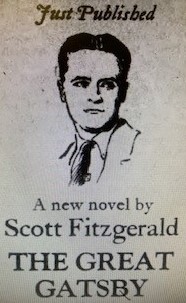
Things “Heard” in The Great Gatsby

In The Great Gatsby, F. Scott Fitzgerald cultivates a tension between an individual’s authenticity, the perception they project and the perception floated by others via rumor and gossip.  No means of deriving the truth about someone is presented as any more reliable, all convey elements of truth and falsehood.  Gatsby projects an image of himself that appears entirely constructed, but as Nick finds out, the construct itself and the motivation behind it reveal a lot about the authentic Jay Gatsby.     

Early in the story, characters discover truth and authenticity by believing what they “heard.”  When Nick goes to visit his cousin Daisy, she tells him, “We heard you were engaged to a girl out West.”  Nick quashes the rumor, but Daisy persists.  “But we heard it….We heard it from three people so it must be true.”  

In his thoughts, Nick sarcastically equates these rumors with an official notice of engagement, but maintains he won’t be “rumored into marriage.”  It’s an acknowledgement of the power of rumor and public perception to make things true that have virtually no basis in reality.  Gatsby himself wields this power to mesmerize and enchant Long Island society folk while trying to capture the object of his desire, Daisy.

Nick gets an earful of things heard from his hosts, Daisy and Tom, who lay bare the dysfunction present in their lives.  First Daisy fills him in on the “family secret” concerning the butler’s nose.  Then Nick is thrown off guard by Jordan’s prying into the secrets of Tom and Daisy’s marriage.  While Tom can be heard inside the house taking a call from his mistress, Jordan eavesdrops, leaning “forward, unashamed, trying to hear….’Don’t talk. I want to hear what happens,’” she says.  The whole scene culminates in an anxious and uncomfortable moment when the truth of what is known, the illusion of what is portrayed, and the confusion of rumor become entangled and loom over the party like a neurotic gloom. 

Regarding his meeting Jordan, Nick remembers he “had heard some story of her too, a critical, unpleasant story, but what it was I had forgotten long ago.”  This unpleasant story will shape the way Nick thinks of Jordan for the rest of their time together, preventing him from committing to her, even as he appears to fall for her.

In the next chapter, Tom invites Nick along to partake in his secret life, treating Nick’s inclusion like it’s the most natural thing in the world, and rendering the whole charade with Daisy and Jordan a mere fact of married life.  Like Gatsby, Tom maintains his own outward illusion, exhibiting a life of wealth, privilege and domesticity while concealing a tawdry affair with the mechanic’s wife and slumming it with her friends in the city.

Then there are the things people have heard about Gatsby, that he is a bootlegger and that he had once killed a man.  It becomes clear to Nick that among the elites of Long Island it is assumed that the image one puts forward is a false representation, and the real truth can be found in the rumors whispered at parties or laid out in scandal rags.  Few people are who they seem and Gatsby represents the biggest mystery of them all.  At some level, it is assumed by the inhabitants of this world that wealth can buy virtue, so the virtue put on display must constitute a fiction.  Gatsby represents a new force emerging in this society that holds a mirror up to the false virtue of the old world money elite and exposes it as a fiction.  His background as an outsider and an interloper reveals that all these old world social customs are just a pretense, a posturing the old money elites engage in to claim moral superiority over those who represent a threat to their status.

Gatsby at 100: “Romantic Readiness”

At the outset of The Great Gatsby, Nick Carraway reveals what he most admired about Jay Gatsby “was an extraordinary gift for hope, a romantic readiness such as I have never found in any other person….”  Of course, at many points during the course of the story, Gatsby’s romantic illusions are met with a mixture of disbelief and mild amusement by Nick.  Gatsby’s “gift for hope” and “romantic readiness” is seen as a character flaw, a naive hindrance to fitting in among the East’s leading elites.  Yet, time and again, Gatsby’s visions manifest themselves in ways that not only serve his purpose, but are met with great enthusiasm by those around him.  The people around Gatsby become willing players in the romantic drama he’s staging.  Nick, despite his momentary reservations, becomes the most willing participant of all, sticking with Gatsby until the end, even when others have fled or forgotten him.  In this way, the people who attend Gatsby’s parties, who inhabit his romantic illusion, are his own creation.  They, too, possess a sort of romantic readiness that finds its reality in the gayety and riotousness of the parties Gatsby throws and the thrilling mystery he represents.  They are drawn like moths to the light of his romantic vision, but soon disperse when that vision is extinguished.                      

According to Nick, Gatsby possesses “some heightened sensitivity to the promises of life….”  Gatsby is the embodiment of this emerging American trait.  The rules and norms of the old social order are on the decline.  It is no longer the case that a person is born into life circumstances and a social rank from which he cannot transcend.  Gatsby can dream a future and he can make it happen.  In order to win back the love of Daisy, Gatsby mimics the elites into whose orbit he has positioned himself.  But Gatsby’s production lacks authenticity.  It is, in many respects, an artificial representation of old money status and materialism.  Those who represent the old order, like Tom Buchanan, do not possess a “romantic readiness,” or a “sensitivity to the promises of life.”  They inhabit the pinnacle of life’s promise and are not dazzled by Gatsby’s flashy stage production.  Tom represents a cold, impenetrable reality in opposition to Gatsby’s grand, romantic aspirations, and he takes extreme diabolical pleasure in exposing the artifice of Jay Gatsby.

Halloween undergoes months of intense whiteboarding

On the eve of Halloween, a group of youngsters in Munster feel they are finally ready for the festivities to get underway after months of intense whiteboarding and strategizing.  

Topics of concern for the myriad whiteboard sessions included costume selection and preparation, neighborhood selection and route scouting, a comprehensive review of previous trick or treat experiences, and development of a candy rating system designed to maximize accumulation of the most desirable treats.

“We really whiteboarded the shit out this Halloween,” said ten-year-old Preston Metcalfe.  “Halloween only comes once a year, so our approach has been that we cannot afford to leave a single stone unturned when it comes to raking in a candy harvest that is second to none.  I mean, I need this Halloween booty to get me through until Christmas.”

Metcalfe explained that in the past too much time has been wasted in neighborhoods where there is low participation and trick or treaters are forced to cover too much distance between participating households.  So Metcalfe and his team identified five “hotzones” in town where they feel the candy is most plentiful and accessible.

Additionally, the team’s rating system has prioritized houses that have traditionally handed out the biggest and tastiest treats while downgrading dwellings that put an emphasis on healthy or eco-friendly snacks.  

“We spent months poring over data to come up with our map.  Additionally, we’ve already walked the route several times, identifying areas of concern and making appropriate adjustments.  If all goes well, this will be the most bountiful Halloween ever,” Metcalfe said.

Euros Back in a New York Groove

Much of the hype leading up to this year’s Ryder Cup at Bethpage Black Golf Course revolved around the challenge the visiting Euros faced playing in front of a hostile New York crowd.  While the New York fans did their best to get inside the heads of the Euros by heaping abuse on the players and their families, it did not produce the outcome they were looking for.  It did, however, produce a somewhat predictable outcome.  All of the rudeness, taunting, heckling and vulgarity did zero to throw the European players off their game and instead elicited some of the most inspired and exceptional play ever seen at a Ryder Cup event.

As an Indiana Pacers fan, I’ve witnessed this phenomenon many times before.  Whether we’re talking about the Reggie Miller era or the Tyrese Haliburton era, there’s no greater feeling than watching the New York faithful choke on their jeers and insults as their championship hopes go up in flames.  Even though the Pacers have yet to win it all, beating the Knicks and their fanbase year after year is a pretty awesome consolation prize.

The point is, all of the boorish and abusive behavior does nothing to throw a great player off his game.  Great players feed off it and get inspired by it.  They lock into states of concentration and focus seldom achieved under normal circumstances.  Say what you will about Justin Rose, but on Saturday the dude was dialed into Matrix level mental and physical performance, willing the improbable into certainty time and time again.  So, by the way, were his teammates, Tommy Fleetwood, John Rahm, Rory McIlroy and Shane Lowry.

This weekend, the European Ryder Cup team not only won the Ryder Cup but reaped the added bonus of sticking a golf cleat in the mouth of the vaunted New York fanbase.  To his credit, Shane Lowry didn’t give the “choke” sign to the abusive fans after sinking the winning putt, but rather reveled in the victory.  It was nice to see the pure joy of the moment pour out of Lowry and Euros.  They could have taunted the crowd, but instead opted for class and dignity.  Perhaps, in the future, some of the worst clowns in the gallery will do the same.

Parallel Parking Crisis

Among the many things we as a society should be concerned about regarding the younger generation is their inability to parallel park.  Student loan debt, AI, social isolation, mental health and a lack of affordable housing are all things young people are going to struggle with going forward.  But the chief indicator that these kids are not ready for the future is their inability to parallel park.  

As I sat on my front porch the other day, I witnessed the neighbor kid spend 20 minutes trying to parallel park his car.  I’m not sure who was more lame in this situation – the guy who struggled to park his car, or the old timer who had nothing better to do than watch the whole wretched scene unfold.  I fought mightily against the urge to run to his aid and impart my four decades of experience and wisdom.  No doubt, he would have welcomed the neighbor standing on the sidewalk, making hand signals and shouting instructions.  But this felt like a lesson he had to learn on his own.  In the end, he succeeded in getting the little Toyota in the space with only two wheels up on the sidewalk.

Helpful hint:  If you hit the curb with your rear wheel before you get a chance to cut the front end into the space, you’re fucked.  Pull out and start again.  You’re not going to succeed in forwarding and reversing into the space.  Unless your idea of success is parking halfway onto the sidewalk.  You have to start cutting the front end into the space when you still have at least six inches of space between the rear wheel and the curb.  Today’s back up cameras make this maneuver a little easier, but I’m old school, so I just use The Force. 

Sometimes when you’ve cut the front end halfway into the space and you feel like your rear wheel could hit the curb, you can make some midstream adjustments.  But this is some next level parallel parking and should only be attempted once you get the basics down.

I’m aware that a bad parallel parker has options.  Self-parking cars are already a thing, and I’ve even heard there’s an app that, for a small fee, sends out a distress signal to master level parallel parkers who will come park your car for you.  Most of these guys are Uber drivers and off-duty valets.  So, don’t despair, impress that special someone and learn how to parallel park. 

Morning of unrest at the doughnut shop

Serious grumblings nearly escalated into violence at the doughnut shop this morning over excruciating wait times to get served.  Witnesses report customers began to grow hostile after a series of large doughnut orders frustrated and enraged patrons waiting in line.

Tempers flared as yet another customer ordered enough doughnuts to feed a biker rally.

“Okay, I’m going to need eight dozen.  Give me two chocolate frosted, one with sprinkles.  I’ll take a cinnamon glazed, two double chocolate, one apple spice, two long johns…”

“With or without cream filling?” the doughnut lady asked.

“One with, one without.  Okay, where are we at?”

“Nine down, only 87 more to go.”

Patrons let out audible groans as they glanced at their watches, mindful of the time left before the start of work.  The next customer in line stepped up to the counter. 

“How many please?” the attendant asked.

“I’m going to need an even dozen dozen.”

A chorus of protestations and curses went up from the waiting throng.

“For the love of God, man.  Are you trying to feed every police and fire station in the county?” someone shouted.

Trying to be helpful, a man at the back of the line calmly asked the doughnut lady if they might open an express lane for people ordering 12 doughnuts or less.  The request fell of deaf ears.

“Please, sir.  Please think of my children,” a mother implored the gentleman ordering 144 doughnuts.  “Their energy level is quite diminished and they need a chocolate frosted with sprinkles before they go to school.  Could you please find it in your heart to stand aside for a moment and let them be served?”  

“Fat chance!” the man grumbled.

After several more gargantuan orders, it became apparent that the stacks of trays that once contained a seemingly limitless number of doughnuts, rolls, and fluffy pastry now appeared mostly sparse.  Panic set in as the realization hit that the day’s supply of doughnuts was close to running out.  A number of patrons raced for the door, desperate to get to the next doughnut shop.  Others pushed to the front of the line shouting out their last orders.  

“Please, I just need a twister!”

Then the doughnut lady, who had been toiling since 2:00 in the morning, thanked her customers and closed up shop having sold all her doughnuts before 9:00 a.m.

Bookstore (No Books)

Recently the fam and I spent the weekend back in my old college town.  Despite the fact that my  wife and kids love it when dad shows them his old haunts and regales them with stories of his college days, I found myself alone again while the family unit was off making candles.  

With football season right around the corner, and me still rocking fashion from a previous millennium, it felt like I was due for an update to my university athletic apparel.  Pretty much every retailer close to campus sells it, but I thought in order to get the real goods maybe I should visit the campus bookstore for the officially licensed merch.  Despite having three floors of t-shirts, hats, hoodies, sweats, jerseys, golf apparel, banners and bedding, nothing really stood out as a must have, so I decided to stick with my crummy old outdated shirts and sweat stained ball caps and left the bookstore empty handed.  

However, after walking for about ten minutes, reflecting on how much the bookstore had changed in the last thirty years, it dawned on me that the university bookstore didn’t contain any books.  In the olden days, the lowest level was entirely devoted to stocking texts for the current semester, while the upper levels featured merch and apparel.  Now, the whole place was a massive gift shop superstore, yet they still called it a bookstore.

So where the hell do students get their books these days if not the campus bookstore?  Do they even use books?  When was the last time I saw a kid with a book in his hands?  After all, that would necessitate prying the smartphone from fingers palsied by a constant and unrelenting grip on a smart device.  “From my cold dead hands,” is the response I got last time I attempted to extract a smartphone from a young person. 

Clearly, they have no need for books.  They probably just sit down in class and the professor says, “Okay, class, open the internet to page blah, blah, blah,” and they go from there.  Of course these days even looking stuff up on the internet has become so much of an imposition that we now have several versions of artificial impersonators that will do the research for us, summarize findings, and even produce scholarly works. 

I know, there he goes again, the old man yelling at technology.  Fact is, they probably download class materials onto tablets and computers, and it undoubtedly costs them a small fortune, as it always has.  

Anyway, I could get to the bottom of this Bookstore (No Books) situation simply by asking a powerful computer brain for help, but I’d rather just ask a student when I get a chance.  As for the brainiacs down there at the University of Science Bookstore, you probably ought to think about changing the name to Gift Shop.

Artificial Impersonators

Used to be you’d turn on the old boob tube and watch some comedian like Rich Little, Dana Carvey or Darrell Hammond do impressions of famous figures that were so spot on they sounded like the real thing.  Only they obviously weren’t because the voice was clearly coming out of a different person and the content was entirely farcical.  

Recently, I was consuming content on the internet’s most prominent boob tube channel when I realized I was being taken for a ride by one of its artificial impersonators.  I’ve been watching Bishop Robert Barron’s channel since way back when he was only Father Barron and his content featured movie reviews in which he’d insert some relevant christian theology.  The other day I’m listening to one of his messages on a channel I’d never heard of before when I became curious about the YouTube account and the channel’s background.  The thumbnail featured Bishop Barron’s image and the audio sounded like a message or sermon he’d possibly recorded privately or perhaps spoken publicly at some time or another.  Here’s a direct quote from the video’s description:

“In this 21-minute morning message, Bishop Robert Barron reflects on the power of morning prayer, gratitude, and surrender to God’s plan.

“Through Scripture, prayer, and reflection, Bishop Barron reminds us that when we start our day with thankfulness and intention, we align our hearts with divine peace and purpose.”

I immediately wondered if this channel represented some new offering from Bishop Barron’s Word on Fire Ministries, so I read on.  After scrolling through chapter titles, hashtags and descriptions of what I would learn from “Bishop Robert Barron’s Catholic insights,” I finally arrived at this disclaimer:

“This message includes public theological reflections and prayers inspired by Bishop Robert Barron.”

Because I’m not super bright, and I’m old and not very clever when it comes to the ways of technology, the internet and social media, I still did not get the hint.  

The message included “public theological reflections and prayers.”  So, Bishop Barron spoke these words publicly and someone recorded it and here it is, right?

If, at that moment, someone would have smacked me upside the head and said, “Do I need to spell it out for you?” I would have deserved it.  Instead, there is this:

“Altered or synthetic content:  Sound or visuals were significantly edited or digitally generated.”

As much as I wanted to believe that I hadn’t been duped by an artificial impersonator, it became abundantly clear that I had.  Apparently, many others had been as well, because there were lots of comments thanking Bishop Barron for the message.

The channel is called “The Divine Motivation,” it’s on YouTube and it’s fake.  It is not Bishop Barron, and it doesn’t matter if it has some ambiguous disclaimer buried deep within the show notes, it is deliberately deceptive.  Some additional searching immediately revealed two other artificial impersonator channels:  “Bishop Barron’s Motivations” and “The Faith Journey.”  

I know I sound like an old man yelling at technology.  I can imagine someone countering, “Where have you been, old timer?  This is the world we live in.”  Fair enough.  But this old man can’t abide while dull-witted content creators harness technology to impersonate authentic, exceptional, thoughtful and inspiring human beings.  

Using someone else’s name, likeness and voice to create artificial messages without being upfront about it is massively deceptive.  And you can never motivate, inspire, reveal truth or instill hope through fakery and deceit.

Terror In The Shrubbery

Jack Hayward is reeling today following a report by his insurance company that his landscaping presents a clear and present danger to his home and property. 

Up until today, Jack thought he was pretty much crushing it, and then in one brief moment his whole life was turned upside down when a group of insurance underwriters informed him that among his shrubbery lurk heretofore unimagined terrors. 

Apparently, a seemingly innocent shrub, situated under a window, can serve as a launching pad for a criminal caper that could potentially undo everything Jack’s ever worked for. 

While it’s true that neighborhood kids like to utilize his shrubs to hide and seek, and on at least one occasion some homeless person may have spent the night curled up behind his lilac bush, it never occurred to Jack that shrubs are especially useful for concealing nefarious deeds. 

Nevermind the alarm system and security cameras Jack installed to thwart potential break ins, an accomplished second story man can utilize a pyramidal arb to launch himself like a pole vaulter onto a lower roof and quickly gain access to upper story windows. 

Apparently, the thieves take advantage of the shrub cover to cart off your 55 inch television and exercise equipment, because the whole point of the danger shrubs pose is that the bad guys can do all this without attracting the attention of neighbors or passersby.

A skilled burglar disguised as a juniper bush can enter and exit a house undetected by cloaking stolen merchandise in bush clippings.   

Tree limbs, too, are nothing to trifle with, according to the underwriters. A tree limb, it seems, is nothing more than a bony hand reaching out to dismantle a house one shingle at a time. 

One never knows when an angry oak will lower a wooden fist and severely scratch or dent one’s guttering.  

The news filled Jack with such revulsion and dread that he immediately climbed out on his roof and stood atop the peak risking life and limb in an attempt to prune away all tree limbs encroaching on his home’s airspace.  

With bushes yanked and tree limbs tamed, Jack was finally able to rest easy, at least until the next alert of impending catastrophe comes along.

Speculation grows that Ludvig Åberg is a simulation

Fresh off a victory at the Genesis Invitational, Ludvig Åberg appeared to really step into his element on Monday night when he helped guide The Bay GC to two victories in TGL golf action.

While he ranks among the best in the world on traditional golf courses, his ability to interface with TGL’s massive, high-tech simulator has left some scratching their heads in wonder.

Stepping into the simulator, the young Swede appears to benefit from a strange symbiotic relationship with the highly advanced tech.  His play is so close to perfection that some wonder if his kinship with the virtual golf format extends beyond someone who merely possesses game.

Case in point: Åberg squared off against Rory McIlroy in the singles portion of Monday night’s competition.  McIlroy, who is no slouch with a driver in his hand, executed what appeared to be an excellent drive, which sailed down the middle and landed in the fairway’s “speed slot,” enabling the ball to roll out for some extra distance.  

However, Åberg casually executed the drive to even greater perfection by catching the speed slot even further down the fairway, permitting the ball to roll so far that Åberg had time to stroll over to the sideline, put his club away, and update his Instagram before the ball finally came to rest.  At nearly 400 yards and the longest in TGL’s brief history, it made McIlroy’s effort look like that of a junior golfer.  

In the two holes in which they faced off against each other, McIlroy looked thoroughly human as he summoned all his talent and skill to throw at the super Swede.  For Åberg’s part, he appeared unfazed and played like he was running an algorithm orders of magnitude greater than anything McIlroy could muster. 

Throughout the night, Åberg was an AI supersoldier throwing darts and draining putts.  He nearly recorded TGL’s first hole in one.  If Åberg isn’t already a product of the simulation, he may merge with it soon.