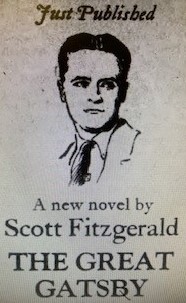
Things “Heard” in The Great Gatsby

In The Great Gatsby, F. Scott Fitzgerald cultivates a tension between an individual’s authenticity, the perception they project and the perception floated by others via rumor and gossip.  No means of deriving the truth about someone is presented as any more reliable, all convey elements of truth and falsehood.  Gatsby projects an image of himself that appears entirely constructed, but as Nick finds out, the construct itself and the motivation behind it reveal a lot about the authentic Jay Gatsby.     

Early in the story, characters discover truth and authenticity by believing what they “heard.”  When Nick goes to visit his cousin Daisy, she tells him, “We heard you were engaged to a girl out West.”  Nick quashes the rumor, but Daisy persists.  “But we heard it….We heard it from three people so it must be true.”  

In his thoughts, Nick sarcastically equates these rumors with an official notice of engagement, but maintains he won’t be “rumored into marriage.”  It’s an acknowledgement of the power of rumor and public perception to make things true that have virtually no basis in reality.  Gatsby himself wields this power to mesmerize and enchant Long Island society folk while trying to capture the object of his desire, Daisy.

Nick gets an earful of things heard from his hosts, Daisy and Tom, who lay bare the dysfunction present in their lives.  First Daisy fills him in on the “family secret” concerning the butler’s nose.  Then Nick is thrown off guard by Jordan’s prying into the secrets of Tom and Daisy’s marriage.  While Tom can be heard inside the house taking a call from his mistress, Jordan eavesdrops, leaning “forward, unashamed, trying to hear….’Don’t talk. I want to hear what happens,’” she says.  The whole scene culminates in an anxious and uncomfortable moment when the truth of what is known, the illusion of what is portrayed, and the confusion of rumor become entangled and loom over the party like a neurotic gloom. 

Regarding his meeting Jordan, Nick remembers he “had heard some story of her too, a critical, unpleasant story, but what it was I had forgotten long ago.”  This unpleasant story will shape the way Nick thinks of Jordan for the rest of their time together, preventing him from committing to her, even as he appears to fall for her.

In the next chapter, Tom invites Nick along to partake in his secret life, treating Nick’s inclusion like it’s the most natural thing in the world, and rendering the whole charade with Daisy and Jordan a mere fact of married life.  Like Gatsby, Tom maintains his own outward illusion, exhibiting a life of wealth, privilege and domesticity while concealing a tawdry affair with the mechanic’s wife and slumming it with her friends in the city.

Then there are the things people have heard about Gatsby, that he is a bootlegger and that he had once killed a man.  It becomes clear to Nick that among the elites of Long Island it is assumed that the image one puts forward is a false representation, and the real truth can be found in the rumors whispered at parties or laid out in scandal rags.  Few people are who they seem and Gatsby represents the biggest mystery of them all.  At some level, it is assumed by the inhabitants of this world that wealth can buy virtue, so the virtue put on display must constitute a fiction.  Gatsby represents a new force emerging in this society that holds a mirror up to the false virtue of the old world money elite and exposes it as a fiction.  His background as an outsider and an interloper reveals that all these old world social customs are just a pretense, a posturing the old money elites engage in to claim moral superiority over those who represent a threat to their status.

Shadow of the Bridge cuts through the true crime clutter

As a true crime consumer, it is easy sometimes to get so wrapped up in an ongoing case that you can lose your way in a maze of possible suspects or avenues of investigation that often lead nowhere.  Then, of course, there are the crackpot conspiracy theories that, if indulged, can draw your ass into a wilderness of mirrors from which you may never find your way back to the known facts and circumstances of the case.  The longer the case goes on and the more information accumulates, it can be difficult to separate relevant facts from useless distractions, until your mind becomes like the house of a hoarder, hanging onto every little scrap in case you need it at some point.

One great thing about Aine Cain and Kevin Greenlee’s new book, Shadow of the Bridge:  The Delphi Murders and the Dark Side of the American Heartland, is the way it removes the accumulated clutter of eight years, takes you back to a time before the nightmare started and tells the story based only on what is true, verifiable and relevant.

The authors do an exceptional job opening the book in the Delphi that existed before it became the focus of so much media and public attention.  They offer a description of the Monon High Bridge and its place in the community before it became part of a crime scene and a symbol of terror and dread.  Cain and Greenlee then turn their focus to Abigail, Liberty and their families, skillfully and respectfully portraying their lives as they existed before tragedy struck.  It is a credit to the authors that the reader experiences a sense of what these families and communities lost when these two young girls were taken from them.  As you’re drawn into the lives of Abigail and Liberty, it is impossible not to feel heartbroken for them, knowing the horror that awaits these two innocent children of Delphi.

All this is to say, for anyone who has followed this case closely, it is extremely useful, instructive and a little therapeutic to permit the authors to clean the slate or remove whatever true crime or conspiracy corkboard you may have mounted in your brain and let them lay out the relevant testimony and facts.  Their presentation is clear, methodical and precise, focused squarely on people and events surrounding the crime, investigation and trial.  

Everyone who cares about this case should read this book.  Then if you’re inclined to return to your internet beefs, creator rivalries, left-field theories and true crime cat fights, you’re free to do so, and the rest of us will know that’s all you ever really cared about.

Bookstore (No Books)

Recently the fam and I spent the weekend back in my old college town.  Despite the fact that my  wife and kids love it when dad shows them his old haunts and regales them with stories of his college days, I found myself alone again while the family unit was off making candles.  

With football season right around the corner, and me still rocking fashion from a previous millennium, it felt like I was due for an update to my university athletic apparel.  Pretty much every retailer close to campus sells it, but I thought in order to get the real goods maybe I should visit the campus bookstore for the officially licensed merch.  Despite having three floors of t-shirts, hats, hoodies, sweats, jerseys, golf apparel, banners and bedding, nothing really stood out as a must have, so I decided to stick with my crummy old outdated shirts and sweat stained ball caps and left the bookstore empty handed.  

However, after walking for about ten minutes, reflecting on how much the bookstore had changed in the last thirty years, it dawned on me that the university bookstore didn’t contain any books.  In the olden days, the lowest level was entirely devoted to stocking texts for the current semester, while the upper levels featured merch and apparel.  Now, the whole place was a massive gift shop superstore, yet they still called it a bookstore.

So where the hell do students get their books these days if not the campus bookstore?  Do they even use books?  When was the last time I saw a kid with a book in his hands?  After all, that would necessitate prying the smartphone from fingers palsied by a constant and unrelenting grip on a smart device.  “From my cold dead hands,” is the response I got last time I attempted to extract a smartphone from a young person. 

Clearly, they have no need for books.  They probably just sit down in class and the professor says, “Okay, class, open the internet to page blah, blah, blah,” and they go from there.  Of course these days even looking stuff up on the internet has become so much of an imposition that we now have several versions of artificial impersonators that will do the research for us, summarize findings, and even produce scholarly works. 

I know, there he goes again, the old man yelling at technology.  Fact is, they probably download class materials onto tablets and computers, and it undoubtedly costs them a small fortune, as it always has.  

Anyway, I could get to the bottom of this Bookstore (No Books) situation simply by asking a powerful computer brain for help, but I’d rather just ask a student when I get a chance.  As for the brainiacs down there at the University of Science Bookstore, you probably ought to think about changing the name to Gift Shop.

True Crime Fiction

I recently finished Broadway Butterfly by Sara DiVello.  The novel tells the true story of the 1923 murder of Broadway flapper Anna Marie Keenan, aka Dot King, and the corrupt police investigation that followed.  While the crime remains officially unsolved, at least one character in the story stands out as the probable killer, with other prominent figures implicated in the cover up if not the actual crime itself.  As someone who has done a fair amount of research into Broadway crimes of the 1920s, I’m familiar with this case and the murders of other Broadway flappers of the era.  Sara DiVello does a masterful job of bringing the characters and the setting to life.  The story is compelling enough when experienced through the lens of old newspaper accounts, but DiVello’s storytelling animates the setting and brings a depth to the characters that is seldom found in most true crime novels.

The work is marketed as true crime fiction, but DiVello poured an enormous amount of research into the story.  She spent nearly ten years assembling 1700 pieces of research that she weaves into the tale.  It is a fascinating story and she provides a complete picture of the facts and circumstances surrounding the case.  The fiction comes in when she imagines moments of private conversations that took place behind closed doors, or when she sets out the interior thoughts of the four main characters on whom the novel is focused.  While there is no way she could know everything that was said or thought by these characters, the extensive research so thoroughly backs up what is written that it becomes entirely believable that these conversations could have taken place.  

As a work of true crime fiction, all the facts are expertly assembled, and the fiction layer makes the work three dimensional, keeping the narrative moving along and the pages turning.  The fiction elements animate the characters and show them wrestling with internal conflicts that undoubtedly would have troubled them as the investigation proceeded.  This adds a layer of drama that a reader is generally not going to get from a nonfiction or journalistic approach.

However, after finishing this true crime novel, I’m left wondering, what is the difference between true crime fiction and creative nonfiction?  As a work of creative nonfiction, Dean Jobb’s A Gentleman And A Thief has come in for some criticism from this blog.  Jobb flatly asserts in his note to readers that he is presenting facts, that “all scenes and events unfolded as described,” and “an essential element of true crime, after all, is truth.”  But, as I’ve shown in previous posts, he has taken some pretty big liberties with the truth.  At best, he’s providing a version of the truth flowing from conman and thief, Arthur Barry.  At worst, he’s making a deliberate choice to ignore the facts as reported by much more reliable sources whose job it is to present the truth.  Why does Jobb get to hang a nonfiction label on his product, while DiVello’s work, which is much more thoroughly and painstakingly researched, comes in as a work of fiction?

Jobb’s approach misleads readers.  In one instance, he asserts that Noel Scaffa knowingly lies to the police on behalf of Arthur Barry regarding an alleged exchange of cash for stolen jewelry.  Setting aside the problem of taking the word of a thief and conman over that of a private investigator, where does Jobb get off portraying Scaffa as a liar without providing a shred of proof of Scaffa’s deception?  Presenting a work as nonfiction ought to require a good faith rendering of all relevant versions of the events you’re attempting to portray.  If you’re choosing to exclude relevant information or mislead the reader in order to shape a narrative, then you’re not writing nonfiction.  It’s pretty ironic that DiVello’s work of true crime fiction comes off as more truthful and honest than Jobb’s alleged work of creative nonfiction.

A small but jolly gathering

In September of 1924, Edward, the Prince of Wales, made a much publicized visit to the United States.  To call it “much publicized,” however, fails to adequately describe the media frenzy that accompanied his visit.  The press hounded Wales mercilessly, reporting on his every movement: where he dined, where he danced, where he played, how long he slept, when he rose.  The press of the day literally tried to account for every moment of his time on American soil.  

While in the states, Wales spent almost the entirety of his visit among the American aristocracy of Long Island, New York.  Most nights, Wales and his entourage, which included the Lord and Lady Mountbatten and Mrs. Richard Norton, were entertained at some lavish Long Island affair where they danced and partied until the wee hours of the morning.  

One of these luxurious all-nighters took place at the estate of Joshua S. Cosden, a prosperous oil man who rose from very humble beginnings to become one of the richest men in America.  It is this party that plays a prominent role in the forthcoming Dean Jobb true crime book, A Gentleman And A Thief.  The book tracks the life and criminal endeavors of jazz age gentleman jewel thief Arthur Barry, who Jobb credits as the chief culprit behind the Cosden jewel robbery, which occurred during the royal visit of 1924.  

In addition to being a critically acclaimed true crime author, Jobb is a professor emeritus at the University of King’s College where he specializes in creative nonfiction.  Indeed, Jobb describes his true crime books as works of creative nonfiction, meaning he’s sticking to the facts, but utilizing a creative narrative-driven presentation.

Although Gentleman And A Thief doesn’t officially release until next month, the prologue of the book is available for sampling on Amazon’s website.  The narrative dives straight into the Cosden party and Arthur Barry’s alleged presence there.  According to Jobb, “It was there, in the midst of what one press report termed a ‘small but jolly’ gathering, that Gibson (Arthur Barry) met the prince.”  Jobb’s prologue also describes in some detail Wales’ alleged surreptitious late night journey to a couple of notable Manhattan speakeasies.  Whether or not these events actually took place at all, and that point is definitely up for debate, one thing for certain is the events could not have taken place as Jobb describes them.

The Cosden party Jobb describes took place during the late night hours of Wednesday, September 3, 1924 into the early morning hours of September 4.  The Thursday, September 4 edition of the Brooklyn Daily Eagle reports, “Last night the Prince shared honors with polo players of both the British and American international teams at a stag dinner given for them at the Piping Rock Club at Locust Valley.”  Will Rogers entertained the group with a 20 minute monologue, and according to the Daily Eagle account, “After the dinner the Prince left for a dance.”  Earlier in the article it read, “It was another dancing party which kept Wales out all night, this time at the home of Mr. and Mrs. J. S. Cosden at Sands Point.  The party was a small but jolly one.  Other guests included Lord and Lady Mountbatten, Lord and Lady Milhaven and the Hon. Mrs. Richard Norton.”

This “small but jolly” account of the Cosden party got picked up by the Associated Press and appeared in newspapers across the country.  The problem with Dean Jobb’s depiction of that night is that not only did Wales not leave the party with Arthur Barry, but Wales’ alleged secret excursion into Manhattan nightlife took place the following evening. 

Popular journalist of the day Grace Robinson wrote on September 4:  “Before inspecting his third Long Island sunrise from the Cosden Manor, the prince had been with the Piping Rock Club at a gay stag….After the stag, the prince went to the Cosdens where he danced until morning.  And along went Lord and Lady Mountbatten, Lord and Lady Milford Haven and the rest of the who’s who.”  This account is interesting because years later it will be Grace Robinson pushing the Arthur Barry story that he left the Cosden party with the prince.

So contemporary accounts of the “small but jolly” Cosden party make no mention of the Prince slipping away.  That’s because Wales’ alleged foray into Manhattan occurred the following evening.  On Friday, September 5, 1924, the newspapers were buzzing with speculation over the whereabouts of Wales between 2:00 to 5:00 Thursday afternoon September 4 and the early morning hours of Friday, September 5.  Rumors start flying about Wales’ possible attendance at the El Fey Club 107 West 45th street, Manhattan, because a car bearing a license plate traced back to the Burden estate, where Wales was lodged, was seen near the club in the early morning hours of Friday, September 5.  Despite denials by the club owner and the prince’s spokesperson that his grace had not graced the club’s premises, rumors persisted.  

Jobb quotes a newspaper account which read, “he went in disguise to one of the white light jazz palaces on Broadway.”  This account appears in Friday, September 5 newspaper editions, speculating as to the Prince’s whereabouts the previous evening into early morning.  It concerns a time period a full 24 hours after the Cosden party where Arthur Barry, alias Dr. Gibson, allegedly lured Wales away to the “White Light Belt.” 

Whether or not Wales pulled a Manhattan Holiday and stealthily eluded the press and his handlers to bask in the white light of Broadway was unclear at the time and remains unclear today.  However, what is clear is that the account depicted in Jobb’s book could not have happened the way he described it.  Maybe there was some other Cosden party that Arthur Barry lured His Royal Highness away from, but it wasn’t the “small but jolly” one.  

If it can be shown that I’m confusing my dates, I’ll be happy to admit my error.  However, it seems pretty clear that the specific events Jobb references did not take place on the same night.  At any rate, I’m looking forward to reading the rest of Jobb’s book.  The Cosden case and other area gem thefts have been of great interest to me for quite some time, and I’m anxious to learn what else Jobb has uncovered.