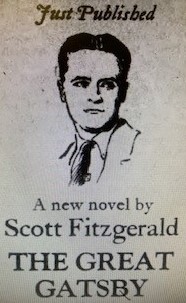
Gatsby the creator

Throughout The Great Gatsby, Jay Gatsby is presented as something of an artist or creator.  Like the many musicians, actors and stage performers who attend his parties, Gatsby himself aspires to give life to his imaginings, not for the stage or the screen, but to bring the humble reality of his life into accord with the audacity of his dreams.

At Nick’s first Gatsby party, he observes a solitary Gatsby, in the midst of unbridled gayety, taking in his creation:        

“The nature of Mr. Tostoff’s composition eluded me, because just as it began my eyes fell on Gatsby, standing alone on the marble steps and looking from one group to another with approving eyes…I wondered if the fact that he was not drinking helped to set him off from his guests, for it seemed to to me that he grew more correct as the fraternal hilarity increased….When the “Jazz History of the World” was over girls were putting their heads on men’s shoulder in a puppyish, convivial way, girls were swooning backward playfully into men’s arms, even into groups knowing that someone would arrest their falls – but no one swooned backward on Gatsby and no French bob touched Gatsby’s shoulder and no singing quartets were formed with Gatsby’s head for one link.” (p.55) 

Gatsby stands apart from his creation, controlled and observing.  The scene meets his approval because it is a scene meant to seduce Daisy in the manner it has enraptured so many of his party guests.  No doubt Gatsby has dreamt this moment hundreds of times and now it has spilled forth from his imagination into reality.

At the second party, Gatsby is once again presented as a figure who can conjure a scene and make material that which inhabits his thoughts.  In this instance, however, Gatsby not only makes manifest the products of his own imagination, but he renders real the ‘ghosts’ of his guests’ imaginations as well.  

Showing Tom and Daisy around the party Gatsby points out figures they might find familiar:

“‘You must see the faces of many people you’ve heard about….Perhaps you know that lady.’  Gatsby indicated a gorgeous, scarcely human orchid of a woman who sat in state under a white plum tree.  Tom and Daisy stared, with that peculiarly unreal feeling that accompanies the recognition of a hitherto ghostly celebrity of the movies.” (p. 111)

Here Gatsby, like an artist, not only connects others to his dreams, but reaches into their consciousness and pulls apparitions out of their imaginations as well.  He makes these scenes real for his party guests, but they retain an aspect of unreality, appearing transitory, like spectral projections of their imaginations. 

“Almost the last thing I remember was standing with Daisy and watching the moving picture director and his Star.  They were still under the white plum tree and their faces were touching except for a pale thin ray of moonlight between.  It occurred to me that he had been very slowly bending toward her all evening to attain this proximity, and even while I watched I saw him stoop one ultimate degree and kiss at her cheek.” (p. 113)

Gatsby’s parties evoke the magic and romanticism stored in the hearts of his guests.  Everything about him and his world is an act of creation and retains an aura of artificiality intended to inspire awe and give life to his longings and the desires of those who surround him.  He lulls those around him into an “aesthetic contemplation” and creates for them “something commensurate” with their “capacity for wonder.” (p. 189)

Dean Jobb continues to promote a false true crime narrative

In a recent interview with the Crime Writers of Canada podcast, Dean Jobb, author of A Gentleman and a Thief, doubles down on his contention that jazz-age jewel thief, Arthur Barry, crashed a Long Island cocktail party in 1924, befriended the Prince of Wales, and whisked his new royal pal off on a secret tour of Broadway speakeasies.  

The claim strains credulity, but Jobb provides the following defense:  

“I lead off with him (Arthur Barry) meeting the Prince of Wales, the future Edward the VIII, who was visiting Long Island in the twenties.  Barry crashes a party, because there were a whole bunch of Long Island parties for the prince and his entourage, and ends up meeting the prince, takes him on a clandestine tour of the bright lights of Broadway and the speakeasies.  

“I mean, a writer has to go, really?  Did this really happen?  Well, start digging into reporters.  I find memoirs or memories of reporters who covered the story, who vouch for it, who did their homework.  The coverage makes it clear that the prince disappeared right at the time Barry says he was doing this.  So, it’s a matter of digging as deeply as you need to in the record to verify for your own peace of mind.  But you owe it to the reader, and if you’re not sure, you tell the reader that.”

As I’ve shown in previous blog posts, all the contemporary newspaper accounts of the party Jobb describes have the Prince of Wales dancing at the Cosden estate until dawn and returning to the Burden estate that morning.  None mention Wales slipping away from the party to experience the nightlife of Broadway.  

Rather than belabor that point here, I’ll address the following contention:  “The coverage makes it clear that the prince disappeared right at the time Barry says he was doing this.”  The “coverage” Jobb refers to involves an episode that occurred the night following the Cosden party.  The “small but jolly” Cosden gathering described in Jobb’s book began late in the evening of Wednesday, September 3, 1924 and continued through the early morning hours of Thursday, September 4.  The period of time when Wales went missing began in the afternoon or early evening of Thursday, September 4 and continued until the next morning, Friday, September 5.

Here is the passage Jobb quotes from to show “that the prince disappeared right at the time Barry says he was doing this.”  The article was penned Thursday night, September 4, one night later than the night of the Cosden party, and appeared in the following morning’s Buffalo Courier.

“The whereabouts of the Prince of Wales were shrouded in mystery tonight.  At midnight he had not returned to the Burden estate where he is stopping.

“He had dinner at the home of J.S. Cosden…It was reported that he left the Cosden home shortly after dinner, but since that time he has been playing a game of hide and seek with those who sought to check his movements.

“Some believe he went for a boat ride up Long Island Sound, others say he attended an all-night dance party at some nearby home, but others believe he went in disguise to one of the white light jazz palaces on Broadway.”

Not only does this passage describe a different night from that of the late-night Cosden party, it describes a completely different set of events.  Wales had dinner at the Cosden home and he left, possibly by boat, and either went to a party or to check out the white light jazz palaces of Broadway.  He’s not fleeing a late night party, he’s leaving after having dinner.  How does Jobb not recognize that these are not only separate dates but separate events as well?  

While the order of events may seem a little confusing to someone unfamiliar with the Prince’s 1924 visit, it isn’t to someone who has casually researched the topic, and it shouldn’t be confusing to someone who has researched and written a work of nonfiction where an alleged encounter between Arthur Barry and the Prince of Wales plays a central role.

The prince’s movements over the 24 hours in question go something like this:  Wales attends a late night party at the Cosden estate and dances until dawn.  He then returns to the Burden estate and sleeps until around noon.  Then he goes to the polo fields for the afternoon.  Sometime in the late afternoon, he returns to the Cosden estate where he either plays golf or takes a stroll around the Cosden’s nine hole golf course.  Then he eats dinner, hops in a motorboat, and disappears off into the Long Island Sound.  From there his whereabouts are unknown for the next 12-24 hours. 

These events are widely covered by the newspapers of the day.  Here’s a question the New York Daily News posed regarding the prince’s missing hours:

“What the folk down Long Island way wanted to know was where the prince passed the time from 2 p.m. Thursday until his reappearance yesterday.”

Does that sound like Wales stole away from a late night party with a stranger he just met, or does it make more sense that he went missing the following afternoon?  How does Jobb miss that unless he’s intentionally taken the route of ignoring the truth and printing the legend?