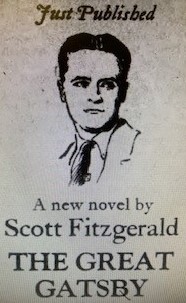
Things “Heard” in The Great Gatsby

In The Great Gatsby, F. Scott Fitzgerald cultivates a tension between an individual’s authenticity, the perception they project and the perception floated by others via rumor and gossip.  No means of deriving the truth about someone is presented as any more reliable, all convey elements of truth and falsehood.  Gatsby projects an image of himself that appears entirely constructed, but as Nick finds out, the construct itself and the motivation behind it reveal a lot about the authentic Jay Gatsby.     

Early in the story, characters discover truth and authenticity by believing what they “heard.”  When Nick goes to visit his cousin Daisy, she tells him, “We heard you were engaged to a girl out West.”  Nick quashes the rumor, but Daisy persists.  “But we heard it….We heard it from three people so it must be true.”  

In his thoughts, Nick sarcastically equates these rumors with an official notice of engagement, but maintains he won’t be “rumored into marriage.”  It’s an acknowledgement of the power of rumor and public perception to make things true that have virtually no basis in reality.  Gatsby himself wields this power to mesmerize and enchant Long Island society folk while trying to capture the object of his desire, Daisy.

Nick gets an earful of things heard from his hosts, Daisy and Tom, who lay bare the dysfunction present in their lives.  First Daisy fills him in on the “family secret” concerning the butler’s nose.  Then Nick is thrown off guard by Jordan’s prying into the secrets of Tom and Daisy’s marriage.  While Tom can be heard inside the house taking a call from his mistress, Jordan eavesdrops, leaning “forward, unashamed, trying to hear….’Don’t talk. I want to hear what happens,’” she says.  The whole scene culminates in an anxious and uncomfortable moment when the truth of what is known, the illusion of what is portrayed, and the confusion of rumor become entangled and loom over the party like a neurotic gloom. 

Regarding his meeting Jordan, Nick remembers he “had heard some story of her too, a critical, unpleasant story, but what it was I had forgotten long ago.”  This unpleasant story will shape the way Nick thinks of Jordan for the rest of their time together, preventing him from committing to her, even as he appears to fall for her.

In the next chapter, Tom invites Nick along to partake in his secret life, treating Nick’s inclusion like it’s the most natural thing in the world, and rendering the whole charade with Daisy and Jordan a mere fact of married life.  Like Gatsby, Tom maintains his own outward illusion, exhibiting a life of wealth, privilege and domesticity while concealing a tawdry affair with the mechanic’s wife and slumming it with her friends in the city.

Then there are the things people have heard about Gatsby, that he is a bootlegger and that he had once killed a man.  It becomes clear to Nick that among the elites of Long Island it is assumed that the image one puts forward is a false representation, and the real truth can be found in the rumors whispered at parties or laid out in scandal rags.  Few people are who they seem and Gatsby represents the biggest mystery of them all.  At some level, it is assumed by the inhabitants of this world that wealth can buy virtue, so the virtue put on display must constitute a fiction.  Gatsby represents a new force emerging in this society that holds a mirror up to the false virtue of the old world money elite and exposes it as a fiction.  His background as an outsider and an interloper reveals that all these old world social customs are just a pretense, a posturing the old money elites engage in to claim moral superiority over those who represent a threat to their status.

Gatsby at 100: “Romantic Readiness”

At the outset of The Great Gatsby, Nick Carraway reveals what he most admired about Jay Gatsby “was an extraordinary gift for hope, a romantic readiness such as I have never found in any other person….”  Of course, at many points during the course of the story, Gatsby’s romantic illusions are met with a mixture of disbelief and mild amusement by Nick.  Gatsby’s “gift for hope” and “romantic readiness” is seen as a character flaw, a naive hindrance to fitting in among the East’s leading elites.  Yet, time and again, Gatsby’s visions manifest themselves in ways that not only serve his purpose, but are met with great enthusiasm by those around him.  The people around Gatsby become willing players in the romantic drama he’s staging.  Nick, despite his momentary reservations, becomes the most willing participant of all, sticking with Gatsby until the end, even when others have fled or forgotten him.  In this way, the people who attend Gatsby’s parties, who inhabit his romantic illusion, are his own creation.  They, too, possess a sort of romantic readiness that finds its reality in the gayety and riotousness of the parties Gatsby throws and the thrilling mystery he represents.  They are drawn like moths to the light of his romantic vision, but soon disperse when that vision is extinguished.                      

According to Nick, Gatsby possesses “some heightened sensitivity to the promises of life….”  Gatsby is the embodiment of this emerging American trait.  The rules and norms of the old social order are on the decline.  It is no longer the case that a person is born into life circumstances and a social rank from which he cannot transcend.  Gatsby can dream a future and he can make it happen.  In order to win back the love of Daisy, Gatsby mimics the elites into whose orbit he has positioned himself.  But Gatsby’s production lacks authenticity.  It is, in many respects, an artificial representation of old money status and materialism.  Those who represent the old order, like Tom Buchanan, do not possess a “romantic readiness,” or a “sensitivity to the promises of life.”  They inhabit the pinnacle of life’s promise and are not dazzled by Gatsby’s flashy stage production.  Tom represents a cold, impenetrable reality in opposition to Gatsby’s grand, romantic aspirations, and he takes extreme diabolical pleasure in exposing the artifice of Jay Gatsby.

True Crime Fiction

I recently finished Broadway Butterfly by Sara DiVello.  The novel tells the true story of the 1923 murder of Broadway flapper Anna Marie Keenan, aka Dot King, and the corrupt police investigation that followed.  While the crime remains officially unsolved, at least one character in the story stands out as the probable killer, with other prominent figures implicated in the cover up if not the actual crime itself.  As someone who has done a fair amount of research into Broadway crimes of the 1920s, I’m familiar with this case and the murders of other Broadway flappers of the era.  Sara DiVello does a masterful job of bringing the characters and the setting to life.  The story is compelling enough when experienced through the lens of old newspaper accounts, but DiVello’s storytelling animates the setting and brings a depth to the characters that is seldom found in most true crime novels.

The work is marketed as true crime fiction, but DiVello poured an enormous amount of research into the story.  She spent nearly ten years assembling 1700 pieces of research that she weaves into the tale.  It is a fascinating story and she provides a complete picture of the facts and circumstances surrounding the case.  The fiction comes in when she imagines moments of private conversations that took place behind closed doors, or when she sets out the interior thoughts of the four main characters on whom the novel is focused.  While there is no way she could know everything that was said or thought by these characters, the extensive research so thoroughly backs up what is written that it becomes entirely believable that these conversations could have taken place.  

As a work of true crime fiction, all the facts are expertly assembled, and the fiction layer makes the work three dimensional, keeping the narrative moving along and the pages turning.  The fiction elements animate the characters and show them wrestling with internal conflicts that undoubtedly would have troubled them as the investigation proceeded.  This adds a layer of drama that a reader is generally not going to get from a nonfiction or journalistic approach.

However, after finishing this true crime novel, I’m left wondering, what is the difference between true crime fiction and creative nonfiction?  As a work of creative nonfiction, Dean Jobb’s A Gentleman And A Thief has come in for some criticism from this blog.  Jobb flatly asserts in his note to readers that he is presenting facts, that “all scenes and events unfolded as described,” and “an essential element of true crime, after all, is truth.”  But, as I’ve shown in previous posts, he has taken some pretty big liberties with the truth.  At best, he’s providing a version of the truth flowing from conman and thief, Arthur Barry.  At worst, he’s making a deliberate choice to ignore the facts as reported by much more reliable sources whose job it is to present the truth.  Why does Jobb get to hang a nonfiction label on his product, while DiVello’s work, which is much more thoroughly and painstakingly researched, comes in as a work of fiction?

Jobb’s approach misleads readers.  In one instance, he asserts that Noel Scaffa knowingly lies to the police on behalf of Arthur Barry regarding an alleged exchange of cash for stolen jewelry.  Setting aside the problem of taking the word of a thief and conman over that of a private investigator, where does Jobb get off portraying Scaffa as a liar without providing a shred of proof of Scaffa’s deception?  Presenting a work as nonfiction ought to require a good faith rendering of all relevant versions of the events you’re attempting to portray.  If you’re choosing to exclude relevant information or mislead the reader in order to shape a narrative, then you’re not writing nonfiction.  It’s pretty ironic that DiVello’s work of true crime fiction comes off as more truthful and honest than Jobb’s alleged work of creative nonfiction.

Insider article halts production at Pottermore Publishing

The ancient, rusted printing press at Pottermore Publishing rests covered in cobwebs this morning, and the old inky-fingered typesetter is out looking for other employment following new revelations outlined in Pam Segall’s recent Insider piece “There is no good way to introduce ‘Harry Potter’ to the next generation.” 

Segall, a self-described millennial Potterhead, claims the Harry Potter magic is dead, killed by its creator’s malicious spells transmitted via Twitter in 2020.  Furthermore, according to Segall, J.K. Rowling’s assault on the Potter magic goes back as far as 2018 when the Harry Potter author “liked” a “couple of offensive tweets” cast by other like-minded magic killers.  

In probably one of the more relevant assertions of the piece, Segall says of Rowling, “Her actions disenchanted scores of fans, who have struggled to figure out what to do with their love for the series given the controversy around its creator.”  Meaning some multiple of twenty fans is experiencing the same emotional difficulty and confusion described by Segall in this piece.  

Having not been a millennial Potterhead in the late nineties, but rather a gen-x pothead too old for Harry Potter, it is difficult for me to fully appreciate Segall’s sense of disenchantment and loss.  However, it must be darn near impossible to maintain a sense of magic and possibility when you’re swallowing all that ideological bullshit Segall’s been feasting on.

After bringing up about four or five of Rowling’s inclusivity infractions across all the Harry Potter works, Segall succinctly summarizes how the magic came to be drained from Potterland for Segall and the 20, 40, 80 or so other disenchanted fans.  “In a series that spans thousands of pages and often provides minute details, the thought that Rowling couldn’t spare a few words to mention a character’s race or sexuality already seems preposterous,” Segall writes. 

Indeed it is preposterous.  Because everyone knows that beginning at some fixed date in 2016 or 2017 it became a cultural imperative that every children’s book detail the race, ethnicity, gender and sexuality of each of the book’s characters.  The fact that some books don’t include these details is a colossal failure of imagination.  Everyone knows that for a budding young reader to truly understand what makes characters tick, the author must include the character’s race or sexuality.  Furthermore, it would be ideal if their distribution across the works would reflect the demographics of today’s modern society, even if the story is set in some other time and place, or some altogether made up realm. 

It is Segall’s contention that Rowling’s bigotry has imposed itself on the Harry Potter works, thus releasing all the magic that has enchanted readers for nearly 25 years now.  She calls this “the intrusion of real life” onto the works and concludes, “When we introduce the real world to the Wizarding World, we inherently drain some of its magic.”  Setting aside whether or not Rowling’s tweets and likes are offensive, why is it that we are dragging the real world into the wizarding world again?  It seems to me, again from the perspective of a former pothead and not a Potterhead, that often when you drag the contemporary world into the make believe world, you run the risk of disrupting the illusion.  I don’t know, someone once told me that magic isn’t real, but often I can set aside that reality and enjoy tales of kick ass magic and wizardry anyway. 

By the way, asserting that biological sex is real, and criticizing the phrase “people who menstruate” as a dehumanizing term for women is entirely within the bounds of mainstream thought and opinion.  Among readers of Harry Potter books, there is nothing controversial about Rowling’s remarks and sales of her books reflect it.  Currently, her most recent children’s book ranks #6 on Amazon and the Harry Potter box set ranks #16 in children’s books.

Still Segall writes:  “Some fans treasure their existing copies of the beloved series while refusing to purchase anything new to support Rowling financially. For others, the books lie obscured and discarded, awaiting a fate yet to be determined.”  I’m sure Segall wants this to be true because Segall and a few colleagues and friends feel this way, but this is clearly an example of magical thinking, dragging the world of belief and illusion into the real world.  

Looking forward to a world without Harry Potter, Segall writes, “the best we can hope is that these conversations inspire the next generation to foster fully inclusive magic and create a more perfect version of this fantasy world.”  No doubt this world would be fully embraced by the public if it were as imaginative, entertaining and enchanting as the Harry Potter books.  However, the biggest obstacle facing this hypothetical work would most likely come from critics like Segall and company.  Because they measure out their inclusivity in teaspoons and there is seldom enough of it in any work.  Additionally, given the arbitrary formulation and constantly shifting nature of the inclusivity regulations, there is little doubt that if such a work as Segall describes were to set the reading world on fire, a new group of puritans would emerge to douse the flames.

From the sales of her Harry Potter books, J.K. Rowling has donated literally scores of millions of dollars to support research and treatment of multiple sclerosis.  That’s some multiple of 20 million dollars of her own money.  Additionally, she has used her platform to raise money to fight poverty, support children’s welfare and advocate on behalf of victims of domestic abuse.  Segall and company seem unable wrap their heads around that magic, preferring instead to do the work of depriving Rowling of her powers to generate millions for those in need.  I’m sure there’s some villainous character in Harry Potter who tried to steal or otherwise thwart the magic of those who sought to do good, but I wouldn’t know the name of that character because I was too busy taking bong hits and reading detective novels.  Regardless, how does it feel, Segall, to become a villain in one of your formerly beloved Harry Potter books?  There’s a story you can introduce to the next generation.