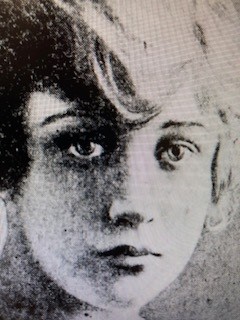
Broadway Butterfly Beatrice Fay Perkins

In the early morning hours of Monday, March 9, 1925, Mrs. Beatrice Fay Perkins returned to her Manhattan apartment at 168 W. 58th St., in the company of her escort, Milton Abbott, a cotton broker and family friend.  The two had been to Reuben’s, 622 Madison Ave., where late night revellers often concluded the night’s gayety with coffee and cold beef sandwiches.  There Mrs. Perkins became ill and asked Abbott to escort her home.  The pair arrived at the apartment around 3 a.m.  

A short time later, a group of masked bandits, using a crowbar and other tools,  “chopped and hacked their way into the luxurious studio apartment.”  Taking the pair by surprise, the gang of thugs first bound and gagged Mr. Abbott before setting upon Mrs. Perkins.  As Mrs. Perkins screamed, one of the robbers punched her in the mouth and grabbed her by the throat.  Another bandit grabbed her arm and twisted it as he tore a diamond bracelet and a diamond-studded watch from her wrist.  He grabbed one of her rings and tore the flesh as he ripped it from her finger.  Then her necklace was taken, and when one of her rings proved too stubborn to remove by conventional means, one of the bandits nearly bit her finger off trying to remove the ring with his teeth.  Not satisfied with the jewels they’d ripped from her body, they cursed and punched Mrs. Perkins as they demanded more loot.

“Where’s the rest of your jewelry, quick, or we’ll kill you,” one of the bandits threatened.

“For God’s sake, don’t do any more,” Mrs. Perkins moaned.  “It’s on the dressing table.  There, in that casket.”

As she lay in a broken heap on the floor, one of the men gave her a final kick while another grabbed the jewels from the dressing table.  Before they fled, the trio of bandits brutally beat Mrs. Perkins unconscious and choked her with a pillow to prevent her from crying out while they fled the scene.  Then, without so much as disturbing a hair on Mr. Abbott’s head, they warned him not to move for ten minutes after they left, or they would kill him.

Once the attackers had left the apartment, it only took Abbott a few moments to slip his bonds.  Once free, Abbott showed little compassion and rendered little aid as he merely clipped Mrs. Perkins’ wrist restraints with a pair of scissors.  Then Abbott did a very curious thing.  As Mrs. Perkins lay semi-conscious on the floor, bleeding from the severe beating she had just endured, Abbott did not call for an ambulance.  He did not run to the neighbors for help.  Nor did he call the police or summon a doctor.  No, Milton Abbott, cotton broker, neglected to undertake any action the emergency situation required and, instead, ran straight to the office of Arnold Rothstein.  

Estranged from her husband, Benjamin F. Perkins, wealthy proprietor of the Colannade Club, Beatrice Fay Perkins was described as a beautiful young woman and a frequenter of popular cabarets.  “Young, slim and beautiful, clothed in the finest Parisian creations,” Perkins earned the nickname ‘The Sleeping Beauty,’ because she wore her jewelry in bed during a hospital stay only a few weeks earlier.  

Badly beaten and abandoned by her companion, Mrs. Perkins left “a trail of blood behind her on the carpet” when she “dragged herself to the telephone” and called for help.  Meanwhile, Abbott ran the few blocks to the office of Arnold Rothstein, 45-47 W. 57th Street where he was unable to locate Rothstein at that late hour.  The following day, Mrs. Perkins told detectives, “Arnold Rothstein was the man who insured my jewels for me.  That’s why we wanted to see if he could think of any way to trace them.”

Three o’clock in the morning seems like a rather strange hour to be contacting your insurance man about stolen jewelry.  But Arnold Rothstein wasn’t just an insurance broker.  He was a leading figure in the Manhattan criminal underworld with interests in gambling, bootlegging, narcotics and stolen jewelry.  And Beatrice Fay Perkins wasn’t the first Broadway Butterfly to be severely beaten and robbed in her home.  At least two women had already lost their lives to a gang of “Butterfly Guerillas.”  However, this robbery, more than any of the others, appears to indicate that these attacks weren’t just random, unconnected events by unrelated gangs of thugs.  But rather, one individual may have been the leading figure behind all of these brutal crimes. 

Sources:

Brooklyn Daily Times

Brooklyn Eagle

Brooklyn Citizen

Dean Jobb continues to promote a false true crime narrative

In a recent interview with the Crime Writers of Canada podcast, Dean Jobb, author of A Gentleman and a Thief, doubles down on his contention that jazz-age jewel thief, Arthur Barry, crashed a Long Island cocktail party in 1924, befriended the Prince of Wales, and whisked his new royal pal off on a secret tour of Broadway speakeasies.  

The claim strains credulity, but Jobb provides the following defense:  

“I lead off with him (Arthur Barry) meeting the Prince of Wales, the future Edward the VIII, who was visiting Long Island in the twenties.  Barry crashes a party, because there were a whole bunch of Long Island parties for the prince and his entourage, and ends up meeting the prince, takes him on a clandestine tour of the bright lights of Broadway and the speakeasies.  

“I mean, a writer has to go, really?  Did this really happen?  Well, start digging into reporters.  I find memoirs or memories of reporters who covered the story, who vouch for it, who did their homework.  The coverage makes it clear that the prince disappeared right at the time Barry says he was doing this.  So, it’s a matter of digging as deeply as you need to in the record to verify for your own peace of mind.  But you owe it to the reader, and if you’re not sure, you tell the reader that.”

As I’ve shown in previous blog posts, all the contemporary newspaper accounts of the party Jobb describes have the Prince of Wales dancing at the Cosden estate until dawn and returning to the Burden estate that morning.  None mention Wales slipping away from the party to experience the nightlife of Broadway.  

Rather than belabor that point here, I’ll address the following contention:  “The coverage makes it clear that the prince disappeared right at the time Barry says he was doing this.”  The “coverage” Jobb refers to involves an episode that occurred the night following the Cosden party.  The “small but jolly” Cosden gathering described in Jobb’s book began late in the evening of Wednesday, September 3, 1924 and continued through the early morning hours of Thursday, September 4.  The period of time when Wales went missing began in the afternoon or early evening of Thursday, September 4 and continued until the next morning, Friday, September 5.

Here is the passage Jobb quotes from to show “that the prince disappeared right at the time Barry says he was doing this.”  The article was penned Thursday night, September 4, one night later than the night of the Cosden party, and appeared in the following morning’s Buffalo Courier.

“The whereabouts of the Prince of Wales were shrouded in mystery tonight.  At midnight he had not returned to the Burden estate where he is stopping.

“He had dinner at the home of J.S. Cosden…It was reported that he left the Cosden home shortly after dinner, but since that time he has been playing a game of hide and seek with those who sought to check his movements.

“Some believe he went for a boat ride up Long Island Sound, others say he attended an all-night dance party at some nearby home, but others believe he went in disguise to one of the white light jazz palaces on Broadway.”

Not only does this passage describe a different night from that of the late-night Cosden party, it describes a completely different set of events.  Wales had dinner at the Cosden home and he left, possibly by boat, and either went to a party or to check out the white light jazz palaces of Broadway.  He’s not fleeing a late night party, he’s leaving after having dinner.  How does Jobb not recognize that these are not only separate dates but separate events as well?  

While the order of events may seem a little confusing to someone unfamiliar with the Prince’s 1924 visit, it isn’t to someone who has casually researched the topic, and it shouldn’t be confusing to someone who has researched and written a work of nonfiction where an alleged encounter between Arthur Barry and the Prince of Wales plays a central role.

The prince’s movements over the 24 hours in question go something like this:  Wales attends a late night party at the Cosden estate and dances until dawn.  He then returns to the Burden estate and sleeps until around noon.  Then he goes to the polo fields for the afternoon.  Sometime in the late afternoon, he returns to the Cosden estate where he either plays golf or takes a stroll around the Cosden’s nine hole golf course.  Then he eats dinner, hops in a motorboat, and disappears off into the Long Island Sound.  From there his whereabouts are unknown for the next 12-24 hours. 

These events are widely covered by the newspapers of the day.  Here’s a question the New York Daily News posed regarding the prince’s missing hours:

“What the folk down Long Island way wanted to know was where the prince passed the time from 2 p.m. Thursday until his reappearance yesterday.”

Does that sound like Wales stole away from a late night party with a stranger he just met, or does it make more sense that he went missing the following afternoon?  How does Jobb miss that unless he’s intentionally taken the route of ignoring the truth and printing the legend?

Did Arthur Barry commit the Cosden jewel theft?

In the days following the capture of Arthur Barry, investigators were eager to pin a long list of Long Island jewel thefts on the gentleman burglar and his partner in crime, Boston Billy Williams.  One job authorities were especially eager to hang on the pair was the early morning robbery of the J. S. Cosden estate, where the Cosdens and Lord and Lady Mountbatten lost $125,000 in precious jewels to thieves during the Prince of Wales American visit of 1924.  

As the Brooklyn Daily Eagle reported on June 8, 1927, “Nassau County authorities investigating the $100,000 jewel robbery in the Kings Point home of Jesse L. Livermore ten days ago believed today that they had reached a solution of the sensational $250,000 jewel thefts from the Port Washington estate of Joshua E. Cosden three years ago…”  

Although Barry cooperated extensively with investigators, confessing to the Livermore robbery and a number of other area thefts, he did not confess to the Cosden robbery, much less reveal his alleged friendship with His Royal Highness.  

Reporting Nassau County District Attorney Elvin N. Edwards statements to the press following Barry’s arraignment, the Montreal Gazette wrote, “Mr. Edwards said that Barry had denied complicity in the robbery at the home of Joshua E. Cosden, near Port Washington, L.I.…Barry admitted other robberies so readily, Mr. Edwards said, that he did not see any reason to doubt his denials of these crimes.”

So, in late August 1927, when a burglar silently exited the Southhampton bedroom of Mrs. James Hastings Snowden with $100,000 of her finest jewelry as she soundly slept, the idea that other sneak thieves might be responsible for some of the high profile Long Island gem thefts became not just a real possibility, but a near absolute certainty.  After all, Arthur Barry and William Monahan were by this time securely behind bars, yet the plundering continued.

Having previously debunked Arthur Barry’s jailhouse tale of sneaking into the “small but jolly” Cosden party and sneaking off with the Prince of Wales in the early morning of September 4, 1924, it is now time to consider the likelihood of whether Barry carried out the Cosden theft. 

Everything that is known about Barry’s alleged involvement in the Cosden robbery appears to originate with Grace Robinson’s 1932 interview with the gentleman bandit.  Dean Jobb’s A Gentleman And A Thief relies heavily on this account, as well as on Anna Blake’s telling and that of Barry’s biographer, who, of course, received the story from Arthur Barry.

Barry’s interview with Robinson comes a full eight years after the Cosden robbery, allowing for no small amount of revisionism to creep into the narrative of his career as a gentleman thief.  In the November 3, 1932 edition of the New York Daily News, under the byline Arthur Barry as told to Grace Robinson, Barry first reveals his tale of how he became chums with the Prince of Wales.  “If I were asked to name the very pinnacle of my success as a gentleman burglar, I would mention my friendship with the Prince of Wales.  I met His Royal Highness in a New York night club when he made a sortie to Broadway during his famous Long Island holiday in 1924.”

This story of Barry’s first encounter with Wales is interesting because it contradicts what would become the accepted narrative that Barry first encountered Wales at the Cosden party.  

Barry goes on to say about his alleged friendship with Wales, “I make the admission reluctantly – it sounds like bragging, but I tell it in no boastful spirit.  It merely shows how far a gentleman burglar can get, if he brings look and manners to his profession of collecting jewels.”

Journalist Grace Robinson interrupts Barry’s narrative to provide some background information.  “Note:  Barry’s reluctance is not feigned.  He repeatedly denied knowing the Prince, and it was not until I confronted him with statements from persons who remember the incident well, that he confessed to having Wales for a drinking buddy in two exclusive hot spots in the smart Broadway of 1924”

Arthur Barry then makes another reluctant admission, “In this connection I may as well admit that it was I who pulled off the Joshua S. Cosden robbery.  That statement will interest the police.  For it’s never been hung on me.”

So up until 1932, more than eight years after the Cosden robbery, Barry denied a role in the theft and avoided revealing any connection to his alleged drinking buddy, Wales.  If not for Grace Robinson setting Barry straight on some of these details and coaxing the real story out of him, we may have never known about this historic encounter.

Barry avoids going into detail about the Cosden theft and returns instead to his first meeting with the Prince of Wales.  “On a night which was shortly before or shortly after the Cosden robbery I was drinking champagne in the Deauville Club … .Suddenly without warning, the Prince walked in.”  After Barry and Wales ordered more champagne and “everybody became chummy,” the two parties “pulled tables together, and I was introduced to His Royal Highness as ‘Dr. Gibson.’” 

This admission is astonishing because in the very first paragraph of Dean Jobb’s book, A Gentleman And A Thief, we are told that Arthur Barry introduced himself as Dr. Gibson to Wales and company as they exchanged pleasantries around the Cosden punch bowl.  How is it that Barry is claiming to have first met Wales at the Deauville Club?  

Once again, Grace Robinson has to call a timeout and interrupt Barry’s account to provide some much needed clarification.  “Note:  At this point Barry, who was speaking in the presence of six policemen, refused to tell more.  From friends out of Barry’s past, we have an amazing story which differs from his own account.” 

Apparently someone forgot to tell Barry how he actually became pals with Wales, and now Grace Robinson sets the story straight.  Robinson then delivers an account which, more or less, lines up with that of Jobb’s book, revealing, “The next night, Barry, now familiar with the ‘inside lay’ at the Cosden home, perpetrated his notorious job there.  Two or three nights later occurred the meeting in the Club Deauville, which Barry has related above.”

Only it wasn’t the next night that the Cosden jewel theft went down, it was five nights later.  The night before the Cosden break-in, the royal entourage attended a party at the home of F. Ambrose Clark.  The night before that Wales attended a dinner of 48 guests at the Piping Rock Club, the Brooklyn Daily Eagle reported, and “After the dinner the Prince embarked on the sort of little party that he likes best.  He did not go to a New York dance, nor did he seek out a tremendous monied palace, but instead he went to the simple little farm retreat owned by Henry Alexander at Glen Cove….There were 25 couples of the young people and the Prince and the young men and girls danced and strolled about the comfortable little homey place under the light of a brilliant moon.”

The more Grace Robinson and Arthur Barry try to construct this tale of Barry crashing the Cosden party and befriending the Prince of Wales, the more the pieces bump up against stubborn reality.  Any investigator hearing this account would have to conclude that Barry is lying, and Grace Robinson, in her zeal to land a great story, is leaning into credulity and trying to help Barry along.  Additionally, anyone today, who claims to be interested in the truth and who uncritically accepts the Arthur-Barry-as-told-to-Grace-Robinson narrative, is committing the sin of not letting the truth get in the way of a good story.      

However, just because Barry is fabricating events after the fact doesn’t mean there couldn’t be some truth to his tale.  It is possible that he committed the Cosden robbery, but the real story is a bit more mundane.  It is also possible that Barry encountered the Prince of Wales at the Deauville Club, and even chatted with him, but never became his friend and ‘drinking buddy.’  However, since Barry’s story contains so many falsehoods and contradictions, it becomes difficult to believe any of it.  Instead, it makes more sense to default back to the position of investigators at the time of Barry’s arrest and believe his claim that he was not responsible for the Cosden break-in.  Almost all the information that later emerges either turns out to be unverified or provably false.  Add to that that there were high profile jewel thefts before Barry became active, and the thefts continued after he was locked up, and it’s clear that Barry’s operation was not the only game in town.