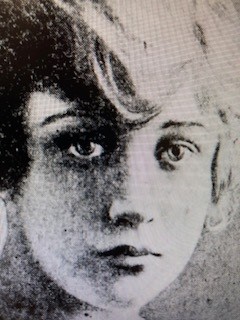
Broadway Butterfly Beatrice Fay Perkins

In the early morning hours of Monday, March 9, 1925, Mrs. Beatrice Fay Perkins returned to her Manhattan apartment at 168 W. 58th St., in the company of her escort, Milton Abbott, a cotton broker and family friend.  The two had been to Reuben’s, 622 Madison Ave., where late night revellers often concluded the night’s gayety with coffee and cold beef sandwiches.  There Mrs. Perkins became ill and asked Abbott to escort her home.  The pair arrived at the apartment around 3 a.m.  

A short time later, a group of masked bandits, using a crowbar and other tools,  “chopped and hacked their way into the luxurious studio apartment.”  Taking the pair by surprise, the gang of thugs first bound and gagged Mr. Abbott before setting upon Mrs. Perkins.  As Mrs. Perkins screamed, one of the robbers punched her in the mouth and grabbed her by the throat.  Another bandit grabbed her arm and twisted it as he tore a diamond bracelet and a diamond-studded watch from her wrist.  He grabbed one of her rings and tore the flesh as he ripped it from her finger.  Then her necklace was taken, and when one of her rings proved too stubborn to remove by conventional means, one of the bandits nearly bit her finger off trying to remove the ring with his teeth.  Not satisfied with the jewels they’d ripped from her body, they cursed and punched Mrs. Perkins as they demanded more loot.

“Where’s the rest of your jewelry, quick, or we’ll kill you,” one of the bandits threatened.

“For God’s sake, don’t do any more,” Mrs. Perkins moaned.  “It’s on the dressing table.  There, in that casket.”

As she lay in a broken heap on the floor, one of the men gave her a final kick while another grabbed the jewels from the dressing table.  Before they fled, the trio of bandits brutally beat Mrs. Perkins unconscious and choked her with a pillow to prevent her from crying out while they fled the scene.  Then, without so much as disturbing a hair on Mr. Abbott’s head, they warned him not to move for ten minutes after they left, or they would kill him.

Once the attackers had left the apartment, it only took Abbott a few moments to slip his bonds.  Once free, Abbott showed little compassion and rendered little aid as he merely clipped Mrs. Perkins’ wrist restraints with a pair of scissors.  Then Abbott did a very curious thing.  As Mrs. Perkins lay semi-conscious on the floor, bleeding from the severe beating she had just endured, Abbott did not call for an ambulance.  He did not run to the neighbors for help.  Nor did he call the police or summon a doctor.  No, Milton Abbott, cotton broker, neglected to undertake any action the emergency situation required and, instead, ran straight to the office of Arnold Rothstein.  

Estranged from her husband, Benjamin F. Perkins, wealthy proprietor of the Colannade Club, Beatrice Fay Perkins was described as a beautiful young woman and a frequenter of popular cabarets.  “Young, slim and beautiful, clothed in the finest Parisian creations,” Perkins earned the nickname ‘The Sleeping Beauty,’ because she wore her jewelry in bed during a hospital stay only a few weeks earlier.  

Badly beaten and abandoned by her companion, Mrs. Perkins left “a trail of blood behind her on the carpet” when she “dragged herself to the telephone” and called for help.  Meanwhile, Abbott ran the few blocks to the office of Arnold Rothstein, 45-47 W. 57th Street where he was unable to locate Rothstein at that late hour.  The following day, Mrs. Perkins told detectives, “Arnold Rothstein was the man who insured my jewels for me.  That’s why we wanted to see if he could think of any way to trace them.”

Three o’clock in the morning seems like a rather strange hour to be contacting your insurance man about stolen jewelry.  But Arnold Rothstein wasn’t just an insurance broker.  He was a leading figure in the Manhattan criminal underworld with interests in gambling, bootlegging, narcotics and stolen jewelry.  And Beatrice Fay Perkins wasn’t the first Broadway Butterfly to be severely beaten and robbed in her home.  At least two women had already lost their lives to a gang of “Butterfly Guerillas.”  However, this robbery, more than any of the others, appears to indicate that these attacks weren’t just random, unconnected events by unrelated gangs of thugs.  But rather, one individual may have been the leading figure behind all of these brutal crimes. 

Sources:

Brooklyn Daily Times

Brooklyn Eagle

Brooklyn Citizen

Arthur Barry did not accompany Prince of Wales on ‘little lark’ to Manhattan

The morning of September 3, 1924, the Prince of Wales slept until past noon at the Long Island estate of James Burden, where Wales lodged during his royal visit to the United States.  As was becoming a routine, Wales partied late the night before and didn’t return to his lodging until between five and six in the morning.  Press reports reveal the prince had dined at the home of Henry R. Winthrop of Woodbury the previous evening and danced there until 2:00 a.m.  Following the Winthrop affair, Wales and a small contingent of revelers led by Mrs. Vincent Astor motored to her estate on Hempstead Harbor to prolong the gayety.  

So as morning broke on the third of September, Wales was in no condition to participate in any of his usual princely activities.  As Frank Getty reported, “Wales was scheduled to follow the hounds in one of the fashionable Long Island hunts, but since he got in from a late party only after 5 a.m., he called off the hunt plan and slept instead.” 

William Woodford wrote of the canceled hunt, “Wales did not stir, nor did the bugle sound the chase.  Instead he was slumbering, as he still was well after noontime, heedless of hounds, horses or even of his favorite game of polo.”

However, Wales did heed the call of the polo grounds that afternoon, attending the British team practice at Meadow Brook field followed by the American workout at W.R. Grace field, Westbury.

That evening, September 3, 1924, Wales again enjoyed the camaraderie of the polo crowd, attending a stag dinner at the Piping Rock Club at Locust Valley.  An orchestra provided music, many toasts were made and Will Rogers delivered a 20 minute monologue that “made a great hit.”

“Leaving the Piping Rock Country Club at about midnight, the royal visitor went with his cousin, Lord Louis Mountbatten, and Lady Mountbatten, and Lord and Lady Milford Haven to the home of J. S. Cosden at Sands Point, where a jolly and small house party kept the fun going until the sun sent its first rays over Long Island.  Then the prince went home,” The Buffalo News reported the following day, September 4. 

The Brooklyn Daily Eagle provided a similar description of events following the Piping Rock Club dinner.  “It was another dancing party which kept Wales out all night, this time at the home of Mr. and Mrs. J. S. Cosden at Sands Point.  The party was a small but jolly one.”

Grace Robinson wrote on September 4, “After the stag, the prince went to the Cosdens where he danced until morning.”

Accounts of Wales’ whereabouts the evening of Wednesday, September 3 through the early morning hours of Thursday, September 4 all agree that Wales danced the night away at the Cosden estate and only left at daybreak to return to his Long Island lodging.  None of the contemporary descriptions of the “small but jolly” Cosden shindig contain any mention of a secret royal excursion “to one of the white light jazz palaces of Broadway.”

While the Prince of Wales’ movements are unanimously agreed upon the night of the Piping Rock stag and the Cosden party, the following day’s itinerary is a little more shrouded in mystery.  

Following his daybreak return from the Cosden festivities, Wales slept for about five hours at the Burden estate.  Upon rising the morning of Thursday, September 4, Wales immediately headed for the polo field.  As Grace Robinson reported, “The prince, having slept all of five hours, was at the private polo field of John S. Phipps promptly at noon….He seemed fresh and eager for the sport, while journalists were still nursing headaches following all night duty on the Piping Rock dinner and the Cosden dance.” 

Later in the afternoon, after polo, Wales returned to the Cosden estate where other members of the royal entourage were staying during the visit.  As John K. Winkler reported, “Late this afternoon he motored to the Cosdens after his polo game with Rogers and members of two scratch teams and had a try at golf.”  

The Cosden’s gardener appeared to verify this account, telling reporters that Wales “had shot a few holes of golf” on the Cosden’s private links.

While differing on a few details, Grace Robinson’s reporting on Wales’ late afternoon activities lines up with other accounts.  “He inspected the oil man’s nine hole golf course, but did not play.  He sauntered through the beautiful shaded walks…enjoying the wild scenery.  Finally he walked down to the private dock, where the Cosden yacht, the Crimper, was lying at anchor.  H.R.H. stepped aboard a speed boat and was soon speeding across Long Island sound toward Greenwich, Ct.”

The speedboat getaway from the Cosden estate during the late afternoon or early evening of Thursday, September 4 caused the press to lose track of Wales until the following morning.  Whether he ended up bar hopping in Manhattan that night or simply returned to the Burden estate was the cause of a great deal of frenzied speculation in the papers the following day.  

One thing we can know for certain is that Arthur Barry did not befriend Wales at the Cosden party and lure him away to the white light of Broadway, as Arthur Barry bragged and Dean Jobb would have us believe in his new book, A Gentleman And A Thief.  Barry was indeed a thief and a con man, and his latest con is to convince a modern day audience that he was once the Prince of Wales’ wingman.