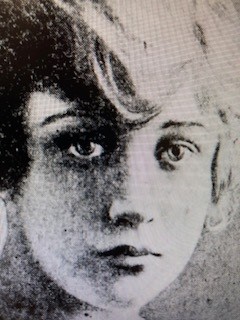
Broadway Butterfly Beatrice Fay Perkins

In the early morning hours of Monday, March 9, 1925, Mrs. Beatrice Fay Perkins returned to her Manhattan apartment at 168 W. 58th St., in the company of her escort, Milton Abbott, a cotton broker and family friend.  The two had been to Reuben’s, 622 Madison Ave., where late night revellers often concluded the night’s gayety with coffee and cold beef sandwiches.  There Mrs. Perkins became ill and asked Abbott to escort her home.  The pair arrived at the apartment around 3 a.m.  

A short time later, a group of masked bandits, using a crowbar and other tools,  “chopped and hacked their way into the luxurious studio apartment.”  Taking the pair by surprise, the gang of thugs first bound and gagged Mr. Abbott before setting upon Mrs. Perkins.  As Mrs. Perkins screamed, one of the robbers punched her in the mouth and grabbed her by the throat.  Another bandit grabbed her arm and twisted it as he tore a diamond bracelet and a diamond-studded watch from her wrist.  He grabbed one of her rings and tore the flesh as he ripped it from her finger.  Then her necklace was taken, and when one of her rings proved too stubborn to remove by conventional means, one of the bandits nearly bit her finger off trying to remove the ring with his teeth.  Not satisfied with the jewels they’d ripped from her body, they cursed and punched Mrs. Perkins as they demanded more loot.

“Where’s the rest of your jewelry, quick, or we’ll kill you,” one of the bandits threatened.

“For God’s sake, don’t do any more,” Mrs. Perkins moaned.  “It’s on the dressing table.  There, in that casket.”

As she lay in a broken heap on the floor, one of the men gave her a final kick while another grabbed the jewels from the dressing table.  Before they fled, the trio of bandits brutally beat Mrs. Perkins unconscious and choked her with a pillow to prevent her from crying out while they fled the scene.  Then, without so much as disturbing a hair on Mr. Abbott’s head, they warned him not to move for ten minutes after they left, or they would kill him.

Once the attackers had left the apartment, it only took Abbott a few moments to slip his bonds.  Once free, Abbott showed little compassion and rendered little aid as he merely clipped Mrs. Perkins’ wrist restraints with a pair of scissors.  Then Abbott did a very curious thing.  As Mrs. Perkins lay semi-conscious on the floor, bleeding from the severe beating she had just endured, Abbott did not call for an ambulance.  He did not run to the neighbors for help.  Nor did he call the police or summon a doctor.  No, Milton Abbott, cotton broker, neglected to undertake any action the emergency situation required and, instead, ran straight to the office of Arnold Rothstein.  

Estranged from her husband, Benjamin F. Perkins, wealthy proprietor of the Colannade Club, Beatrice Fay Perkins was described as a beautiful young woman and a frequenter of popular cabarets.  “Young, slim and beautiful, clothed in the finest Parisian creations,” Perkins earned the nickname ‘The Sleeping Beauty,’ because she wore her jewelry in bed during a hospital stay only a few weeks earlier.  

Badly beaten and abandoned by her companion, Mrs. Perkins left “a trail of blood behind her on the carpet” when she “dragged herself to the telephone” and called for help.  Meanwhile, Abbott ran the few blocks to the office of Arnold Rothstein, 45-47 W. 57th Street where he was unable to locate Rothstein at that late hour.  The following day, Mrs. Perkins told detectives, “Arnold Rothstein was the man who insured my jewels for me.  That’s why we wanted to see if he could think of any way to trace them.”

Three o’clock in the morning seems like a rather strange hour to be contacting your insurance man about stolen jewelry.  But Arnold Rothstein wasn’t just an insurance broker.  He was a leading figure in the Manhattan criminal underworld with interests in gambling, bootlegging, narcotics and stolen jewelry.  And Beatrice Fay Perkins wasn’t the first Broadway Butterfly to be severely beaten and robbed in her home.  At least two women had already lost their lives to a gang of “Butterfly Guerillas.”  However, this robbery, more than any of the others, appears to indicate that these attacks weren’t just random, unconnected events by unrelated gangs of thugs.  But rather, one individual may have been the leading figure behind all of these brutal crimes. 

Sources:

Brooklyn Daily Times

Brooklyn Eagle

Brooklyn Citizen

Shadow of the Bridge cuts through the true crime clutter

As a true crime consumer, it is easy sometimes to get so wrapped up in an ongoing case that you can lose your way in a maze of possible suspects or avenues of investigation that often lead nowhere.  Then, of course, there are the crackpot conspiracy theories that, if indulged, can draw your ass into a wilderness of mirrors from which you may never find your way back to the known facts and circumstances of the case.  The longer the case goes on and the more information accumulates, it can be difficult to separate relevant facts from useless distractions, until your mind becomes like the house of a hoarder, hanging onto every little scrap in case you need it at some point.

One great thing about Aine Cain and Kevin Greenlee’s new book, Shadow of the Bridge:  The Delphi Murders and the Dark Side of the American Heartland, is the way it removes the accumulated clutter of eight years, takes you back to a time before the nightmare started and tells the story based only on what is true, verifiable and relevant.

The authors do an exceptional job opening the book in the Delphi that existed before it became the focus of so much media and public attention.  They offer a description of the Monon High Bridge and its place in the community before it became part of a crime scene and a symbol of terror and dread.  Cain and Greenlee then turn their focus to Abigail, Liberty and their families, skillfully and respectfully portraying their lives as they existed before tragedy struck.  It is a credit to the authors that the reader experiences a sense of what these families and communities lost when these two young girls were taken from them.  As you’re drawn into the lives of Abigail and Liberty, it is impossible not to feel heartbroken for them, knowing the horror that awaits these two innocent children of Delphi.

All this is to say, for anyone who has followed this case closely, it is extremely useful, instructive and a little therapeutic to permit the authors to clean the slate or remove whatever true crime or conspiracy corkboard you may have mounted in your brain and let them lay out the relevant testimony and facts.  Their presentation is clear, methodical and precise, focused squarely on people and events surrounding the crime, investigation and trial.  

Everyone who cares about this case should read this book.  Then if you’re inclined to return to your internet beefs, creator rivalries, left-field theories and true crime cat fights, you’re free to do so, and the rest of us will know that’s all you ever really cared about.

Dean Jobb continues to promote a false true crime narrative

In a recent interview with the Crime Writers of Canada podcast, Dean Jobb, author of A Gentleman and a Thief, doubles down on his contention that jazz-age jewel thief, Arthur Barry, crashed a Long Island cocktail party in 1924, befriended the Prince of Wales, and whisked his new royal pal off on a secret tour of Broadway speakeasies.  

The claim strains credulity, but Jobb provides the following defense:  

“I lead off with him (Arthur Barry) meeting the Prince of Wales, the future Edward the VIII, who was visiting Long Island in the twenties.  Barry crashes a party, because there were a whole bunch of Long Island parties for the prince and his entourage, and ends up meeting the prince, takes him on a clandestine tour of the bright lights of Broadway and the speakeasies.  

“I mean, a writer has to go, really?  Did this really happen?  Well, start digging into reporters.  I find memoirs or memories of reporters who covered the story, who vouch for it, who did their homework.  The coverage makes it clear that the prince disappeared right at the time Barry says he was doing this.  So, it’s a matter of digging as deeply as you need to in the record to verify for your own peace of mind.  But you owe it to the reader, and if you’re not sure, you tell the reader that.”

As I’ve shown in previous blog posts, all the contemporary newspaper accounts of the party Jobb describes have the Prince of Wales dancing at the Cosden estate until dawn and returning to the Burden estate that morning.  None mention Wales slipping away from the party to experience the nightlife of Broadway.  

Rather than belabor that point here, I’ll address the following contention:  “The coverage makes it clear that the prince disappeared right at the time Barry says he was doing this.”  The “coverage” Jobb refers to involves an episode that occurred the night following the Cosden party.  The “small but jolly” Cosden gathering described in Jobb’s book began late in the evening of Wednesday, September 3, 1924 and continued through the early morning hours of Thursday, September 4.  The period of time when Wales went missing began in the afternoon or early evening of Thursday, September 4 and continued until the next morning, Friday, September 5.

Here is the passage Jobb quotes from to show “that the prince disappeared right at the time Barry says he was doing this.”  The article was penned Thursday night, September 4, one night later than the night of the Cosden party, and appeared in the following morning’s Buffalo Courier.

“The whereabouts of the Prince of Wales were shrouded in mystery tonight.  At midnight he had not returned to the Burden estate where he is stopping.

“He had dinner at the home of J.S. Cosden…It was reported that he left the Cosden home shortly after dinner, but since that time he has been playing a game of hide and seek with those who sought to check his movements.

“Some believe he went for a boat ride up Long Island Sound, others say he attended an all-night dance party at some nearby home, but others believe he went in disguise to one of the white light jazz palaces on Broadway.”

Not only does this passage describe a different night from that of the late-night Cosden party, it describes a completely different set of events.  Wales had dinner at the Cosden home and he left, possibly by boat, and either went to a party or to check out the white light jazz palaces of Broadway.  He’s not fleeing a late night party, he’s leaving after having dinner.  How does Jobb not recognize that these are not only separate dates but separate events as well?  

While the order of events may seem a little confusing to someone unfamiliar with the Prince’s 1924 visit, it isn’t to someone who has casually researched the topic, and it shouldn’t be confusing to someone who has researched and written a work of nonfiction where an alleged encounter between Arthur Barry and the Prince of Wales plays a central role.

The prince’s movements over the 24 hours in question go something like this:  Wales attends a late night party at the Cosden estate and dances until dawn.  He then returns to the Burden estate and sleeps until around noon.  Then he goes to the polo fields for the afternoon.  Sometime in the late afternoon, he returns to the Cosden estate where he either plays golf or takes a stroll around the Cosden’s nine hole golf course.  Then he eats dinner, hops in a motorboat, and disappears off into the Long Island Sound.  From there his whereabouts are unknown for the next 12-24 hours. 

These events are widely covered by the newspapers of the day.  Here’s a question the New York Daily News posed regarding the prince’s missing hours:

“What the folk down Long Island way wanted to know was where the prince passed the time from 2 p.m. Thursday until his reappearance yesterday.”

Does that sound like Wales stole away from a late night party with a stranger he just met, or does it make more sense that he went missing the following afternoon?  How does Jobb miss that unless he’s intentionally taken the route of ignoring the truth and printing the legend?


The Hendricks County Grave Robberies Part 4

As the winter of 1987 rolled in, the reports of opened graves and disturbed cemetery plots in central Indiana ceased.  It makes sense that snow and frozen earth would put the brakes on grave robbing activities.  Finding it difficult to operate in the winter months, the fair-weather-satanists probably took their activities indoors as outdoor conditions became inhospitable.

With 15 graves robbed in Hendricks County and no suspects in sight, at least one expert voiced the opinion that the focus on satanists was misguided.  Julia M. Corbett, Religious Studies professor at Ball State University, told the Indianapolis Star that the profile of a grave robber did not match that of a typical satanist.  

According to Corbett these crimes were committed by “real ‘sickies’ out there who do things like animal sacrifice and grave robbing and things like that and say they’re doing it in the name of satanism. 

“My impression of it… is that we have a collection of several incidents that may be tied together of people simply doing very bizarre things that are being labeled satanism.  It’s very probably not associated with the Church of Satan.

“Legitimate satanists don’t break laws as long as they consider it’s for the public good.  I’m quite sure the grave robbing wouldn’t be in the public interest.  ‘Devil-worshipper’ is kind of a convenient catchbasket when something negative like this happens,” Corbett said.

Police did manage to apprehend at least one individual who was not acting in the public interest.  A Hendricks County teen-ager was arrested for robbing the grave of a woman buried in 1865.  Although the theft occurred three years earlier, the youth had only recently confessed his misdeeds to the police.  When questioned by investigators, the youth admitted that he had removed the earth from the grave.  Once the casket was exposed, he smashed the glass in the lid and searched inside for jewelry or other valuable items.  Finding nothing of value, the youth removed some teeth from the skull and took them.  The young man was charged with misdemeanor criminal mischief and theft.

As the calendar turned to 1988, stories about the Hendricks County grave robberies investigation began to fizzle in the local press, even as the news of satanic activity exploded in the national media.  However, Lt. Michael J. Nelson did not give up the investigation, despite being told by Sheriff Roy Waddell to drop inquiries into alleged satanic activity in the county.  Additionally, when national media outlets like the Wall Street Journal, People Magazine, and the New York Times came calling, Lt. Nelson gave interviews without getting permission from Waddell.

Sheriff Waddell was not pleased to see the local issue sensationalized in the national media.  “In the 30 years I’ve been here, I’ve had no experience with satanic cults, before or since this.  We try to investigate all avenues and that’s one avenue that could be considered, but nothing panned out.  That’s not to say we don’t have any individuals who may, to whatever degree, be involved.  I have no idea.  But the bottom line is there’s no substance to think we have a satanic cult problem,” Waddell told the Indianapolis Star. 

By February of 1988, Lt. Nelson found himself transferred from detective work to patrol duty, and in May he resigned from the Hendricks County Sheriff’s Department.  “In a nutshell, without getting in a battle with him, I believe there is satanic activity and he believes there isn’t … .He just doesn’t feel it’s a legitimate investigation and there’s no basis for any satanic cult operating in the county,” Nelson said.

However, just a few months after Nelson’s resignation, three Hendricks County teen-agers were charged and found guilty of cruelty to an animal after they each confessed in juvenile court to participating in a ritual in which they cut out the heart of a live stray cat.  The incident occured the previous October, around the time the grave robberies were discovered, and took place under the Avon Road bridge in Plainfield.

According to her testimony to the Hendricks County Circuit Court, the 16-year-old leader of the ritual sacrifice asserted that only animals are to be killed, not humans.  ”In satanism, we believe that the human is the ultimate being – we don’t believe in violence or suicide.  Murder of a human is wrong.  But every religion has its own thing, and the cat (sacrifice) is ours.”

Apparently, they should have audited professor Corbett’s class before embarking on their satanic practices.

Another youth who admitted to stabbing the animal and cutting out its heart told the judge he became involved in satanism because he “just needed something to believe in.  I can’t believe in anything anymore.  I’ve had a rough life, your honor.”

While none of these incidents revealed a vast satanic underground in operation, they undoubtedly provided fuel for the paranoia that would grip Hendricks County and the entire state, making Indiana, in some respects, ground zero for the so-called satanic panic. 

Sources:

The Indianapolis Star

The Indianapolis News

The Hendricks County Grave Robberies Part 3

While no vandals or cult members were apprehended by law enforcement on Halloween night, Hendricks County officials did receive a report of cult activity at a cemetery in Avon.  Some adults allegedly witnessed a group of teens in black robes “holding sticks and dragging what appeared to be a body,” the Star reported.  

Hendricks County Sheriff’s Lt. Stephen Golden offered his thoughts on the alleged cult activity.  

“We are sure devil worship exists, but we don’t know if it is really going on (in the county) or if it’s teens playing a game or people out to steal things to sell.  If it’s teens, a lot could have to do with movies they’re watching like Prince of Darkness or Nightmare on Elm Street.  If it is teens, it’s a very small select group of teen–agers that are not representative of teens here in Hendricks County.” 

Although investigators believed more than one cult was operating in the area, they could not determine whether the groups were involved in devil worship.  Additionally, Golden clarified that in most instances the devil worship activity was not illegal.  

“When they trespass on people’s property, dig up graves and when they kill or maim animals, then it becomes our business.  That’s why we want to find out what’s going on and get to the bottom of it.”

Investigators reported discovering a ritual site in a densely wooded area near I-74 and State Road 267 north of Brownsburg.  A tree spray-painted with a “666” and the word “Satan” marked the site.  Attached to the tree were a pair of ropes with an ax handle hanging from one of the ropes.  Also present at the site were two small platforms and a candle in a jar.

At the previously mentioned bonfire site northeast of Pittsboro, where an 8-inch bone was found, investigators also discovered candle wax drippings on a table.  Tests performed on the bone showed it to be that of a large dog.

Then in the early morning hours of November 4, 1987, the night manager of a Brownsburg restaurant was driving home from work along a dark stretch of road outside Pittsboro.  Near the intersection of County Roads 750 North and 475 East, the man suddenly came upon a vehicle parked in the middle of the road.  Unable to stop, he was forced to drive off the road to avoid hitting the vehicle.  Angered at the driver in the stopped vehicle, the night manager grabbed an ax handle he kept in his car for protection.  (Apparently, ax handles were widely available and in heavy rotation back in 1987.)  As the night manager exited his vehicle, a man wearing a black leather jacket, a black hood and a black glove with spikes or claws appeared out of the darkness.  Additionally, two other men wearing ski masks emerged from another vehicle.  The night manager was pushed to the ground, kicked and struck by the group, and slashed across the face and abdomen by the man with the claw glove.  The men fled when the night manager lost consciousness. 

The night manager was not badly injured and the assailants were never identified.  Robbery was ruled out as a motive in the attack because the restaurant’s deposit the manager carried with him was not taken.  

As highly bizarre as the attack appeared, it was not an isolated incident.  Due to the popularity of the Nightmare on Elm Street series, assaults committed by individuals with clawed or studded gloves were not altogether uncommon back in 1987.  But with fears already running high over reports of satanism and satanic crimes in the press, the attack only caused the paranoia to grow.        

Sources:

The Indianapolis Star

The Indianapolis News

The Hendricks County Grave Robberies Part 2

As Halloween 1987 approached, reports of grave robberies in Hendricks County continued to pour in.  On October 27, the remains of four people were discovered missing at the Weaver-Dillon Cemetery, bringing the total number of grave robberies to ten.  A resident who lives nearby discovered the open graves while walking in the wooded area northeast of Pittsboro, Indiana.  Lt. Stephen G. Golden expressed doubts about a Halloween prank, as the work involved in opening the graves required a great deal of digging and the location was very secluded.

The largest hole was marked by a headstone inscribed with the names Joeann F. Dillon, Judith M. Dillon, James W. Dillon, Abia Dillon and Flemingo Dillon whose deaths occurred between 1852 and 1919.  Golden commented that the freshness of the dirt indicated the hole had been dug sometime within the previous two months.  Another hole lay at the base of a headstone with the inscription “Emma V., wife of S. A. Surber.”  Nearby another large hole with no headstone marking the grave had been dug and filled back in.  

With no apparent motive and little to go on other than the profile of an extremely fit and prolific hole digger, the theory that the crimes were motivated by satan worship moved to the forefront.  An 8-inch-long bone resembling a femur discovered at the most recent site, bolstered the satanic angle.

“What’s significant is that it was found near a bonfire site.  In rituals, they usually have a bonfire near the cemetery,” Lt. Golden told reporters.  

For Sheriff’s Lt. Michael J Nelson, who had been working on the grave robberies since they first began appearing, the satanic cult angle had always been at the top of his list.  Investigators believed that almost anything found in the hundred-year-old graves would be of value to a group of satan worshippers.  Items discovered in these ancient graves would bond members to the group, investigators thought.

Needless to say, residents of this part of Hendricks County were becoming very nervous indeed.  Grave robberies and allegations of devil worship would send a chill down anybody’s spine in 1987.  But Lt. Golden assured the public it was too soon to start worrying.

“Sure, it’s unusual, but people shouldn’t be scared.  Hopefully, we’ll find out who’s doing it and they’ll be arrested,” Golden said.   

However, the grave robberies continued.  On Halloween 1987, an Indianapolis Star headline announced “5 more graves disturbed in Hendricks County.”  According to the article, attempts had been made to steal the remains of five more people, but it could not be determined whether the thieves were successful in their endeavor.

Meanwhile, additional reports of graveyard malfeasance flooded into the Hendricks County Sheriff’s office.  In Avon, a woman reported that a private cemetery on her property had been targeted.  A four foot deep hole had been dug at the site of one grave, but no remains removed.  Two other cemeteries in the Pittsboro area showed attempts to open graves that were abandoned after two feet of digging.  In one instance, it appeared the robbery had been attempted several months earlier, as the hole showed signs it had been dug earlier in the spring.

“What is getting strange now is, for some reason, they’re digging part of the way into these graves and then quitting,” Lt. Golden told reporters.

Could there have been a copycat on the loose who didn’t have the stomach to finish the job, or could the older abandoned attempts show a grave robber who was just getting started but lacked the confidence to see the gruesome task through?

Whatever the case, Lt. Golden called up a number of local reservists to patrol the area on Halloween night in hopes of catching a grave digging ghoul in the act.  After all, what twisted creature of the night or sick satanic cult could resist communing with the dead on Halloween night?

At the time and given the circumstances, Golden’s plan was necessary and had to be undertaken.  But imagine being a local citizen called up to stake out a remote, ancient cemetery on Halloween night.  In retrospect, it sounds like a movie premise with loads of comedic potential, something like Abbott and Costello Meet the Body Snatcher.

At any rate, with the level of weirdness in Hendricks County cranked up to 11, it seemed impossible that events could get any weirder, but as Hunter S. Thompson used to say, “When the going gets weird, the weird turn pro.”

Sources:

The Indianapolis Star

The Indianapolis News

The Hendricks County Grave Robberies Part 1

On Monday, September 28, 1987, Hendricks County Sheriff’s deputies followed up on a report of a recently reopened grave in a remote cemetery plot north of Plainfield, Indiana.  A hiker discovered the disturbed area near a tributary of White Lick Creek while exploring the surrounding farm fields and wooded areas.  A six foot deep hole had been dug at one grave site and the remains removed, while several inches of topsoil had been cleared from two other plots.  

The site was an old family cemetery belonging to the Carters, an early pioneer family who in 1823 settled 240 acres in that part of Guilford Township.  One grave belonged to Ruth Hadley Carter, who died at the age of 68 on April 24, 1869.  Another grave belonged to a two-month-old infant, and the third grave was unmarked.

Regarding what would motivate an individual to remove centuries old remains from a remote and obscure settler grave, there weren’t many good theories.  Hendricks County Sheriff Lt. Stephen G. Golden speculated that the robbers could have been looking for antique jewelry, or the disturbance was possibly just a sick prank.   

Christopher S. Peebles, director of the Glenn A. Black Laboratory of Archaeology at Indiana University, was also uncertain of what the vandals would have found in the grave other than skeletal remains.  “I don’t know what would have been left in this case, but it all comes down to thievery, pure and simple.  It’s pretty sick for someone to dig up graves for no apparent purpose.  I suspect it’s someone with a screw loose,” Peebles said.

There was one thing investigators did know for sure, the present scene of a recently looted grave in Central Indiana was not an isolated incident.  Only a month earlier, residents of nearby Brownsburg and Greenfield, Indiana, went to clean up an ancient family cemetery near Brownsburg and discovered one of the graves dug up and the remains missing.  Walker Cemetery, as it is known, sits along 56th street near Brownsburg about a mile west of the Marion County line.  The missing remains belonged to Ann Walker, a member of one of Brownsburg’s founding families.

Whether it was someone with a screw loose, a thief in search of valuables, or some twisted, rogue member of the local historical society was anybody’s guess.  However, in 1987 there was one theory that explained a lot of grisly and macabre behavior: devil worship.  In the climate of the time, it was difficult to understand a series of grave robberies as having any explanation other than dirty deeds done in service of the dark arts.  And as the discoveries of disturbed graves and missing remains continued, and tales of strange hooded figures deepened the mystery, the spectre of Satanism spread like a fever until all became infected with its delirium.

Sources:

The Indianapolis Star

The Indianapolis News

Snapchat teachers arrested

Morgan County, Indiana public school teacher Brittany Fortinberry faces up to 10 counts of child molestation, 9 counts of dissemination of matter harmful to a minor, 6 counts of contributing to the delinquency of a minor and 4 counts of sexual misconduct with a minor following accusations that she forced multiple teenage boys, some as young as 13, into group sex with her.  

According to 13WTHR, court documents allege, “one of the victims, a middle school boy, accused Fortinberry of drugging him repeatedly and having sex with him when he was 13. He said Fortinberry would have him bring his friends to her house, where she would allegedly give the teens drugs and then have sex with them…Fortinberry was paying teen boys between $100 and $800 for photos of their genitals…All of the teens said Fortinberry would send them nude and explicit photos and videos on Snapchat and an app called Session.” 

FOX59 reports, “Detectives interviewed a woman who claimed to be friends with Fortinberry since 2022, court documents said.

“The woman went on to state that Fortinberry supported her as she went through a divorce by helping with her children. The woman reportedly told detectives that she noticed Fortinberry would allegedly act differently around one of her children.

“Some of Fortinberry’s alleged actions included purchasing expensive gifts for the teen, according to court documents. After observing this behavior change, the mother decided to prevent her child from interacting with Fortinberry any longer. However, she later learned that Fortinberry had reportedly added the minor on Snapchat and the two had continued communicating on that app.

“The woman went on to state her child said Fortinberry had allegedly sent him videos of her using vibrators and engaging in sexual activities with other men.

“The minor added that Fortinberry allegedly drugged him with ‘shrooms, weed, and that she would make him drink a bottle,’ when they were together.

“The victim said it tasted like alcohol and that he had difficulty remembering anything after consuming it. The victim said Fortinberry would purchase vapes and marijuana for several other victims.

“The victim added that Fortinberry allegedly forced other victims to watch her engage in intercourse if they refused to participate, court documents show.

“Detectives spoke with another victim who informed them that he was in 7th grade when he met Fortinberry.

“This victim recounted Fortinberry ‘snapping’ him all of the time after meeting her. Fortinberry is also alleged to have purchased vapes, marijuana and THC cartridges.

“Court documents show that the victim remembered Fortinberry supplying capsules containing shrooms and that it would make him feel ‘funny.’ The victim reported there were four other people there during this particular interaction.

“The victim said Fortinberry would then begin to touch him and the others inappropriately. The victim recounted another experience where Fortinberry allegedly made him watch as she had sex with another underage victim.

“In another instance, one of the victims reported that Fortinberry invited a group of teens to her home and had sex with all of them while making one wear the mask from the horror film ‘Scream.’”

Once again the Snapchat app appears to have been instrumental in enabling a predator to groom and abuse multiple victims, all of whom lived in her community.  

“All of the teens said Fortinberry would send them nude and explicit photos and videos on Snapchat” and a “victim recounted Fortinberry ‘snapping’ him all of the time after meeting her.”

If the allegations are true, a single individual was able to devastate multiple children and families and an entire community by utilizing a smartphone and a social media app.  We’re not talking about Jeffrey Epstein or a coordinated child sex ring, we’re talking about a lone public school teacher.

The scale of the damage is incredible, but if you think this is an isolated incident, representing one bad apple in the classroom, think again.

The Miami Herald reported on January 30, 2024, “Miami-Dade teacher posts inappropriate video on Snapchat…Wesly Alvarez, 45, was charged with computer pornography…The video shows him exposing himself in front of a school bathroom mirror.”

Northern News Now reported on January 2, 2025, “Former Duluth teacher charged for messaging minor over Snapchat ….  Scott Johanik, 32, of Duluth was charged with messaging a minor that related or described sexual conduct.” 

Valley News Live reported on January 16, 2025, “Snapchat data reveals communications between former Fargo teacher and minor in court….  Investigators took the stand on day three of a criminal trial against a former Fargo school teacher.

“Ashley Peterson is charged with promoting a sexual performance by a minor and contributing to the deprivation of a minor. Snapchat data was at the center of the courtroom Thursday.”

The Valley News Live site featured another pair of child predators, one of whom was employed by the local public schools, and, of course, Snapchat featured in the story.

On March 24, 2025, Valley News reported, “Former Lake of the Woods school employee and husband accused of having sex with teen….  A couple from Williams, Minnesota, is accused of engaging in a sexual relationship with a teen girl.

“Kraig and Jennifer Stokke are each charged with one count of 3rd degree criminal sexual conduct in Lake of the Woods County. According to court records, Jennifer Stokke is an employee at Lake of the Woods Public Schools….  The victim told investigators that Jennifer has gone to great lengths to hide their previous communications to include, changing phone numbers and phones and by deleting her Snapchat account.”

Fox11 reported on February 12, 2025, “Former Logan County teacher charged with soliciting student through Snapchat, records say….  A former Logan County Schools teacher has been criminally charged after being accused of sending sexually explicit messages to a student on social media, court records said.

“Charles Stephen Wallace, 32, of Chapmanville has been charged with soliciting a minor using a computer, according to a criminal complaint filed in Lincoln County Magistrate Court.

“The complaint identified the victim as a 17-year-old female from Lincoln County attending classes at Chapmanville Regional High School where Wallace worked as a choir teacher and director.”

10WBIR reported on December 9, 2024, “Former KCS teacher charged with sending sexual content to boy via Snapchat….  A former Knox County Schools teacher is accused of sending sexual material to an underage boy via Snapchat.

“A Knox County grand jury indicted Kristin M. Brown, 34, earlier this month on five counts of exploitation of a minor by electronic means. She originally was due in Knox County Criminal Court on Dec. 6; the date was changed to Dec. 11, records show.

“The crimes are alleged to have occurred between December 2023 and March 5, records state. The counts specifically state the alleged victim was under age 13 and that she exposed the boy by electronic communication to ‘material containing sexual activity’ for her own gratification.”

News12 Brooklyn reported March 3, 2025, “Ex-Brooklyn math teacher pleads guilty in student Snapchat sexting case….  A Brooklyn high school math teacher pleaded guilty to convincing students to send him sexual pictures and videos.

“Winston Nguyen, a former teacher at St. Ann’s in Brooklyn Heights, accepted the charges that included one count of inducing a minor to engage in a sexual performance, as well as five additional counts of actions that were injurious to a minor.”

A simple Google search of “Snapchat teacher” without quotes opened up this horror show.  This list only draws from the first two pages of results.  Despite the fact that the search terms don’t include any mention of “abuse” or “sex abuse” or “sex material,” these accounts are almost exclusively all that is contained in the search results as far as the eye can see.  It seems if you put “Snapchat” and “teachers” together, you’re going to get a whole lot of depraved and felonious behavior.  To be fair, if you put “coach” and “Snapchat” together, or you put “pastor” and “Snapchat” together, you’re most likely going to get similar results.  So one common denominator that makes all this deviance and perversion possible appears to be Snapchat.  It’s the perfect DIY tool for a would-be predator, streamlining all the features a predator needs into one easy-to-use app.

Granted, no one makes the news for “snapping” images of a beautiful cake they baked, so news about Snapchat is going to skew towards its worst abuses.  However, the sheer volume of instances of adults using the app to prey on minors is staggering and should cause Snapchat’s corporate leadership to take greater steps to track predators or to remove features that enable criminality to thrive on their platform.  Additionally, the app represents such a public nuisance, it should be within the scope of federal authorities to force the company to put a stop to the criminal behavior on its app.

True Crime Fiction

I recently finished Broadway Butterfly by Sara DiVello.  The novel tells the true story of the 1923 murder of Broadway flapper Anna Marie Keenan, aka Dot King, and the corrupt police investigation that followed.  While the crime remains officially unsolved, at least one character in the story stands out as the probable killer, with other prominent figures implicated in the cover up if not the actual crime itself.  As someone who has done a fair amount of research into Broadway crimes of the 1920s, I’m familiar with this case and the murders of other Broadway flappers of the era.  Sara DiVello does a masterful job of bringing the characters and the setting to life.  The story is compelling enough when experienced through the lens of old newspaper accounts, but DiVello’s storytelling animates the setting and brings a depth to the characters that is seldom found in most true crime novels.

The work is marketed as true crime fiction, but DiVello poured an enormous amount of research into the story.  She spent nearly ten years assembling 1700 pieces of research that she weaves into the tale.  It is a fascinating story and she provides a complete picture of the facts and circumstances surrounding the case.  The fiction comes in when she imagines moments of private conversations that took place behind closed doors, or when she sets out the interior thoughts of the four main characters on whom the novel is focused.  While there is no way she could know everything that was said or thought by these characters, the extensive research so thoroughly backs up what is written that it becomes entirely believable that these conversations could have taken place.  

As a work of true crime fiction, all the facts are expertly assembled, and the fiction layer makes the work three dimensional, keeping the narrative moving along and the pages turning.  The fiction elements animate the characters and show them wrestling with internal conflicts that undoubtedly would have troubled them as the investigation proceeded.  This adds a layer of drama that a reader is generally not going to get from a nonfiction or journalistic approach.

However, after finishing this true crime novel, I’m left wondering, what is the difference between true crime fiction and creative nonfiction?  As a work of creative nonfiction, Dean Jobb’s A Gentleman And A Thief has come in for some criticism from this blog.  Jobb flatly asserts in his note to readers that he is presenting facts, that “all scenes and events unfolded as described,” and “an essential element of true crime, after all, is truth.”  But, as I’ve shown in previous posts, he has taken some pretty big liberties with the truth.  At best, he’s providing a version of the truth flowing from conman and thief, Arthur Barry.  At worst, he’s making a deliberate choice to ignore the facts as reported by much more reliable sources whose job it is to present the truth.  Why does Jobb get to hang a nonfiction label on his product, while DiVello’s work, which is much more thoroughly and painstakingly researched, comes in as a work of fiction?

Jobb’s approach misleads readers.  In one instance, he asserts that Noel Scaffa knowingly lies to the police on behalf of Arthur Barry regarding an alleged exchange of cash for stolen jewelry.  Setting aside the problem of taking the word of a thief and conman over that of a private investigator, where does Jobb get off portraying Scaffa as a liar without providing a shred of proof of Scaffa’s deception?  Presenting a work as nonfiction ought to require a good faith rendering of all relevant versions of the events you’re attempting to portray.  If you’re choosing to exclude relevant information or mislead the reader in order to shape a narrative, then you’re not writing nonfiction.  It’s pretty ironic that DiVello’s work of true crime fiction comes off as more truthful and honest than Jobb’s alleged work of creative nonfiction.

Queen of the Con: Buda Godman Marries Tell Taylor

Safely ensconced at convent school in Adrian, Michigan, Buda Godman was midway through her time at St. Joseph’s Academy when a group of travelling players came through town.  It was Christmas Eve and the students were allowed to give a late supper.  One of the invited guests was Mr. Tell Taylor, a young actor and aspiring songwriter from Findlay, Ohio.  He sat across the table from Buda Godman and the pair seemed to hit it off.  However, when the dinner ended, the two parted ways without any intention of continuing the friendship through future meetings or correspondence.

A few years later, a nineteen-year-old Buda Godman was out of school and back in Chicago where her family resided.  One evening in 1907, Buda attended a performance of The Girl Question, a hit musical that enjoyed a run of over a hundred performances at the Lasalle Theater.  There she recognized the man playing the part of Harold Sears as the same actor she’d met a few years earlier.  After the performance, she sent him a note and “their acquaintance was renewed.”  Buda Godman and Tell Taylor proceeded to embark on a whirlwind courtship.  “Several times during the course of the week the young couple were out together, lunching and driving, and Monday evening after dinner together at a downtown hotel Judge Arms was called to the parlor and joined them in marriage,” the Lafayette Journal and Courier reported.  Before going to the theater to catch her husband’s performance that evening, Buda called her parents and notified them of the marriage.  Buda’s father joined her at the theater and after the performance took the couple back to his house where the Godmans held a dinner for the newlyweds. 

While the Journal and Courier reported that the new bride “would not go on the stage,” Jack Lait and Lee Mortimer wrote in Chicago Confidential that Taylor got Buda work in the chorus of The Time, The Place, and The Girl.  According to Lait and Mortimer, following Buda’s performance “Chicago woke up to the discovery of a new rave, Buda Godman.  She was wooed and pursued and she fell.  Taylor tried to kill her and fired several shots at her, but missed.”

There are more than a few inaccuracies in Lait and Mortimer’s account of the life of Buda Godman, so it’s difficult to know how much, if any, of this episode actually happened.  However, one thing that is undeniable is that Tell and Buda’s relationship was stormier than a water spout off of Ohio St. Beach.  To hear Tell Taylor tell it, “I married Buda when we were both drunk and I found out she was quite incapable of loyalty to anyone.”  As Variety put it when Taylor filed for divorce from Buda in 1910, “his complaint mentioned several vaudevillians as ‘affinities.’  Their names were omitted from the final record.”

One thing that is never mentioned in the ‘love story’ of Tell Taylor and Buda Godman is the erratic behavior of Taylor himself.  Life with the songwriter wasn’t always blissful romance by the old mill stream.  Taylor did start a successful music publishing company in Chicago, and he managed to author his most famous tune “Down By The Old Mill Stream” in 1910 while still married to Buda.  However, Taylor had his own ‘affinities’ that caused him to make headlines on more than one occasion.  

In July of 1908, Taylor was fined $3 for disorderly conduct over a fight that took place at Freiberg’s Dance Hall 182 22nd street, Chicago.  In his defense, “Taylor declared to Judge Crowe that as a result of the fracas he was carrying around two highly decorated eyes as well as several and sundry abrasions on different parts of his anatomy and that he did not deserve any additional punishment,” The Inter Ocean reported.  Apparently, Taylor, Tim Jordan of the Brooklyn Superbas professional baseball team, and several other individuals were out “doing the levee” when they wandered into Freiberg’s at around two a.m.  As the Inter Ocean reported, Taylor “created a disturbance in the dance hall, and that when asked to leave he had started a row.”  He was then ejected by two waiters and later arrested when he tried to return to the dance hall.

During a separate incident in August of 1910, Tell Taylor again tangled with waiters at George Silver’s basement saloon at Clark and Randolph streets.  After Taylor made a request to cash a check, he was attacked by Silver and several waiters who “threw him to the floor” and “pounded his head with a billy.”  Silver maintained that Taylor “started the row” when he “used abusive language” and “refused to leave when ordered,” the Chicago Tribune reported.  “O, no, he wasn’t beaten up.  He was just thrown out gently,” Silver said.    

The following month, on September 13, 1910, Buda’s father, Otho Godman, died in New York City at the age of 53.  Less than two weeks later, Tell Taylor filed for a divorce.  While Taylor blamed Buda’s lack of loyalty and affinities for fellow vaudevillians as the reason for the break up, it is pretty clear that his adventures in the levee, his brawling, and public drunkenness demonstrated that he was no more committed to the marriage than Buda.  

Within a few years, Buda Godman would be deploying her theatrical skills to con rich men out of large sums of money.  How a former convent school girl managed to fall in with a highly organized gang of international blackmailers is a bit of a mystery.  She certainly could have encountered some of these characters in Chicago.  Lait and Mortimer write that “her father’s calling threw him in with shady people….”  Could Buda have come in contact with underworld figures among her father’s business associates?  Otho Godman’s obituary said he worked “at race tracks in the big cities, and his services were always in demand.”  As an expert in telegraphy, morse code and wireless communications, Otho Godman’s work at horse racing tracks would have placed him directly in the sphere of big-time gambling interests.  Was it only a matter of time before Buda Godman adopted the life of crooks and conmen?  Whatever the case may be, it appears that once the protective influence of Otho Godman had fallen away, and her marriage to Tell Taylor dissolved into ruin, Buda Godman was set free to relieve rich, philandering fat cats of their beefy bankrolls.